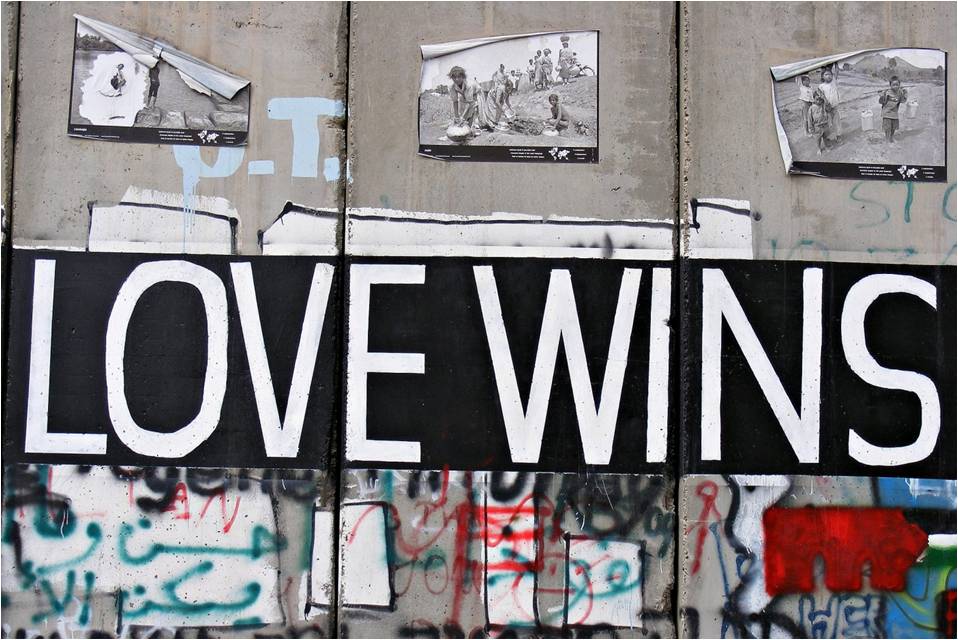
Of Course Love Wins, But It Has To Be In Your Heart

Anaïs Nin wrote, “We write to taste life twice, in the moment and in retrospect.” Sometimes, I feel the need to add, “…and hope to understand it, at least once.” A lot of this blog is like that for me – trying to make sense of things that happen, what they portend, what they imply, and where they must lead me, the woman I must be who gives account of the things I see and experience.

I am in Savannah, GA, for the week, for the American Association of Children’s Residential Centers annual meeting. I’ve written about it before (and again) – I love being a part of this organization. I love the opportunity to learn, this group of beloved friends who give so much more than I ever feel able to return. Tomorrow, I’ll get to spend a day learning about commercially sexually exploited youth – I would so love to do more beyond buying pajamas made by survivors of the sex trade (they are pretty fab, though, and the cute black tee is a great code sign to other radical feminists in the room). I am so ignorant, and just coming to understand that kids, right here, under our noses, are being drawn into commercial sexual exploitation, and it makes my blood boil. The rest of the week, I’ll be supporting a presentation and a luncheon on supporting sexually and gender diverse youth. I also need to pick up the thread of talking about how we innovate in education for youth in residential treatment – I pledged to lead writing a position paper on this, and I need to make good. Of course, I’ll be talking about bringing the autism revolution (like I could stop).

Someday, I'll be, big enough so you can't hit me...

Someday, I’ll be, big enough so you can’t hit me…

Some of you saw this on Facebook, but on my way into town, yesterday afternoon, I had a small, but unnerving experience, that stuck with me, and here I am, living life twice, trying to understand it once. I caught a taxi at the airport for the 20 minute drive into town. The driver was polite and gentle, making small talk and making me feel at home* and welcome to his beautiful city. He asked about where I was from and what I was doing in town, and had some questions about kids who are served in residential settings. He even put on his Bob Marley CD for me.

Then I caught something out of the corner of my eye. I knew what it was, somehow, instinctually, but I leaned in to be sure. On his rearview mirror was a Post-It note, just a little yellow Post-It note, with three Bible verses penned down. They weren’t just any verses of scripture, though. They were what I sometimes call Deadly Passages (get a copy, or borrow mine, and watch my beloved Actors’ Theatre’s take on them). The sticky note started with Leviticus 18:22.

Do not have sexual relations with a man as one does with a woman; that is detestable.

Considered in isolation, each of these verses (from the New and Old testaments) are most likely part of historically bound conversations. They call for frank discussion, today, about the predecessors of our Christianity and all the things that are neither love nor compassion that have been and are still done in God’s name. But taken together (the next verse on his sticky called for the punishment of stoning to death), these verses form a powerful credo of hate in the guise of Christianity. Like a wolf in sheep’s clothing, they are not a prayer to God but a call to evil. And every bit as much as my tee is a call to the sisterhood among feminists, they are a call to solidarity amongst minions of hate and injustice. Taken apart and in context, they are, perhaps, God’s word. But together, they are an incantation from somewhere else, altogether.

I maintained my composure, but I was honestly afraid. All kinds of thoughts went through my mind. I love life, so much. I thought of Teri and Iago back home, of all my little children, and the opportunity we are trying to create for them. My driver seemed kind, but flashing through my consciousness was the possibility of being killed, cut up, thrown in a ditch or swamp or dumpster. And I felt ashamed for hiding behind the cloak of invisibility that I have that someone who can easily be “read” as LGBT might not have in my place. I didn’t say or do anything, until I got to the hotel – I kept making small talk, and being friendly, as if nothing had happened. When the driver got my bag out for me, and I’d paid and tipped and all that, I told him, finally, that I did not mean any disrespect, but I had noticed his sticky note, and I needed him to know that God is about love, and not hate, and that we are called to love others, not to hate them. He mumbled something about his friend reading the Bible and them going through it together, and we parted.

I tried to stay cool the rest of the evening, although it made me unsteady. To my shame, I did not tell Teri about it right away – even at the end of the night, I talked to him and told him I love him and miss him without bringing it up. This morning, when I woke up, I was crying, and that’s when I decided to post about it and share the experience, but also to work harder to process it. I got a lot of support. One friend admitted that she would have assumed I was over-reacting (I felt this way, more than a little, myself), but she had just recently learned that someone she loved had lost a friend to an LGBT hate crime, and so she was beginning to understand that this is real.

The truth is that, even in that situation, the web of privilege in which I move was protecting me – privilege of class, education, and status that allow me to distance myself and command respect, privilege of affluence that keeps me out of many dangerous situations, and many other privileges. And likewise, in truth, the taxi driver was just some mild-mannered man. I don’t know how he came to have those verses on his mirror. But I do suspect this. He may have grown up ignorant – he may have feared people who are not like him. But someone is teaching him to hate, and even though it didn’t turn to violence against me, violence is where the road of hate leads.

And hate is real. Hate is directed at all kinds of people. With respect to the LGBT community, stoning us to death is not just hypothetical. It is happening, today, out there. My taxi driver came from Jamaica many years ago. Here’s a story just two months ago of a Jamaican gay youth not “just” killed, but actually stoned to death. I didn’t find it because I was hunting for a Jamaican story – it was actually the first hit I found when I googled “LGBT stoned to death.” Jamaica is also on a list of countries where consensual sex by gay people is a crime. Other countries, as well, particularly Uganda, feature violence being stoked by Christians, including American Christians, against LGBT people. It isn’t just ISIS. And it isn’t just Islamist Extremists – it is also Christianist Extremists. In both places, verses like the one above are abused to foment hate and incite violence. And it isn’t even just in underdeveloped nations or distant places where people who “don’t look like us” commit atrocities. It’s here in the United States, as well.

Hate doesn’t just happen to LGBT people, either. Whenever I talk about life after the early interventions we provide kids with autism, I brag about my friend Anthony Ianni. An autistic adult thriving and changing the world, powerful on the basketball court and behind the podium, this amazing man is a bullying survivor speaking out against bullying. People at Hope came to me, when they heard about an autistic youth who had feces and urine poured over him when his friends tricked him under the guise of the ALS Ice Bucket Challenge. They came to me, because they knew I would be mad as hell, which I was.

Theirs... and ours.

Theirs… and ours.

Since I’m expropriating quotes, let me expropriate Edmund Burke next. The only thing necessary for the triumph of evil Christians is for good Christians to do nothing. Let us think seriously about that. Christians are not standing up to this abuse of our God and our beliefs. We are not standing up to the hate and intolerance being preached in God’s name. The thing in the hearts of people who use these Deadly Passages as a clobber against LGBT people is not love, is not Christ, and we must recognize that, and help them back to God’s love. When we do not respond, we risk the possibility that the thing in our own hearts is also not love. And Rob Bell is right – of course he’s right – of course love wins. How could love lose**?

Of course love wins. How could it not?

Of course love wins. How could it not?

The question is not whether love wins, but whether we are love.

So let me do my harshest quote expropriation of all: if any of us Christians is not for all people, as Christ is for all people, then we are anathema***.

* I am so excited to be visiting the South. Having spent years near here, in the South, I became a bit of a Southern belle, and I always try to be friendly to people who cross my path, and I so love the gentility of it, the good side of Southern culture, being able to extend and receive politenesses and all the little things we Southerners try to do, at our best, to make the day a little more pleasant for the people we meet.

** Never lose, never choose to, bruise crews who do something to us, talk go through us. I can’t resist. Even though this isn’t a funny blog.

*** When I lived in Grand Rapids’ Midtown neighborhood, I lived around the corner from a streetside church, which had the original verse in big letters over its entrance like a store sign. They made pretty terrible neighbors  … well, as they say in the South, “Bless your heart.”

What if the People Who Don’t Know How to Do Trans Inclusion… Are Us?

I want to stitch together a few experiences I have had recently, with a conversation Teri and I had on the way back from Chicago, where I was an honoree for the 2015 Trans100 on Sunday. None of these experiences are meant to call anyone out – rather, it is reflecting on a pattern that emerges, to me, from these experiences, that speaks about all of us, not any individual actor, but the culture and society we are building amongst trans people. It is not an attempt to pick a fight within the sisterhood (or, rather, among the trans siblinghood), but rather to try and have that crucial conversation that needs to be had.

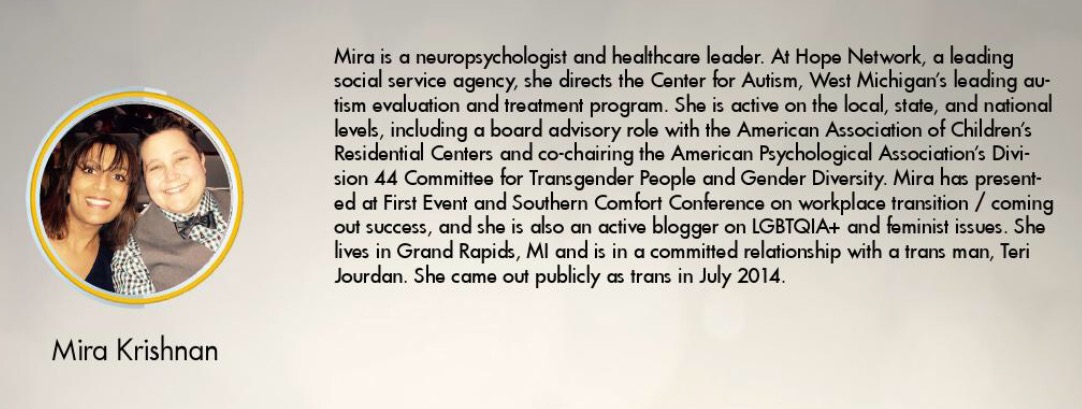
This is my Trans100 bio. I'm so amazed by the talent of the people chosen, and I feel more than a little unworthy.

This is my Trans100 bio. I’m so amazed by the talent of the people chosen, and I feel more than a little unworthy.

The first experience was months ago, at one of a series of workshops put on by leaders in the Michigan trans community. The workshops aimed to develop leadership and build and mobilize trans leaders. At the start of the first meeting, however, things went quickly off the rails. We had a brainstorming session in which we were asked to say what we needed to feel accepted, but it became quickly apparent that the designated note taker, who was putting the ideas on big sheets of paper that everybody could see, would write ideas in really big letters when they* liked them, and really small letters when they didn’t care about them. I pointed this out, and asked critically how we could have a discussion based on mutual respect if this is how we tried to develop mutual respect. One of the people there had an excellent idea, along with this, which was to foster the idea of assuming best intent in others, by having a simple protocol such as saying just, “Ouch,” when something bothered you, and if the person who said it understood why it offended, they could just say “Oops!” and move on (like you should do if you ever mis-pronoun somebody… just acknowledge it and move on). But there were soon a cacophony of “Ouches” that often had nothing to do with what the person talking had even been talking about. They culminated in a kind of surreal scene where one of the people present used what I can only describe as a Darth Vader voice to patronizingly point out to someone else that, if they were embarrassed about the way their voice sounded, they could change it with voice coaching or exercices (a point lost on nobody in the room). Later, we recovered from this, but there were still a lot of these weird moments. At one point in this series, we had an internal caucusing process. I had suggested a woman’s caucus, both because womanhood is the thing with which I most strongly identify, and because it created a potential home for the group of cis women who were participating. There was no interest in this, and I joined a trans caucus**. All fine and good, but then someone created a trans woman caucus, even though trans women were easily the largest group in the room, and the group would leave out both the cis women and some of the non-woman trans people who didn’t have a home. I didn’t feel comfortable with joining this caucus, because, in that space, it sounded a little bit like creating a white people’s caucus or a rich people’s caucus, or a men with power and influence caucus. The trans caucus, which ended up being Teri, me, and a really cool genderqueer / non-binary person, whom I love, was awesome (telling you, awesome caucuses are the only caucuses we should have). But I was left with this profound sense of not being able to belong to my own tribe – a sense I rarely feel when I am in broad LGBT spaces, and I never feel when I am in women’s spaces, or, amazingly, out in the “straight” world – all the places where belong naturally.

The second experience was at a recent meeting of our local trans support group, Own Your Gender. It was a little momentary interaction that didn’t fully hit me until later***. Wrapping up some group conversation about… something, I lightly said, “It could be worse. I could not be transgender.” One of the facilitators quickly corrected me: “You mean it could be worse, you could still be in hiding.” Sticking still to my pledge not to pick fights in the sisterhood, I sheepishly said, “Well, that’s true.” But I didn’t agree. I didn’t need correcting. I’m glad I’m not in hiding any more. But I’m not just proud in principle, in a Facebook post on Transgender Day of Visibility. I am actually proud to be transgender. I love it, as I love life, and I am thankful for it. I was thankful for it even in hiding, although I am far happier living openly and authentically. I own this truth. Not as a weapon, and not to deny the experiences of our struggling siblings, but because it is my true experience. I have said it at the microphone to elected leaders and in front of large audiences, here on my blog, and in so many one on one conversations. I wasn’t fast enough on my feet, that day, caught off guard, to say it like it is, but it is true. And of all places where I should be able to say such a thing, our own spaces owe me the right to love myself in safety.

If you know one thing about me, you should know I'm happy. That's what lets me not spend my time surviving, but doing things like advocating for kids with autism.

If you know one thing about me, you should know I’m happy. That’s what lets me not spend my time surviving, but doing things like advocating for kids with autism.

The third experience was going to the Trans100 itself. While there is always an “A-Gay” kind of phenomenon at national trans events, like First Event or Southern Comfort, this was very different from anything I’ve experienced before. Maybe it was night club culture (which I’ve always hated, for a wide variety of reasons, chief among them the way in which our women’s bodies become meat in a meat market, or in that it was a place where my charade as a “man” was most transparently not working). From the very beginning, I felt surprisingly unwelcome. At the ticket counter, when I said I had reservations and gave my name, the person hostilely asked me if I paid for a ticket, and waved me away. A bouncer nastily (and cryptically) told me, “Green is downstairs and orange is upstairs.” I genuinely had no idea what they were talking about, and so I asked what that meant. The response was, “Green is downstairs and orange is upstairs, that’s really all there is to it.” I still had no idea what was going on – I hadn’t ever been to the venue (I don’t think it was what it is now, back when I lived in Chicago), didn’t see anything green or orange, and orange and green didn’t mean anything to me. I had to figure out for myself that she was talking about the wristband I had, that I apparently had the “cheap seats,” and that she was there to keep me off the main floor. This is all fine and good, although this is an award others nominated me for, and I didn’t even know there were different kinds of tickets. I asked Teri (critically, not rhetorically) in some detail whether this is just me being a princess, and I finally came to the conclusion that it is really not. Because it wasn’t about me – yes, if I had been asked to buy more expensive seats, as a fundraising opportunity, of course I would have… I end up buying expensive gala and fundraising tickets, for one cause or another, it seems, for us, all the time nowadays. But it isn’t about that. I felt, the whole time I was at the event, that I was standing in someone else’s space, that the little tiny space I was occupying in my little tiny dress and my little heels was space that I should be giving up to someone else****. Really just the same way I feel as a woman on a crowded subway car. Teri, to my surprise, felt the same way. It isn’t about not being an “A-Gay” … I hardly expected the night to be all about me, as one tiny person among many being recognized. And I agree that, as one of the people who was being honored, that I am only a person chosen to represent an ocean of diverse talent, and that the celebration is not of us as the 100 “best” trans people, but a celebration of all the best in the trans community, with us agreeing to be used as exemplars or lenses through which that panoply of trans talent can be seen and celebrated. Yet, I also hardly think it necessary to work so hard to make me feel so unwelcome at what, even if only in a tiny way, was ostensibly my own party (and, of course, my own party in that we were celebrating trans lives, and the belief that trans lives matter, and so my trans life should matter, just for being a trans life), to accomplish this end. And if I felt unwelcome, as an honoree, how did people who were not being honored, who come from experiences of marginalization, feel?

But it was the third thing that really started to put together pieces for me. Lana Wachowski, who directed the Matrix and Cloud Atlas, was the keynote speaker. She made some excellent points, for instance stating of the world, “I don’t need your acceptance. I need your evolution.” She is a highly visible, highly successful, highly talented and creative, highly impactful trans person. She leverages all of these things to make the world a better place for other trans people, including by supporting in significant ways some of the critical work to safeguard trans people that is going on right there, in Chicago. But then, towards the end of her speech, she called out the black community for her perception that black people advocate “against us” for things like the odious bathroom bills. The tension in the room – we were seated next to a couple of our fierce black sisters, and I was really happy that the crowd that night was ethnically diverse – was palpable. A group of people, mostly black trans women, on the other side of the balcony, got up and walked out. We stayed, but all I was thinking about was how our black friends next to us, and the ones down on the main floor, and the ones across the balcony, were feeling, and feeling hurt alongside them. This was Lana’s Patricia Arquette moment. Precious Davis was on point and brought the night back to what it is really about, by saying that we need all our voices present in the room, to have the critical conversations that define us as a community. Later, some people I know called out the women and men who walked out that night, accused them of betraying trans people, but she was not doing that. No, she was calling them back in. 

That night, over a gyro and fries we split instead of going to the after party, because Teri was hungry, and because I needed to stress eat (which I didn’t admit to Teri till the next morning, and my eating disorder behaviors come out infrequently enough that Teri doesn’t always know them when he sees them), and then further cuddling in bed in the morning, and over lattes, we had a really great discussion that help me put the pieces of what I want to say together, into something that, at least to me, makes sense as a whole.

That whole is this: we think that using preferred names and asking for pronouns is creating trans inclusive spaces, but the reality is that we, as a community, have no idea how to create an inclusive or safe space, for us. Rather, disrespecting trans lives is not just something that we need to hashtag to the outside world via #BlackTransLivesMatter, but we need to recognize that disrespecting trans lives is endemic in our own spaces and pervasive in our own processes and approaches.

And this is perilous. Altogether too often, our own spaces are not safe for us. We see it in trans spaces where trans people are called out or made to feel unwelcome because they don’t do “enough to transition” or don’t “pass” or meet some other stupid and arbitrary criteria. We see it in trans spaces that operate as an oppression olympics and don’t allow for the possibility that a trans person can be happy, let alone happy to be trans. And we do it in spaces where we take glee in putting up velvet ropes and using bouncers to make people feel like they’re not good enough.

Again, I say this with love and a sincere desire to keep Lana Wachowski and everyone else I mention, either by name or not, in this article, in the family, and to build a stronger and better family together with all of you.

Again, I say this with love and a sincere desire to keep Lana Wachowski and everyone else I mention, either by name or not, in this article, in the family, and to build a stronger and better family together with all of you.

This is really not about calling out the Trans100. Jen Richards and all the people around her, who made this thing possible, did a really wonderful and revolutionary thing. The 300 people who have been honored, over the last three years, including me, share with all the talent and creativity and passion amongst trans people, the burden of elevating our profile, of helping us all learn to stand taller, chin up, prouder, fiercer. I am thankful, humbled, but also dead serious when I talk about being asked to shoulder a small part of that burden. This is also not about calling out Lana Wachowski. She has done, is doing, will do amazing things. She has tremendous power to be a force for good, and she has already done so much in her own way to lift us up as a people.

On the contrary, this is doubling down on what Precious said, as well as what Tiq Milan said at the event, in his own excellent speech, which is in essence that just people like Laverne Cox on magazine covers (or people like he or I receiving awards or being asked to deliver addresses at events) is not going to be enough to stop trans suicide. We need to call everybody in, and at the core of the discussion we have, we need to talk about the fact that we don’t feel safe, all too often, in our own spaces. If we can’t feel safe in trans spaces, then we will just continue to have what we have now. A subset of fierce, happy trans people, like me, will go about their lives feeling safe and accepted outside of trans spaces, in mainstream society (as I do), and the people who are struggling, who have no place, … will face the ignominy of feeling unwelcome in the one place that has the least business rejecting them.

This is an indictment, but it is an indictment of me as much as of anyone else. Just me being visible, being on TV (to talk about being transgender or to talk about autism), being happy, putting on tiny dresses and drinking cocktails, isn’t the revolution by itself. Sure, it might support other people who, like me, and many of other highly visible, successful trans people, didn’t need much to succeed except for people to get out of our way, but it isn’t going to help all those people who are contemplating, trying, or succeeding at suicide. I – we – have a choice in front of us… every community has hierarchies. In good hierarchies, leaders lift their people up. There is disparity, even in most of the best and safest places in the world, but only just enough, and it is far more often seen as a cause for those who have more to give more, than as a cause to take from the marginalized and give to the privileged. In bad ones, we create classes of toadies who use the power of the dominant subgroup to lord over others, or to take glee in creating velvet ropes and glass ceilings and all kinds of barriers that keep our own people down, and we seek to grow disparity rather than eliminate it.

So what do I think? I think it’s time to tear down those velvet ropes, go out in the parking lot and get our sisters back in the room, and get down to figuring out what it actually means for trans spaces to be places where all trans people can feel safe, spread their wings, and fly.

* I’m using gender neutral pronouns here not based on the preference of the person about who I am talking about, but just to keep this conversation about concepts and not about shaming or calling out anyone.

** The idea of an “awesome caucus,” composed of anybody who was awesome or wanted to be awesome, was also nixed, sadly, even though I and a friend fought hard for it.

*** Yes, okay, it was basically this.

**** There were exceptions – I talked to Laura Jane from Against Me, very briefly, and she was the epitome of not being the problem I’m trying to describe, and really served as a role model influence for me in that, much as people like Amy Gore had been at V to Shining V last year, or Lizz Winstead, also of Lady Parts Justice is, like all the time. And a couple of our Chicago friends grabbed us and made sure we got a drink early in the evening.

My, How We’ve Grown

This morning, I’m finally watching Monica Lewinsky’s TED talk. I hadn’t had time to watch it yet, but I’m being selfish with a few minutes on a Saturday morning. I think you should watch it, too. Like the best of TED talks, Ms. Lewinsky bravely wraps her personal story around knowledge about how others have been harmed as she was harmed, and insight about how her story is a starting point to changing the world and making it better for all of us. She does, incidentally, just exactly what Teri and I have been trying to do with Our Narratives. And Monica used the opportunity to do this on an explosive, national scale, in that unique way only TED truly allows for.

In 1992, I, myself, fell a bit in love with Mr. Clinton – while I had been used to fighting for environmental action and other causes, I had never stumped for anyone in my life, but a classmate and I spent our volunteer hours stuffing mailboxes and trying to “rock the vote” and get people out to vote for Bill and his, at the time still somewhat zombie-like sidekick. He’s still the only president I’ve ever done something like this for, so I guess in my own way, having never met him, I can sympathize particularly with that element of Monica’s story. I remember, in conservative Holland, going to a downtown restaurant and celebrating the Clinton/Gore victory among the tiny cabal of Democrats. I didn’t (and don’t) identify strongly with the Democratic Party as a whole, but I felt it at that moment*.

By 1998, I was still a budding feminist (I’m just a couple years younger than Monica, and I will turn 40 at the end of April). In the past years, I had spent time as a contributor, editor, and ultimately editor-in-chief of a news journal at the University of Michigan, the Michigan Review. The Review and my time with it is a complex story. At times, it has been a neoconservative hotbed, and I am sometimes loathe to admit any affiliation with that. In my time, it was a dynamic balance between social conservatives and libertarians, who often did not agree or see eye to eye, although we all valued the individual and our talent, creativity, and passion as the basis for change and for progress in the world. That ephemeral balance, in those days, was something magical, and an important part of who I am.

I rode in amongst a wave of other libertarians (although I didn’t even know what a libertarian was at that time, and once, a fellow editor told me to ask a prominent local libertarian what the difference was between a libertarian and a libertine, without educating me on what the question meant… good prank), but I recognized tensions with the social conservatives. Most of the social conservatives I rode in with were respectful people, who tolerated difference even if they did not celebrate it. But not all. Sometimes, I stood up. I remember that there was a particularly obnoxious young man who came to the Review. He became infamous in our time on Michigan’s campus – it’s not that easy to stick out amongst 40,000 people. Once, he wrote an “article” in which he stated that a protestor “smelled like a wet Pakistani.” I led a nixing of this foolishness. Another time, in a staff meeting among many young women, he pitched an idea on how he had just turned 21, and gone to a strip club, and how he wanted to write, again #airquotes, an “article” on which girls would “do stuff” when he stuck dollar bills in their panties. I ran him out of that meeting, as managing editor, and damn proud am I. Other times, I sat silently and uncomfortably, on my hands, as women and women’s rights were mocked in our space, and sometimes, I even stooped to the level of token minority, or pretended to laugh along, in order to hide my inner revulsion. I am sure I was an Uncle Tom at many other times, much as I frequently feel like the Uncle Tom (or Aunt Tomasina, or whatever) of the trans community these days. Occasionally, though, I got it right. I actually found (it’s on page five, here) one of the articles I wrote, of which I am somewhat more proud, and Teri and I re-read it, and … I’m still at least not mortified by it**.

I continue to push myself to feel in the real world in each moment, and not to discount my experiences because they are mine. Now, I recognize how much of this was my internalized and self-directed misogyny, as well, although that was something I did not grasp, then.

I continue to push myself to feel in the real world in each moment, and not to discount my experiences because they are mine. Now, I recognize how much of this was my internalized and self-directed misogyny, as well, although that was something I did not grasp, then.

But, at that time, although I questioned her treatment, and I usually avoided the vulgar jokes, I didn’t have the tools or the words to express or understand what was so wrong with the way she was treated. I remember also, clearly, from that era, how I had not understood what had really been going on with Anita Hill. Much as I was a libertarian before I understood the term, and this often led to me not being able to articulate my viewpoint effectively or rise appropriately or summon courage consistently when it was needed, I was a feminist before I properly understood the term, and my early implementations of feminism were, honestly, weak. It would be a few years, around 2001, until I became properly versed in feminism, spending a seven-month period of joblessness, superimposed on 9/11, reading Gloria Steinem, Shulamith Firestone, Andrea Dworkin, Kate Millet, Naomi Wolf, and so many others, as well as backing philosophers like Michel Foucault, the rave of feminists “back in the day.” It was at that time, that I went back to Zora Neale Hurston, Toni Morrison, Richard Wright, and even Frederick Douglass (whom I keep quoting), and re-contextualized what I heard***. And it would take the next 15 years, following that, for feminism to work its way through my tissue and cure me, and like vampire poison, sometimes, I still feel that sense of womanhood and sisterhood coursing through me and curing me, yet.

Now, looking back at all this, 20 years later, I recognize the blatant sexism and mistreatment Monica endured. After some feminist or other explained to me why anyone would reference a “pubic hair on a coke can,” and what the comment had meant, and after Toni and Zora explained to me just a little of what it is like to be black woman in America, now, I better understand what happened to Anita Hill, too. By the time Hilary Clinton was in the news for something called “cankles,” I still had to look the term up, to understand what it meant, but I had a fair idea of what was being done to this accomplished and dedicated leader. And like Monica did in her talk, I now recognize the overlapping and intersecting aims of bullying as it is leveled against not just women, but the LGBT community, and everyone who is not rich, white men and their sons (as long as the sons don’t turn out to be poofters).

By now, I can clearly and comfortably say, that Monica should be so proud of this TED talk. And all women should be proud alongside her, as I certainly am. The way she was treated, twenty years ago, was an attack on all women. It had little to do with the ethics of cheating or leadership impropriety – serious issues but just a front for the subtext in that era – and everything to do with the objectification and denigration of women’s bodies and women’s experiences, a celebration of the sexual double standard, an an entrée into the emerging world of cyber slut-shaming, cyber bullying, and all the brave new things technology fused with hatred brought us in the internet era.

I was not equipped to understand that, and speak out ferociously, in 1998. Neither was Monica Lewinsky. But we have grown into fierce middle-aged women, not in spite of ourselves, but because of ourselves. We just had to overpower the messages society sent us about our value, and reinstate our internal notion of our worth.

My, oh my, how we have grown.

* Later, the second time I felt moved by a candidate would be in Chicago in 2008, when I saw elderly African American ladies waiting at the bus stop, in church lady dresses, with Obama t-shirts pulled on over the top of them, and I was overcome with this magical sense that these women had never felt like the President of the United States of America could belong to them, and I reveled with them in their delight.

** As it turned out, thus far, I have not “turned to the bottle,” but I have experienced, briefly, unemployment, if not any kind of economic deprivation.

*** I was an engineering student at Michigan, and in those days, at least, engineers had maybe 17 credits altogether to spend on everything other than engineering and “hard” science. I think many of the engineers found “blow off” classes to knock out these requirements. I exempted from freshman English, which is hard even for the liberal arts students and nearly unheard of for an engineering student, but I was also the only one I knew who did her liberal arts sequence in English literature. African American literature was probably my favoritest class at Michigan, even better than quantum mechanics (which I also loved). Prescient, non?

Why I’m Giving Up Picking Fights within the Sisterhood

Back when my friends, whose religious practices involve sacrificing something for Lent, were making their picks, I quipped that I would give up picking fights within the Sisterhood* for Lent. It became a little less quip and a little more aspiration, over time, and “for Lent” gradually became a provocative question of what life would look like if I (we) never picked fights within the Sisterhood. I’m not going to pretend that I’m doing that now, or that I will ever get there, but that provocative question gradually became a mission. When I take on missions – I don’t take them on lightly. I don’t know who coined the word impossible, but I bet it wasn’t a Sister.

I'm not stopping cracking the whip altogether. I'm just doing my best not to crack it at other Sisters.

I’m not stopping cracking the whip altogether. I’m just doing my best not to crack it at other Sisters.

Sisterhood** is a powerful thing. A powerful thing in my life – whether it was Gloria Steinem, or Jane Austen, or Charlotte Bronte, or so many other Sisters of the Revolution, who spoke to me as a Sister, and helped me find my own Sister’s voice inside me, or so many Sisters in my life yesterday, today, and tomorrow. It breaks down barriers. It allows me to talk with, to advocate alongside, women who are different from me in so many ways – our skin color, our socioeconomic status, our politics, our life experiences, our education, our queerness or straightness – and I have seen, so many times, we are instantly Sisters, and although all these other things remain, Sisterhood is more fundamental and more immutable. Of all the things worth preserving to me, as a woman, Sisterhood is the greatest***. And my choice is predicated on my treasuring of this most precious thing, on this day that belongs to us, and to me. 

I wrote last year, and spoke at last year’s V to Shining V, about the idea that fights both within and among marginalized communities inevitably stand to benefit our oppressors, and oppression itself as a force, and to fail to help any of us. I stand by that claim. This does not mean that Sisters should not continue learning to cultivate spaces in which inclusive and earnest dialogue occurs over our differences, because we will have differences – because of our experiences, because of our perspectives, because of which part of the Struggle in which we have embedded ourselves most passionately. We would do well as Sisters, also, to include people who are not Sisters in that dialog, because the truth is that there’s a lot of oppression in the world, and it isn’t all directed at people “like us.” And we would do well, as Sisters, to embed ourselves, when welcomed, within dialogs where we ourselves are the outsiders and allies.

I want to be careful here, because telling other people not to pick fights is, frequently, itself picking a fight. Or making some kind of subtle or not-so-subtle assertion that a certain narrative – usually a dominant narrative, like, inside the Sisterhood, the middle-class, white, straight feminist narrative – is more important than other narratives – like, inside the Sisterhood, the narrative of multiply marginalized Sisters. We know as feminists that this is precisely what is done to women – we’ve spent generations and millennia under patriarchy changing the world and then giving credit to our husbands (and even, often, having the gall to say that, with them is where the credit belongs). And, sometimes, we’re angry about it, and we probably do go about voicing our anger in ways that are counterproductive as measured by our own outcome desires (for instance****, in comparing the role of Suffragists in Abolition to the point our sister Patricia Arquette tried to make and the way in which she made it, at the Oscars). Anger is okay. And if my Sisters choose to direct it at me, or at each other, I am not going to judge them (or pretend to be better than them). I am just going to learn not to participate. And I am not going to conflate the Sister with her anger.

I am writing also, a little, and processing still a little, in response to the claims that feminism in Social Media is a toxic thing. I think most Sisters have seen the Sisterhood get toxic. I don’t want to deny this can happen, because it would sound absurd, even to me. But, aside from the ideological analysis of this kind of attack, how it is levied, on whom it is levied, and what its likely function in a system of oppression is (hint, it probably isn’t reducing marginalization), I think I, like many Sisters, reacted to this instinctively in a negative way, because the cloud of women we know in social media (and more generally in the Sisterhood) had done, are doing, will do so much to support us, lift us up so many times, be a cheering voice in our triumphs and a commiserating cry when we fell short. When we think of the Sisterhood, we know this is what we do. Whether modern feminism is toxic (it must not be allowed to be or become so) or whether some of these behaviors are toxic (they are) is just not a fight worth picking. That would allow the toxicity to define us, and it simply does not. Rather, it is reminding ourselves, focusing ourselves on, aligning ourselves with, each other as Sisters, on which we must focus. That defines Sisterhood, and that defines us and makes us who we are. So how am I going to give up picking fights? Without gagging and binding myself? This is what I am learning to do, and what I am pledging to do.

  • When there are opportunities to do good, to make progress, to change the world, I am going to focus my efforts on doing just that. This is probably the biggest thing I’m going to continue doing. My behaviorists talk about replacement behaviors (although there are limits to this philosophy, as we know), and I think this is really the Sister’s ultimate replacement behavior, because alongside connecting with and empowering each other, this is what we do best. So try and stop me.
  • I will continue to tell my own story. Because it’s the only one that’s truly mine to tell. And because there is no point in feminism if it creates a world in which Sisters matter conceptually, but not in practice, as individuals. We would then replace the patriarchy with some internal censer who places our narratives in a hierarchy and uses semaphores to direct us when to speak and when to be silent, and at that phase, the Sisterhood would cease to be revolutionary.
  • I will continue to listen to other Sister’s stories, and to all stories of oppression. I will never own stories other than my own. But having learned to know when our voices were missing, and to call the bluff on histories that pretend to be complete without us, I will continue to listen for the voices that do not get heard, because this is perhaps the most revolutionary act of radical feminism.
  • Whenever I can collaborate with you, I will. Not because I owe it to you, but because I believe in Us, because I owe it to me, and because although we are strong as individuals, Sisterhood makes us far stronger together.
  • If and while you choose to be a fight-picker, you may find yourself on my ignore list. Sisters don’t have to be suckers. If you are the person who wants to constantly ask why I don’t stop telling my own story or changing the world in the way that I’m changing the world, to tell someone else’s story or do what you think needs to be done, or if you want to nitpick or establish yourself as my critic, I’m just not going to respond to you, and please allow me to re-refer you, in advance, to the first bullet point. This also means there are a whole bunch of fights I’m not going to weigh in on, because they seem, to me, just opportunities to argue, and I have decided to be too busy changing the world to argue.
  • When I get angry at a Sister, I will ask why I am really angry. Solidarity in the Sisterhood doesn’t mean man hating (or masculinity hating). But I will remember my own claim, that this infighting is a tool of our oppression, and whenever I am angry at a Sister, I will ask myself what the patriarchy’s game in this is, and I will direct my anger back at oppression, where it belongs.

If you’re somebody who loves me, and you see me get off track with this pledge, please tell me. Preferably, in private, and definitely, in love. I will try to listen to you. And if you’re somebody who loves me, I hope that you will know that I will fail – will fail repeatedly – in my way to achieving this goal, and you will keep loving me anyways, not because I deserve it (I don’t), but because it’s who you are (it is).

It’s International Women’s Day. And women should celebrate by doing whatever they want to do. Because, well, that’s rather the whole point. What this Sister wants to do… is change the world, and she is paring down all the stuff that gets in the way of that.

* By Sisterhood, I really mean radical feminist women (I do embrace that term), but… well, see the next footnote. This raises a whole bunch of red flags to certain people, I’m sure, already. I’m going to talk about “us girls,” and in so doing, I’m talking about and with girls and women who make a choice to co-advocate alongside other girls and women for the good of girls and women. This isn’t really a blog post about whether men can be feminists (of course they can, my mister is a feminist). It isn’t really a blog post about whether or not other gender minority groups belong inside the big tent of women, either as guests or as members (I think they do). But I celebrate the right of women to talk about themselves and not only spend all their time talking about someone or something else.

** I chose Sisterhood as a term because it’s the one that means something to me. In some ways, Sisterhood is the movement wing of what we do in feminism (as opposed to the theoretical wing of what we do). On another layer, there is something sort of else about it. I think all the Sisters know what I am talking about. Probably, if I look at it really carefully, there are people who are women who make nuanced choices not to be Sisters, or who make thoughtless choices not to be Sisters, or who just find themselves not experiencing the connection of Sisterhood. I don’t judge any of them, but I do recognize that, probably, I like any other Sister, can only partially understand what that’s like. Not all women are highly relational, and of course, many men are highly relational. But there’s something special about being a Sister. It is also, admittedly, as much a not mythical thing as it is a mythical thing. It can go awry, which is the whole point of writing this blog and of taking this stand. Still, within the prism of my own experience as a woman, to me, Sisterhood is the best thing about being a woman.

*** And I’m an only child, saying this.

**** In fact, even trying to provide some gentle, inclusion-focused, non-shaming retrospective analysis of a situation, itself, becomes very quickly fight-picking.

Teaching People to “Get” Privilege

At the beginning of the year, I wrote a blog post* outlining why I felt a shakeup in our notion of being an ally was critically needed. It followed up on my attempt to start a conversation around redefining privilege, begun publicly at the West Michigan TDoR a few months earlier. I started, in essence, with how I am dedicated not just to recognizing the marginalization of the LGBT community, but to ending it. And the end I foresee is a world in which we are valued for the gifts we bring, where people know that we anchor communities, where people know that we make towns and cities vibrant, and where people feel motivated to keep us safe not because they feel sorry for us, but because it’s in their own self-interest. To get there, I argued, we needed to become more aware not just of marginalization as we experience it, and privilege as others experience it, but we need to be aware of the privilege each of us carries, and become increasingly willing to leverage that privilege we have to engage audiences, tell stories, build relationships, and change the world.

The second place I engaged in this conversation was by starting Our Narratives, along with my Teri and others, as the Network‘s new initiative to help LGBT people know their stories, relate their stories to the Struggle, and use their stories to advocate for change, both big and small. We started this with our November 2014 Our Narratives workshop (and we have another one coming up, in a couple of weeks). Our Narratives was a critical piece of what needed to be done, because it is difficult to use privilege to advocate for change if you don’t really understand how to advocate for change, or how to broaden that story beyond just your own story. We showed with that inaugural event that our participants came in feeling they knew their story, but they didn’t know how to relate it to the struggles of others (or distill the universal theme or align the societal statistics with their story), and they really didn’t know how to use their own story to advocate for change or understand why their own story was relevant in advocating for change**. And we showed that we could change all that, just in a day. Teri commented, also, that he was blown away by the intensity of these stories, and he felt kind of badly for having underestimated our community, going in. This, I think, really recapitulates my point at TDoR. That passion behind that storytelling… is a kind of talent or privilege, and it’s just one of the many talents*** we don’t recognize or leverage as a community.

So, I’ve got people talking about and understanding their marginalization. But my belief is that we cannot be good allies unless we understand our privilege, too, and we begin to understand intersectionalism of both marginalization and privilege. So, really, I set out with So You Want To Be An Ally (SYWTBAA), which happened at the end of January, with two goals. First, I want to learn to teach people that we exist within an intersecting web of privileges and marginalization – it is fundamentally flawed to think of “us” as marginalized and “them” as privileged. Second, I wanted to socialize our people to critically analyze our behaviors as allies. Again, pulling us out of an “us v. them” mentality, I want us to be good allies to others (because it will stop unfortunate things like ethnic minority groups attacking LGBT rights, because they perceive that “our” freedom is incompatible with “theirs,” when in reality, we are all “us,” and there is no “them”).

I’m coming back now to talk about where I succeeded, and where I’m still trying. SYWTBAA was a three hour seminar with group activities interspersed. Unlike Our Narratives, it placed a heavier emphasis on instructor led content. I originally conceptualized it as being co-led by an LGBT person and a heterosexual ally (and had one picked out). But, the more and more I thought about it****, SYWTBAA became not primarily about heterosexual allies working with the LGBT community, but rather, a broader and more conceptual thing. I got feedback, privately, from some people I trust and respect, that I needed to thin down the feminist theory, because people who came to such an event would be well versed in it already. I respectfully disagree (and I’m sticking with that assessment). At least, here, in Grand Rapids, we do not have people show up to these events with bell hooks under their arm. And I would challenge, that, honestly, while there are a few of us out here, we do not even make up the majority in our own activist/advocacy spaces, let alone the majority of mobilizable people that can make the army we leverage to end oppression. A simple analysis of how many HRC bumper stickers one sees and the sales data on the feminist classics quickly reveals that.

So, the workshop ended up being more of a solo presentation, by me. I would like to broaden the examples I drew on, but I used examples from multiple kinds of marginalization – related to disability, mental illness, different racial and ethnic groups, the young and old, women, and, of course, the LGBT community. I used examples ranging from the Victoria’s Secret expropriation of Native American culture three years ago, to raising the possibility that the 99% may just be the largest of all marginalized groups, even larger than women as a group (or the 51%, as we like to call ourselves). I acknowledged my heroines, provocatively putting Andrea Dworkin and Julia Serano on the same page*****. And I preached feminism. I talked some gay – I explained why we don’t have a straight pride, as an example of how privilege assumptions and the power structure they maintain form an asymmetrical view of the world.

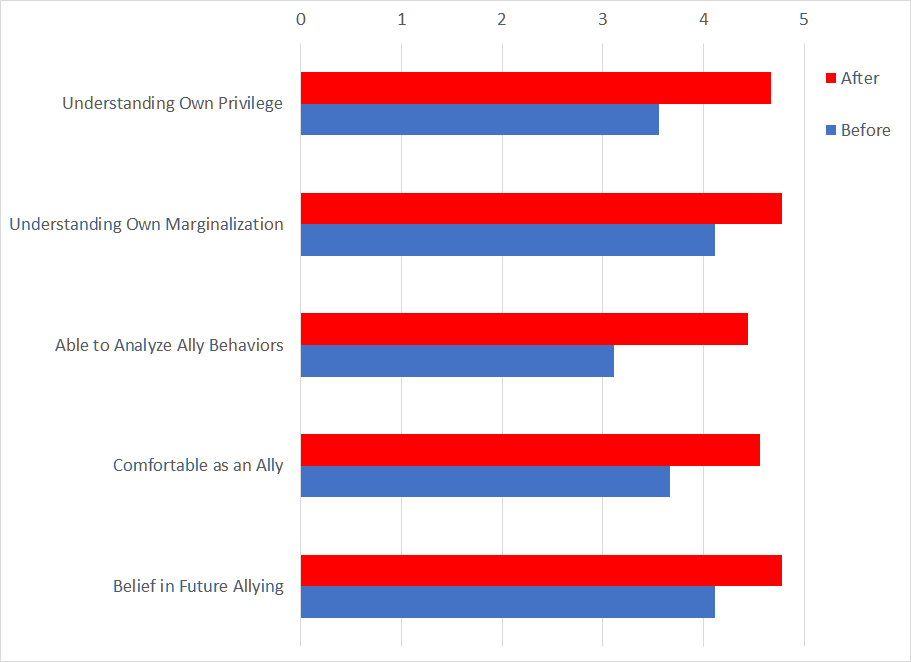
There was some good stuff. Unlike the very targeted before/after results we saw for the flagship Our Narratives workshop, we saw broadband improvements on all five of the questions we asked about our participants’ before and after experiences. But, the biggest gains were in understanding one’s own privilege (that is, understanding of one’s own privilege improved markedly, whereas improvements in understanding one’s own marginalization were more subtle), and feeling able to critically analyze one’s behaviors as an ally. So these are exactly the things we set out to do, and this preliminary data, from the first time we did the program, were very favorable. It also turns out that Keynote makes totally fetch slides, and although I used it at First Event earlier in the month, this is the first really meaty presentation I made in Keynote, and it was much more sophisticated than that prior one.

#Geekgirl loves her data, so here are the numbers – again, noting the big gains on the top-most and middle items:

Participant survey data from our January 2015 So You Want To Be An Ally

Participant survey data from our January 2015 So You Want To Be An Ally

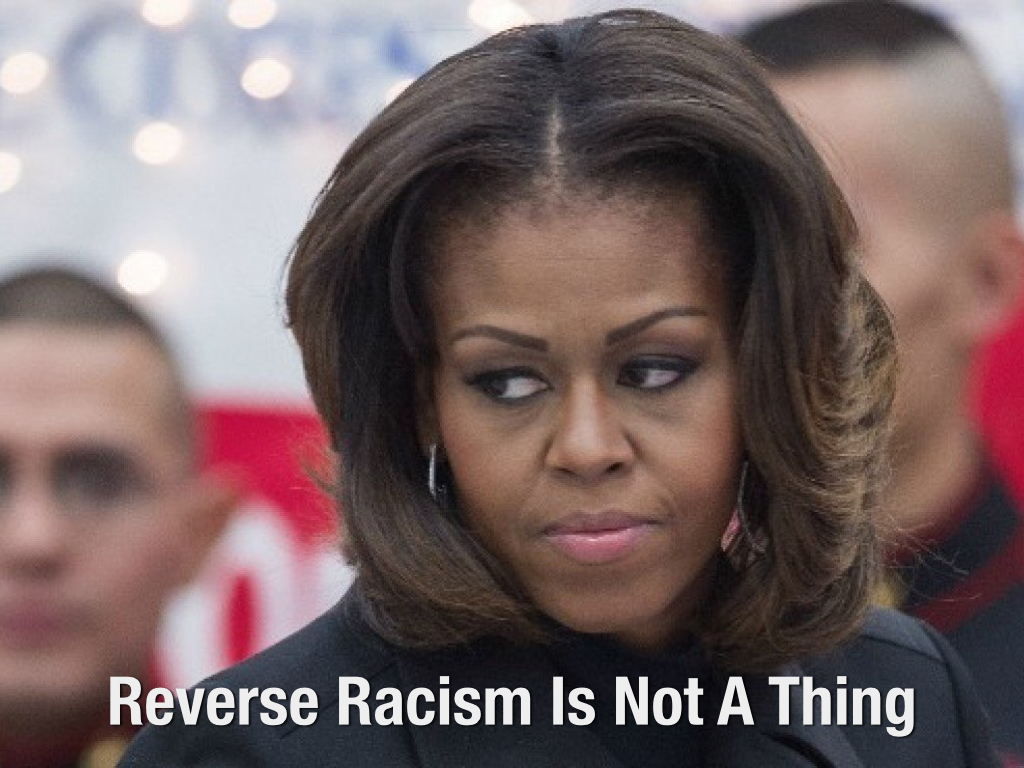
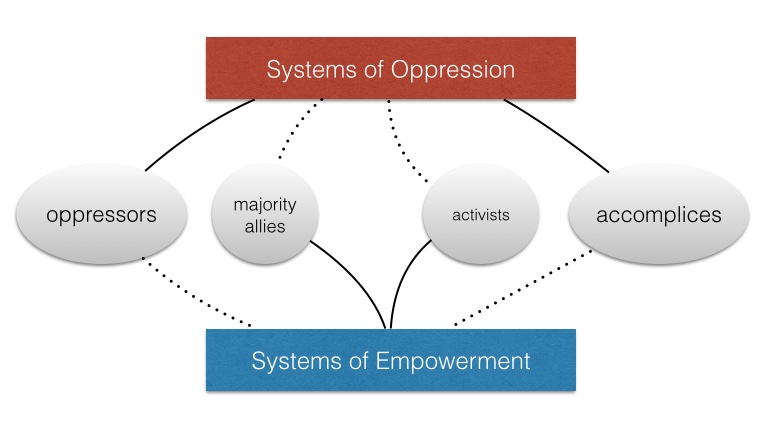
There were some surprises. Using the Network’s detailed identity question****** on our post-hoc survey, only 55% of respondents classified themselves as allies (#FAIL? Or humility?). Of course, with all the work to make sure there were plenty of presentation materials, it went a little long. The last exercise was supposed to really critically push people to identify both when they were an ally and when they were an accomplice (and really, all four roles in the paradigm I borrowed and presented earlier). I do not feel like I fully got across the idea that things like reverse racism are not valid constructually, because of global effects overwhelming the local effects (so that in a majority black neighborhood, like the Hyde Park neighborhood of Chicago, where I lived before I moved back to Grand Rapids, the national/systemic racism against black people overwhelms the fact that Caucasians are a minority just in those few blocks, even though the President of the United States of America lives 2.5 blocks away, etc.). People also still tended to think of themselves as primarily privileged or primarily marginalized (and I really should’ve asked a poll question about this, and I did not – I really want people to come away from something like this understanding that we are all both).

Don't make me do Michelle Obama side eyes.

Don’t make me do Michelle Obama side eyes

Overall, though, I was pretty happy with the conversation. In spite of the early critiques that the feminist / conceptual approach would not be what people wanted, we had a pretty sold-out event, and we had really positive feedback from the participants. One, who leads a drop in center for homeless and runaway youth, followed up by inviting me to a training panel discussion to talk about this content. There was interest in exporting the training to another group, which is something we’re possibly open to (although we really want people to come in our doors). We want to do this quarterly, so I’ll be curious to see if we can find 20-25 people who want this training every three months (I think we should be able to – there are, in any event, to me, more than 20-25 people who need this training every three months).

What’s next? Well, we’re looking at ways other than dramatic / prose speaking and blogging to teach people to tell their stories. Maybe spoken word art, maybe something video-based, so we can go wreck YouTube. I’m also thinkiI’mng of more content elements. I’m wondering, particularly, if we need to QueerTheConversation on racial justice – still giving you side eyes if you talk reverse racism at me. We could come clean (or even cleaner) about how everyone who’s been on our Board of Directors in the last couple of years has been Caucasian or Asian (and, as I’ve argued, there are many ways in which I feel a need for pause and caution, and I do not consider myself a good spokesperson for racial injustice), and much more strategically talk about our outreach to ethnic minorities, both in terms of building support for LGBT people from these populations but also building a reciprocal ally base, because we’ve got a lot to give back to people. We’ve been talking about that a lot, but right now, I feel like we need to double down on that. Amidst all the other things were trying to revolutionize and all the other systems we’re trying to wreck (now, usually I don’t do this, but why don’t you go ahead and break them off a little preview of the remix?).

I guess it turns out that Queering the New Year is a resolution one really must keep all year long.

* Slash manifesto

** For instance, it is also a narrative we can leverage that, in the midst of fighting over whether transgender people should be equal (or should be excluded), my narrative that I am societally accepted, largely by everyone, that I’m here in Grand Rapids creating jobs and opportunity for adults and teaching kids with autism how to communicate and learn, and that I am in danger not of killing myself, if I can’t have rights, but of not building as many jobs (mostly for straight people) or helping as many kids (again, predominantly straight people’s kids) – my narrative is an important narrative, because it dovetails exactly with what the rest of the business community has been saying about our civil rights act. It’s just, by and large – and not for want of talent, see the next footnote – I’m the only trans person saying it. But this is an example of a privilege-based narrative, used to advocate for good. Making me something more like Tesla and Elon Musk, arguing, “Hey, your life would be better if you changed your laws for me.”

*** Sometime, let me write a blog post about all the kinds of people I know because I’m engaged in the LGBT community, that wouldn’t normally be in my social circles… sure, there are doctors, lawyers, engineers, and CEOs, but actors and actresses, airplane pilots, retired Navy SEALs and Army Rangers, authors, poets, comedians, magazine editors, … I’m really not kidding when I say my network broadened by coming out, and didn’t contract really at all.

**** And, well, because we woke up early and finished the last bits of the program the morning of the event, itself, and Teri even cooked us breakfast, so that I could finish.

***** I should be even more provocative, and have some male role models too, and in truth, I do, although most of my strongest inspirations are other women, and I put up six pictures of women. For the record, they were: bell hooks, Gloria Steinem, Shulamith Firestone, Andrea Dworkin, Julia Serano, and Mira Nair.

****** For a lot of our own surveys, we use an inclusive identity question, where a long list of options is presented, and respondents check all that apply, with no validation process. Currently, our list is: female, male, androgynous, agender, bigender, cisgender, transgender, genderqueer, gender fluid, cross dresser, intersex, heterosexual, gay, lesbian, bisexual, pansexual, polyamorous, sexually fluid, asexual, aromantic, questioning, two spirit, queer, and ally. There is a free response “other” option, and my smart-ass boyfriend put in heteroqueer. So we add items as we go – it had less items the last time we used it. Recently, I’ve been asked how to do this on surveys, and I agree that this approach is cumbersome for someone other than an LGBT organization. So my second approach, when we’re trying to make it simpler, is to ask two questions, modeled after the two-question approach of identifying ethnic/racial grouping. There, questions are asked separately, here in the US that is, about being Hispanic/Latino, and about ethnic affiliation. I propose something similar, which is (1) Do you identify as trans/transgender, genderqueer, gender fluid, gender non-conforming, or non-binary? (Yes/No/DK) and (2) Do you identify as (male/female/other). This is nicely subversive, too, in that the questions make more sense and are more welcoming if trans people are put in front rather than put in as an afterthought.

A Mission to Christianity

Last week, Calvin College brought Mark Yarhouse to speak about the transgender community. Christian LGBT community members raised concern. On digging further into the matter (I had heard neither of Dr. Yarhouse nor of the Regent University from which he hails), much of this concern is rooted in Dr. Yarhouse’s historical body of work. At its best, he takes a non-judgmental* approach to supporting Christians (predominantly) who are trying to reconcile their sexual identity with their Christian identity. At its worst, it stoops precipitously close to apologetics for conversion therapy, teetering on an edge (although, from Dr. Yarhouse’s perspective, trying not to go over that edge) of what is considered criminal in multiple states (although not Michigan), and what is considered clearly unethical by a preponderance of us as psychologists.

I, in turn, reached out to friends at Calvin and summarized these concerns. They very graciously had me out to tea to discuss them further. I understand (and welcome) their spirit of trying to create dialog across what they perceive as a chasm (although, in truth, we are quite able to sit at the same table, drink the same tea, and find common language with little difficulty). I also understand and accept their challenge in working with a broader range of stakeholders, ranging from their students (who are generally quite accepting) to some of their older constituents (who are, sometimes, otherwise).

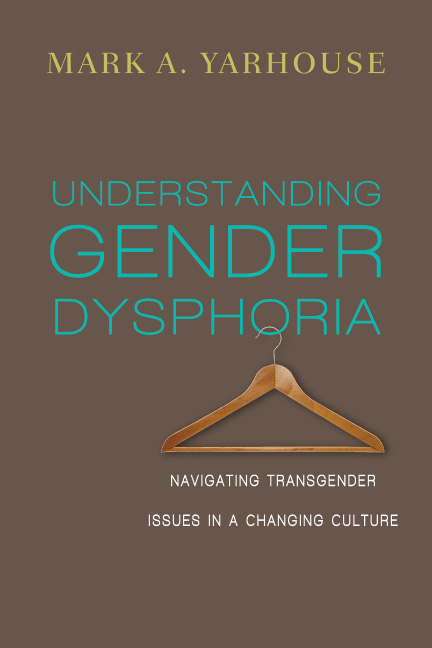
gender-dysphoria-cover

Based on Dr. Yarhouse’s presentation, I cannot recommend his forthcoming book.

I went to hear Dr. Yarhouse speak, and up until now, I have been largely silent (or, as I am sometimes accused of being, “diplomatic”). I did so out of love for my friends at Calvin – and I do sincerely consider them friends – who I am very convinced are trying to do right (and good). I do so out of love for my Calvin alumni staff – anyone who knows me knows how much I love my team, and that I would make (and sometimes have made) all manner of sacrifices for them. My friends at Calvin worked very hard to make this a non-combative atmosphere for discussion, and I do appreciate that, although there are subtle nuances of these choices that are more problematic**.

I have held off because I have been balancing various other perspectives, as well, causing me to wait before I responded. I balance the very different perspective my own organization is in the process of taking towards its own mission of Christian service (one which I wholly endorse, for no simpler reason than that it is based in love), and even the wonderful things Calvin College, itself, is doing for its trans students, like a whole campus network of gender inclusive bathrooms***. I balance my duties to the LGBT community – many of whom would not be willing to even listen to this. And I balance my obligation to live my life, to be the sort of woman God made me, to be what and whom God has seen fit, to be unashamed and unabashed, to try and be a source of support and kinship for others. Again, anyone who knows me really knows how much I love the wonder of this life. In speaking now, I accept and embrace that I am doubtless to be scorned on the one side or the other, and most likely, on both. But I – we – must live our lives against what is right and not against what will receive scorn. From anyone.

Yarhouse spoke about many things. Semantically, he used marginalizing language under the apologetic of recognizing that “we won’t all agree on words.” Scientifically, it is my opinion that he misrepresented and selectively presented data – for instance, in discussing the increasingly common practice of suppression / delay of puberty medically for trans kids, he included data that indicates that young children who do not conform to their birth assigned sex have a high rate of “desisting,” or not being transgender-identified by adulthood, but he ignored data that adolescents have a much lower rate of return to cisgenderhood. He ignored large scale data on the safety and efficacy of transition. This data is not inaccessible or esoteric to the researcher – much of it is summarized in the World Professional Association for Transgender Health’s Standards of Care****, commonly considered the international, scientifically accepted, gold standard, and endorsed widely by other provider and specialty organizations (and freely downloadable – you should read it, if you have not already). He included some references to neuroscience, ignoring much of the most recent cognitive neuroscience data. There is much more that could be said about the scientific content of this lecture. But I think this is entirely not the point*****.

Rather, it is the Christian content of this lecture that most troubles me. On one level, the Christian content of this lecture was deeply problematic because it included discussion of the kind of “deadly passages” that are used, and used absurdly, in Christian discussions of LGBT people. To caution for deep pause and great consideration of scripture such as the Deuteronomy quote, “No one who is emasculated or has his male organ cut off shall enter the assembly of the Lord,” is to forget the gospel (or worse, to fail to understand it). But the real point that bears discussion goes beyond this kind of legalism, too.

My last blog post was a continuation of a discussion from a year ago. In some ways, this post, too, is a continuation of a prior thread of discussion. What remains from that discussion is this question of why full and easy acceptance (for me, particularly) comes from all corners of society except certain elements of the church (which do not include my friends at Calvin, or even Calvin as an organization, and which does not generally include my own church, but which are exemplified by conversations like the one led by this speaker). I am drawn back (again) to Frederick Douglass’s claim that, under the surface, there are two separate Christs – one of the Cross and one of this land. Whereas the former accepted, included, and fought for social justice, the rather, all too often, back in his day, and still today, looks for permission to hate, reasons to exclude, limitations on welcome, and the development of a Christian body that is more concerned with its organization and prosperity, than with serving God. A Christian body that uses religion not as salve, but as weapon. A Christian body that uses its senior leadership not to motivate believers to love and nurture people, but who motivates them to shun them (or, in a weaker form, to have conversations about whom and what they are still ‘allowed’ to shun). The same sort of people who cry foul that Christians are a mistreated minority (in America, no less) while, in the same breadth, fighting marriage equality.

I find, since reading over the foregoing Narrative, that I have, in several instances, spoken in such a tone and manner, respecting religion, as may possibly lead those unacquainted with my religious views to suppose me an opponent of all religion. To remove the liability of such misapprehension, I deem it proper to append the following brief explanation. What I have said respecting and against religion, I mean strictly to apply to the slaveholding religion of this land, and with no possible reference to Christianity proper; for, between the Christianity of this land, and the Christianity of Christ, I recognize the widest possible difference–so wide, that to receive the one as good, pure, and holy, is of necessity to reject the other as bad, corrupt, and wicked. To be the friend of the one, is of necessity to be the enemy of the other. I love the pure, peaceable, and impartial Christianity of Christ: I therefore hate the corrupt, slaveholding, women-whipping, cradle-plundering, partial and hypocritical Christianity of this land. — Frederick Douglass

In Douglass’ day, it was the conflation of Christ with slavery, whereas today, this phenomenon is best seen at looking at too much of the church’s attitude towards women and gender/sexual minorities. But, the phenomenon, itself, is wholly alive. And, sadly, quite well. Although there are times when we let ourselves infight as marginalized communities, and one cannot ignore the overwhelming magnitude of the body of depradation wrought by the Christians who championed slavery, and I have no wish to pretend that I have been subjected to those kinds of horrors, still, the mechanics are the same. In those days, Christians had these very same conversations asking whether Black men were men, whether Black women were women (“like our women”). The fundamental problem with Dr. Yarhouse’s talk – and with “Christian apologetics” and the way transgender people are treated by the church – is a failure to recognize that God’s making us in His likeness is a two-way street. God is in heaven, and we are on earth, yet the reality is that merely existing is not enough to be Christlike to anyone, and failing to love, to understand, or to accept, particularly when done in the guise of Christlikeness – is morally wrong.

Early in my coming out process, once, I had a gay man tell me, presuming that I must be interested in him at all, that I could not be his girlfriend, but that I must be his boyfriend. In saying what is the point in understanding what is wrong with the lecture I went to see, I can only say simply that both he and Yarhouse miss the point of my existence entirely, and in exactly the same way. Yarhouse seems genuinely surprised that a gay Christian would perceive more in common with other LGBT people (as gay) than with him (as a Christian). He would be surprised, likewise, that I would shun this olive branch of being told that I can be accepted, not as the woman that I am, but instead, as a “biological male presenting female” or some other self-evident absurdity (again, evident to everyone except certain members of the Church). But far more than this, this line of reasoning runs the risk of ignoring the inevitability that denying what God made me, must always be a denial of God, Himself, as well.

In truth, I felt the greatest wall separating my closeness to God, all the time between when I realized the woman I must grow up to be, and when I finally let myself be her. When I finally accepted the charge to be myself, that wall – those scales – they fell away at that moment of finally accepting the full truth. In those days, I did make a lifestyle choice – one that kept me from my place as a daughter-child of the divine. I left that choice behind, and I became – am becoming – whole again. Not sin-free, not screw-up-free, because I do many things I feel unworthy of the woman I am called to be, and perhaps, most of the time, find myself generally inadequate at this and many other things. But as whole as a wicked girl like me can find a way to be.

Much as it was not my accepting the truth of who I am that kept me at arms length from God, but rather my refusal to do so, for many years, Yarhouse fails to understand that it is not now any choice of mine that prevents these Christians from being Christ for me. It is their choice. Their lifestyle. Their denial of God’s truth (or even the very small part of it that is evident in my existence) even when presented directly with it. This, I fear, is very much the same to be a disciple of the Christ of the land, and not of the Christ of the Cross, to look for excuses not to love, rather than opportunities to love. I am not the one being intransigent in this case – for being that woman is not one of my many sins. I know that I find myself bathing****** daily and hourly, in all manner of guilt that I did not do more, love more readily, work harder, be less weak, and I scarcely feel capable of being Christ for anyone, but I do not spend my time looking for excuses to not love, to not accept, to exclude, to discriminate.

Thus, the premise underlying Yarhouse’s statement is fundamentally flawed. I appreciate your desire to be Christ for me, but if you wish to call me these names, if you want to have this kind of discussion over my living body, then you’ve already made your decision not to do so. This is your decision, and neither I nor God have made it for you. And again, my fear is that anyone who makes such a decision will find themselves aligned with the Christ of the land. I won’t judge you for making this decision – it isn’t my place. But, like Douglass, I will respectfully decline to be interested in that sort of Christ.

That choice is their moral quandary. But thus, I am left with what becomes my moral quandary. Christ spent time in synagogues. He debated and spoke with elders. But he spent much more time loving people, and being out among them. I must ask myself, what is the opportunity cost of spending time (any time) trying to build inroads into the dwellings of this Christ of the land, instead of being out loving? What is the point in this dialog? What is the point of feeling the rage build up inside me, at the injustice, for all these days since that talk, and before I wrote this? Who was I not able to love, because I was too busy hurting, these last days – hurting man-made hurt? Could I not shed the tears I shed, just now, as I wrote this, for something more worthy? To me, the truth is, it is the Church that needs our prayers, with the “issue” of transgender people, not me. Save your prayers for me, please, for my million actual flaws and shortcomings, and not one of the few things that is not wrong with me.

I don’t have an easy answer to this quandary. In my feeble attempt to be like Christ, I try to spend most of my time out loving others. On most days, I am simply thankful for all the kids God has given me, for the rich work I have been given and for the surprising ability of my small hands to do even a tiny part of it. But, like Christ, I also long for a day when the structural injustice is undone, and the Church can again establish itself as a home for the broken hearted, and not for exclusionary movements.

* What, in my sister, Miss Austen’s, time, would have been called “disinterested,” when that word still meant a good thing, that a person was supporting another person out of a desire for that person’s good and not their own.

** Calvin uses – this is not unique to this event – comment cards for Q&A. The cards are moderated, with a subset being presented to the speaker by a faculty facilitator. In general, this has the significant strength of creating a more civil, and a more continuous discourse. It is also probably ultimately faster, allowing for answer to more questions and questions of more substance. In this kind of a case, however, it, unfortunately, amplifies the fact that this is a conversation on transgender Christians but not by or with us – by further silencing our already marginalized voices from the conversation. When Frank Foster, an outgoing State Representative, who fought for change to our civil rights amendment, but made a tactical decision to sacrifice the wellbeing of transgender people for the sake of a bill protecting the less marginalized (but still at risk) gay/lesbian/bisexual components of our community, only, I did feel it was my responsibility to gently raise the issue that we do, in fact, exist, and that our voices belong in the conversation about us. I do not represent trans women, or trans people, but I am one, and, if no one else will speak, I am willing. I also frequently promise not to pick (verbal) fights, and most usually, I keep my word. But, promises to behave oneself were made somewhat superfluous by the manner of the lecture.

*** Although, I do also hope the point is clear that I welcome this, but that I do not generally need/use gender inclusive bathrooms, myself, and I am content to use the women’s room like any other woman, which is also the only generally accepted policy from an HR standpoint.

**** I am a member of WPATH but was not involved in writing the Standards. As of this writing, Dr. Yarhouse does not appear to be a member of WPATH.

***** I often quote my friend, Mara Keisling, who heads the National Center for Transgender Equality, when she says that, “Science is our best friend.” So this may, especially in conjunction with my own pedigree as a neuropsychologist, for the best of readers, strike as somewhat a surprise. Do let me explain. I do think that there is science underlying my claim that I do not “identify as,” “present as,” “live my life as,” but rather, that I simply am a woman. Science that has to do with my brain. Science that establishes the safety and efficacy of transition-related medical services. Science from an anthropological standpoint that demonstrates our stable presence over time and space, across cultures, a marker of a likely biological/genetic/epigenetic phenomenon. But, for people who have not yet accepted gays and lesbians on this same ground, and who in some cases (this happened at a Christian Reformed event, held by a grassroots effort called All One Body, a few months ago) have still not come around to the idea of what they refer to as “interracial” marriage, I think a scientific conversation is really a waste of time and effort.

****** Alongside all the other more trivial, daily, guilts, of having eaten too much, of having not been ladylike enough, and so many other things.

Why I Want You to Rethink Everything You Thought You Knew about Being An Ally

Since I entered my role as CEO at The Network, I’ve been doing a lot of studying, observing, and reflecting, on the kinds of trainings and programming we provide, the aims of the programming, the tools we use, and the outcomes we attain. We do some great things. There are also some major gaps. In 2015, we’re working on addressing some of those (we have a really great new board member who’s doing some amazing stuff to build up our social and support groups, for instance), and they teach us (and I mean us, not our straight allies) a lot about how to think critically about LGBTQIA+ challenges in 2015.

One new program we created is called Our Narratives – it’s the beginnings of an educational arm of the Network built around the idea that identity ownership is pivotal to the LGBTQIA+ struggle. We started with a first program based around the premise that our identity stories, or narratives, are one of the most powerful tools we have in advocating for change. Change could be big – changing the law or the policy of a large national or multi-national organization. It could be small – getting that one person in your class to actually get to know their queer peer instead of just making fun of her. That first event really overwhelmed us with just how powerful these stories are. My Teri, who led the facilitator group (while I hostessed), wrote about his experience of the event. Our outcomes data also showed that our people who did the program came in knowing who they were, but they didn’t understand how their own experiences related to the struggles of others (like an LGBT youth who is homeless, because he’s gay, may not know that 40% of homeless youth nationally are LGBTQIA+, and in Michigan, the number is more like 50%, even though probably only about 3-5% of people are LGBTQIA+). And they didn’t feel like they could relate their narratives to this broader story and use the combination to advocate for change. But Our Narratives impacted that. Our data suggests this is a trajectory alternating intervention – we are creating, together, an army of self-advocates and activists (apropos of that Smiths song, you don’t need an acoustic guitar, and what some activists look like might just surprise you*).

image

Girl loves her data.

But you know me – I just get radicaler and radicaler**. So two conversations sort of reached a confluence in what we’re doing next, at the end of January. First, we had a number of straight allies who wanted to be a part of Our Narratives. This brought up a lot of touchy conversations. And some boorish behavior – like straight allies who wanted us to stop our conversations and explain readily google-able terms***, like “cisgender.” But, ultimately, also, a respect on both “sides” that we needed to start with a space that was completely safe for LGBT people to tell stories about being LGBT people. Also, there’s this thing. We don’t disrespect the fact that our allies put themselves on the line in being our allies. But you would have limited patience for me (this is the relevant forewarning) if I advocated for change based on how difficult my path is being friends and allies with, say, black women. You might even find that offensive – not that it mightn’t be hard, occasionally, politically, for me to be friends with people who are marginalized, or cost me a couple of invitations to tea**** – but seriously, I ought to get over myself on that count pretty readily, and that story wouldn’t really move you to action. So if we want straight allies to participate in Our Narratives, we can teach them the general concept of using one’s own narrative to advocate for change, but we really can’t justify our space being co-opted for some purpose other than telling stories that center on the lived experience of LGBT people. That’s because The Network, and spaces like it, are by, of, and for LGBT people. And straight people, who feel like they don’t have a space of their own, should look, at, seriously, the world. That’s your space. It’s all yours – and in contrast, we’re the ones who frequently lack safe spaces.

The second conversation was starting to get constructive about what being an ally means. And for that, I’m going to need a diagram*****.

The solid lines mean that the group (in grey) serves to strengthen the system (in color). The dotted lines means the group serves to undermine the system.

The solid lines mean that the group (in grey) serves to strengthen the system (in color). The dotted lines means the group serves to undermine the system.

This is actually a really general concept, this business of what an ally is and should be. We live amidst Systems of Oppression – the patriarchy (or the heteropatriarchy or the cispatriarchy, if you prefer) is one, but just one. A System of Oppression is a process that keeps people marginalized. Notice, she said process. Not a person. Not a group of people. It’s a process. I purposely made all the groups of people in my version of this model grey. Because patriarchy is not synonymous with men. Heterosexism is not synonymous with straight people. White privilege is not synonymous with white people. However, all people – all people, and this is the radical part of the message – play, in any given situation, one of four roles (the names of the roles are negotiable, but not really the point – as my behaviorist friends taught me, it’s the function of the behavior and not the topography) in a system of oppression. They are oppressors, meaning they are in the advantaged group, and their actions maintain the system of oppression and frustrate the empowerment of the marginalized community. They are accomplices, meaning they are in the marginalized group, but their actions nonetheless help the oppressors maintain oppression and frustrate empowerment. Or they’re activists, meaning members of a marginalized community whose actions break down oppression and build empowerment. Or, finally, and this is the point that’s relevant to this story, they’re allies, who are members of an advantaged group who help activists break down oppression and build empowerment. It’s very important, however, that this concept cannot be explained by breaking people down into less than four groups. The role of an activist and the role of an ally is not the same role. Also, again, taking a cue from my behaviorist friends, in this model, a person being an ally is defined based on the function of their behavior – not what it looks like, and particularly, not just calling themselves an “ally.” You don’t get to call yourself an ally. You get to act like an ally, and we’ll call you an ally when we (that is, assuming, I am we) see it. And when you call yourself an ally, but your actions maintain oppression or marginalization, you’re not an ally. You’re functioning as an oppressor, whether you like it, or not.

Again, this model is broad. It applies to you, if you want to be my ally in trans empowerment, whether you are trans or not. It applies to me, when I’m allying with impoverished people as an affluent person. It applies to gay people who are allies in empowering the bisexual or pansexual communities. It breaks down the binary****** that classifies people as LGBTQIA+ or as straight allies, and instead, points out that, dynamically, we all play all four roles in this diagram, at different times and in the contexts of different systems of oppression.

And this is the part where it gets radicaler, yet. One of the things we want to confront with this workshop is that LGBTQIA+ people, all too often, make terrible allies. Lesbians and gay men make terrible allies to trans people, sometimes. Trans women make terrible allies to trans men and genderqueer / gender fluid / non-binary people, sometimes. The whole LGBT make pretty terrible allies to the asexual/aromantic community, rather frequently. And we end up in adversarial relations that push us into being bad allies to marginalized ethnic communities, too. So this isn’t (just) a workshop that is designed to make better allies (to the LGBTQIA+ community) out of straight people. It’s a workshop designed to help us all be better allies, and to help us all understand that, by exposing the dynamical process above, we can learn to be critical about when we are being an ally, and when we are being an oppressor.

Then, we have a choice. We can get defensive, and keep yelling over the voices of the oppressed, that we are their “allies,” or we can accept the problem, and we can correct it. And you don’t need a footnote to know which answer I think we should be adopting. So that’s the intro to what we’re up to next. If you’re in Grand Rapids, I hope you join us for it. Whether you’re here or not, I hope you join me as I learn to stop being an accomplice or an oppressor, keep being an activist, and start being an ally.

* The revolution is wearing heels (although not at this very moment) – which is something else I want to write much more about – how we successfully disentangle and own femininity, as feminine people, and how femininity can exist freely and proudly as something other than a means of oppression used by the patriarchy.

** No, Autocorrect, I do not mean ridiculer. For god’s sake, stop oppressing me.

*** Seriously, people, Google is a fierce thing and perhaps ultimately a horseman of the apocalypse, but when you Google cisgender, you don’t even have to pick a link to click. The definition is right there on the page in front of your eyes! It’s like magic. Srsly. Also, just as an aside by way of an aside, I don’t care if being called cisgender makes you feel uncomfortable. I’m not angry – if you know me, you know my experience from day to day is predominantly elemental joy. But if you really want to compare your discomfort at having to recognize that you’re not transgender to my having to pretend to be a boy and a man for 38 years, you can just tap on over to another blog.

**** Okay, seriously, I have a hard time even finding time for tea… and I’m not so bourgeoisie as all that… she says as she types on her fancy Macbook, leaving a fragrance of ambiguity lingering in the air of this footnote.

***** Because real feminists use diagrams, thus breaking down the gender binary that says that men are visual thinkers and us ladies are verbal / emotive or (more frequently) irrational. Also just because I can. And I give credit to my peep Amanda Niven, from whom I originally learned and subsequently stole this simple but informative model.

****** Careful readers and people who know me well will, at this point, be completely unable to stifle some sort of titter, snort, or open laughter, at the idea of me breaking down the binary, but here we are.

My Talk to PFLAG Holland / Lakeshore This Week

Good evening, everyone, and thank you so much for having me out to speak to you. I want to spend some time sharing with you my story, and I want to use it as a lead-in to talk to you about how we’re re-imagining LGBT community and the role of the LGBT community center, in the Greater Grand Rapids area, and how we need you to be a part of this.

But let me start with my story. Way back when, when I was a little child, I remember very clearly that, whenever there was a choice to do, have, or be things that girls wanted versus those that boys wanted, I always wanted what the girls wanted or had to do. Even when it seemed to most people like the boys had the better option. But right away, I also remember learning that most of this would get me scolded, made fun of, or sometimes punished. The rules seemed confusing to me. I saw girls with painted nails and it seemed to me like mine should be painted, too, but that didn’t go over so well. By the time I was a preschooler, I had a system down to pass as a boy. I wasn’t too good at rough and tumble play, but I liked riding bikes, I learned to like baseball, and then I really took to Lego bricks and building spaceships – people kind of love it when little boys want to build spaceships. Now, I’ve always loved building things, although, as I’ll tell you later, the things I build now are a little different than anything I thought I’d be building back in those days.

In the meantime, over my childhood years, it seemed to me, with the force of everything everyone was telling me, despite what I felt like on the inside, I must be a boy, although obviously not a very good one. So I spent my daydreams dreaming that magic, space aliens, reincarnation, anything, would turn me into a girl, and I imagined all the adventures that girl would go on, the kind of woman she would be, what it would be like to be a bride, but I never thought I could be that girl. I figured out that I could play with the more tomboy girls, especially if there were other boys around, and I could “get away” with that. Every once in a while, I really lucked out, and I found an activity that was mostly full of girls, and I could again “get away” with participating in it. The violin was a major score (some of you can sympathize, if you know how catty and high-strung budding violinists are). Later on, I “got away” with … reading Anne of Green Gables (and later yet, Jane Austen and Charlotte Bronte). This kind of stuff helped a little.

My school unselfconsciously used a lot of logos that look suspiciously like they belong to the Black Panther Party. For serious.

My school unselfconsciously used a lot of logos that look suspiciously like they belong to the Black Panther Party. For serious.

My parents moved here, to Holland (I’m a West Ottawa grad) when I was in third grade. That was a culture shock – think back to Holland in the mid-1980s. I felt like, suddenly, I went from having diverse playmates and lots of Indians around to being one of five non-Dutch kids in my school. I joke that me and the Italian-American kid had to band together, and it’s really not so much of an exaggeration. But I learned to hold my own. I learned to have friendships with girls and boys – having female friends was really nice, because many of the ones that became my friends naturally let me into their lives, and while they didn’t necessarily treat me like a girl, they didn’t treat me like a boy, either. I had male friends, too, and I did like some boy interests – my parents let me learn how to program computers when I saw six or seven years old, and I’ve been scripting as long as I was writing, and computers, again, were a great cover, since they seemed innocuously boyish. So I got through. It got confusing, sure. I was supposed to crush on girls, and I was interested in them, but what I couldn’t put into words was that, like them, I wanted – needed – to be someone’s bride, not anyone’s groom. So I dated… maybe one girl in high school. And I didn’t know how to respond to her affection. And I panicked, and although we became friends later, I always felt badly for that. I got fighting the way girls fight out of my system via orchestra – there was this one girl who was always challenging me for my chair, and I took delight in beating her, even though I was playing a $100 violin and didn’t have private lessons.

By the time I finished high school, I kind of understood that there were “Indian Approved Fields” – my parents weren’t keen on medicine, and there was just something about IT that, as appealing as it was (and who knows, maybe I could have gotten in on the bubble?), I didn’t want. So I went to U of M for engineering. I was good at it, too. Really good grades continued to be part of the sham – not that I’m not proud of or identified with my learning capacity, but anything that I could do that seemed to be what I was supposed to be doing … it helped keep up the façade. Michigan was so much fun, too. I wrote for a student newspaper (and briefly was its editor-in-chief). I led an honors society. I met two of my best friends, even today, at orientation, and I had pizza with them at two in the morning and stayed up all night (I didn’t understand all-nighters, because I didn’t really procrastinate in those days, but they seemed exotic, and so I’d pick a class and not do my homework so I could stay up all night with Wei… it was Engineering Mathematics – Fourier equations and loop integrals and stuff – it was really easy and I wasn’t worried about getting it done, anyways). So… I was good at it, but I didn’t have any passion for it. I didn’t date, but I started having really intense platonic friendships with women.

I got exposed to lots of new things in college, that I’d heard of in magazines but never seen before – you know, like English literature majors (my Indian friends swore they weren’t real). I got exposed a little to gender and sexuality politics. There was something alluring about queer community on campus, but in those days, queer was all about being socially non-conforming, and I just didn’t see how that could be me. I’d heard of “transsexual,” but only in the context of the Rocky Horror Picture Show, and I’m just not Tim Curry. I got lots of weird data. I didn’t know other guys who loved Jane Austen like I did. Or who wanted to be pretty and not handsome. People would comment about gender differences, like how men and women sit, and I’d laugh along and yet know I sat like the women did except when I was extra cautious to imitate the guys. So… I made it work. I did Intervarsity, and later Graduate Christian Fellowship. I moved into more applied physics, and I stayed for a couple of years at U of M doing ultrafast optics. And had more really intense, platonic relationships with girls, and one kind of questionably romantic one that broke my heart, also. That was a negative experience on so many levels. I think she recognized that I wasn’t what she was meant to be with… but neither of us had the words for it, and we did have this intense connection, albeit not a physical one really.

By that time, I just wasn’t finding passion in physics. I left to work in engineering. Again, as always, I was actually really good at it. The projects were never quite right, though. I got hired at Ford to ultimately spend two years proving that a technology they’d acquired was a hoax, and working myself out of a job – it was a big win, but I struggled to get an opportunity to try and do something else that would make me relevant to the organization, since they’d hired me (with a great salary) based solely on highly technical skills that turned out to be largely irrelevant once the technology was clearly a dud. In hindsight my leadership was really protective of me (more on this in a bit). I did consulting briefly, but I was terrible at that. I did supplier warranty and then product development. I had a big win, again – I picked up a project that had a five year developmental cycle and had to be started over, more than four years in. I worked my butt off, and I got that part on those vehicles, in working condition, without missing a beat. So I was really a pretty good engineer. And what I did like about it was that it was kind of social – I mean, there was technical engineering, sure, but a lot of that was driving to the plant, spending days at a time there, bonding with the people on the floor, so that when I needed to prototype in a rush or get them to do something they didn’t want to do, they would take care of me first.  Plants are noisy and scary (I probably don’t seem now, like I much belong in one, but I can hold my own). Back at Ford, we had a couple of deaths in our plants, and someone died on one of the lines at Textron that actually ran parts that I was designing. On a machine I’d actually operated once or twice on prototypes, myself (because I sweet talked them, and I did their work for them sometimes, and they took really good care of me). That was scary, and it was hard to mourn someone I’d known, even in passing, and support the people I was working with, all with a deadline still looming. I made that work, but during that time, I knew I’d had enough. Masters-degree-or-no, I was done with engineering. I took night classes. Rebelliously enough, in Psychology, because I’d looked at things – I’d actually almost gone to business school – and I wasn’t sure anything would make me any happier.

As Nature Made Him is a really remarkable look at the question of nature and nurture and their roles in human gender identity.

As Nature Made Him is a really remarkable look at the question of nature and nurture and their roles in human gender identity.

Surprise, surprise, I saw a human sexuality class, and I took it. And… I found out about all kinds of things. I found out about the range of human sexual experience. I tried dating guys, but it was a bust – I was attracted to them, but I was clearly in the wrong place. And I was attracted to girls, sort of. Anyways, I didn’t seem gay exactly, even though (straight) people thought I was gay not uncommonly. Interestingly, the gay guys all knew I wasn’t one of them. I also found out about other things. There was this kid (David Reimer) from Manitoba. Maybe you know this story. So the doctor tried to do this kind of circumcision on him that involves … well, basically, they burnt his penis off. This other person, Dr. John Money, a psychologist, was trying to prove that gender was socially constructed / behaviorally learned. So he told them to basically remove the boy’s testicles, also, and create girl parts, and treat him like a girl. Later, they followed up with hormones. Except their little girl always wanted to pee standing up, and did other things that didn’t really fit. Okay, so this was practical – I started peeing sitting down, and if small, that was vastly preferable. Later, Reimer “transitioned” back to the man he was supposed to be, although he ultimately killed himself, at just a little younger than my current age. This led me to, in turn, find out that there were transgender people. But at that time (this was about 2002), I couldn’t find any examples of happy trans people (somehow, I didn’t find some books that had already been published, like Jan Morris’s Conundrum. Kate Bornstein’s book was about to come out, but that would probably have been too much for my delicate mind to handle. Jenny Boylan’s book was what I needed, but it was still about a year away at that time. I basically drew the conclusion that there was no future in transitioning, and I put it out of mind.

I did ease up on myself. I didn’t come across, at that time, the idea of being genderqueer, but that’s what I did/was/tried. I did little things, like shaving all the hair off my arms and chest, that made me feel less like a boy. I had been overweight, and I really worked on myself, just before this, on losing weight, and as I lost weight, I felt light and airy and … girlish. It became quite out of control – a diagnosable eating disorder, and it probably almost killed me. But, I also connected with other people with eating disorders, and … again, I found a community of women, in which I was largely accepted as one of them (although also flirted on / hit on / etc). And, as I got thin, I got into fashion, and at that time, there were guys wearing girl jeans and so on, and … that was, again, in a very androgynous way, kind of amazing and liberating. But also unsatisfying, because I was still perceived as a man, and utterly unsuited to the role. Like camping outside heaven’s gate, faraway so close, and I was probably at my darkest emotionally in those years. I just didn’t see how I’d have a Pride and Prejudice kind of ending to my story. I didn’t want to kill myself, but I just had visions in my mind of my life… just not ending well. Thoughts of death, yes, but also the fear of living on, for a long time, miserably.

There were other revolutions. I was taking these psychology classes – living a double life as something than the good Indian engineer son my parents thought they had. Okay, this doesn’t sound rebellious to you, but you don’t come from a nice Brahmin family. It’s way more rebellious than it sounds – one of the things that contributed to my parents’ acceptance of me later, is that I have a cousin who’s a symphony conductor, and that “lifestyle choice” is way less acceptable to my family than being transgender. Anyways, whereas I was a good engineer, I found no questions I wanted to answer. I found in psychology, I could solve problems – I was good at that, and engineering education made me even better at it – but they were problems about people. Marie Curie said that, as scientists, we “must concern ourselves with things and not people.” Even though the advice came from a woman, I just couldn’t swallow it. So this was something. So, I applied for and got accepted to a clinical psychology program. I didn’t know what this neuropsychology thing was, that I was interviewing with (… with the president of the International Neuropsychological Society, I should mention, whom I told this), but he was nice to me anyways, and let me come to grad school in spite of that. So I moved to the University of Florida.

Psychology grad school was great for a “I knew by now that I was supposed to be a girl” like me. Engineering classes had one woman for every 7-8 men, back when I was at U of M, but my psychology classes were close to the opposite. More platonic kind of intense friendships. But also I started dating in earnest, finally. I fell in love… I really did feel in love, although I was acting out a character to be anyone’s boyfriend. This was also weird, because she knew about my anorexia, she knew that I liked to wear girl pants if I could get away with it (even if they looked and fit just the same as guy pants, I wanted them because they were girl pants). She mostly accepted all of that. It didn’t work out, anyways, but when I was at the University of Chicago, for internship, I dated with a vengeance – I did eHarmony and went on maybe 25 first dates. I dated one woman for a couple months, and then I dated someone for a year, into the time I moved to GR, to do my fellowship here. We broke up, again, I loved these women, but I wasn’t what they needed, and I guess I did kind of know that. I dated again here – amazingly, I was actually… appealing to women, which was also all very weird about all of this. I settled into a relationship that lasted three years. It was enough, again, to try and make it work. A lot of us think “love will cure me,” and I thought that, too. But it doesn’t, of course. So I tried, really hard, but it just wasn’t working. And living with a girlfriend really meant that I felt like my one space of privacy – not that I was doing anything at home – well, I basically felt like I had no place at all where I could be me, except maybe in my fantasy or dreams. But, I persevered. I took my job at Hope Network, in part to stay here and try to make the relationship work, and in part because it really was a fantastic opportunity (that also almost killed me!).

Finally, after all of this, as she and I were both realizing we needed to move on, I started waking up to the world around me. We live in kind of amazing times. I supported a local theatre company – Actors, go see their plays! – and they did a play called Looking for Normal. About a trans woman. And so I had season tickets, and I took guests to see it. I go to all the plays, so I didn’t know what it was about in advance. And then I’m getting uncomfortable in my seat. I’m looking around to see if anyone as obvious signs of the pitchfork they’ve got under their seat. I’m waiting for the boos and jeers. Except. There aren’t any. No, the play gets a standing ovation. Wow. So I did what any 21st century girl does. I googled. And… I found out the world I’d been hiding myself from. I found Jenny Boylan’s book, and I found out that there were transgender people who transitioned and maintained their social and professional standing. I found out that one of them – Lynn Conway – had an office in the EECS building at U of M, and I must have walked by it a thousand times in the six years I was there, without even knowing she was there. And I found out the modern truth. Transition was not really (for me) inaccessibly expensive. It was safe. It did work. And I could be me without losing things I valued about my current life. I took a deep breath, and as my girlfriend was moving out, I got ready to seriously consider transition. I found a therapist. I came out, for the first time in my life, this is last October – to one of the women I took to the play. She was a lesbian woman who had come out later in life, and who had left behind a significant part of her life to be true to herself. That first night, coming out at a coffee shop, I said something I’d never told anyone in my life – in Chicago, I paid for a therapist out of my own pocket for almost a year, and she helped me so much with my eating disorder, but I never breathed a word about my gender to her. It was amazing. She was gracious. And accepting. And not entirely surprised. I didn’t sleep a wink that night, that had felt like such a revolutionary act. I came out to other close friends. I started therapy. I went to Own Your Gender at the Network, our adult trans group.  So I was expecting maybe there would be one or two people there, and they’d think, “You aren’t trans, stop pretending,” or maybe they’d catch me out and put me on TV or something. But actually I walked into a room and saw more than 20 trans faces staring back at me. And gained a sense of confidence. A few months later, I went to First Event in Boston, and if 20 trans faces could give me confidence, imagine being around a few hundred of them.

So, anyways, in December, I came out to my boss. She took a deep breath, and said, in essence, “Okay, let’s do this. We support you.” She talked to her boss, my CEO, a day or two later, and he took a deep breath, and he said, in essence, “Okay, let’ do this. We support you.” And as I kept coming out to people, something magical happened. We estimated losses. Everyone told me there’d be losses. We calculated “acceptable casualties” that my still-vulnerable autism program could sustain. But there weren’t any. I came out one by one to the 50 families we had in therapy by this spring. I’m not going to administer a scale to them, “On a scale of 1 to 5, how much do you accept me?” But the ones that cried with me, hugged me, said, “You do your thing, you’ve got to be you,” or “we kind of know a thing or two about having a child that isn’t anything like what you expected to have, and then it turns out they’re pretty great… if we can do this, you can do this.”  I’ll count those as positives. And if they didn’t say anything, just said, “Okay, I understand, thank you, I don’t have any concerns,” I counted them as neutrals. So I had a rate of 70% positive, 28% neutral, and 2% (one person) who responded negatively. Incidentally, that one person got over herself within all of about four hours, and she and her child are still a part of my clinic. I didn’t lose professional contacts either – far from it, networking with OutPro at the GR Chamber of Commerce, I gained so many new business contacts that I scarcely have time to develop them. I got on a plane in February to come out to my parents, and I was ready, if it came to it, to sit on the curb in front of their house and call a cab back to the airport from my cell phone. To get on that plane, I had to be that ready. But they listened, and listened. Then, my dad said, “Okay, but I don’t know why you came to ask us if we accept you. Of course I accept you. You’re my child.” My dad isn’t given to dramatics, this is pretty impressive. And my mom said, “Okay, if anyone in the family has a problem with you, they have to come through me.” That’s pretty par for the course for my mommy – I get in trouble every once in a while, because you really don’t want to see what I’m like if you mess with my kids, and I get that from her. So I didn’t lose them, either When we finally did a staff meeting for my staff, to come out to the ones who didn’t know yet, HR came. I led the meeting. At the end, the HR people said they wished they could go to more staff meetings like this, because my people were so supportive and it was so easy and without tension. Get that – this crazy meeting where your boss’s boss tells you she’s really a girl… it’s the easy meeting.

And… that brought me to the end of July this year. About five months ago. I got a lot of advice to take some kind of sabbatical, but there was too much going on, and by then, I was way too much of a feminist to be “hushed away” like some pregnant daughter of a socialite. So… we did this staff meeting on a Monday morning, and we’d already arranged for a summer staff party at my house for the following Friday. Everyone said they were still coming. In December, I had made the goal of our holiday party to make them feel safe, to make them feel welcome, and to make them feel like part of the family and not just employees. In July, they returned the favor with interest. And they did so happily. And it was easy.

And here I am. A happy girl, changing the world for kids with autism by day, and the LGBT community by night.

And here I am. A happy girl, changing the world for kids with autism by day, and the LGBT community by night.

Fast forward five months, and my transition hasn’t cost me anything with my social life – it’s only made it way better. I haven’t lost friends, but I’ve gained a ton. The very worst responses I have have been mildly lacking in understanding. No one calls me names. I walk with confidence. My career hasn’t slowed down any. We still get invited to parties. I’m not saying that this is what happens. But I want to stop, and take a moment, and say that this is what happened. In Grand Rapids. At a Christian Service Agency. Where even the pastors like me. The next staff party I threw (last week) was even bigger yet. And it happened, amazingly, without a clear policy of LGBT workforce inclusion, with offices in the suburbs (where Grand Rapids’ pioneering non-discrimination ordinance doesn’t apply), and with all of us just doing our best to cobble a transition plan together without much experience in doing this. That’s surprising – in fact, we did have one prior transition happen at Hope Network, some years ago, but it did not go very well, and that makes my experience even more surprising.

Back in January, probably the fourth or fifth time I left the house in makeup, a friend called me to go out to an inclusive bar downtown (Pub 43, it’s gone now) on a cold, cold day. My friend can be kind of a downer, so I felt like I had to say yes and reward good behavior. So I put a dress on, and out I went. I walked up the rusty back stairs, trying not to fall in heels. And this person catches my eye, standing with friends, at the top of the fire escape on a smoke break. Wearing a cute little vest, tie, and pocket watch. And opens the door for me. And our eyes meet. And… I’m taken. I wasn’t looking for a woman in my life. I realized in transition I’m mostly attracted to men, which never made sense until I could get my head around the idea of being their girlfriend. But I was also happy single. And yet, here’s this butch. So I bat my eyelashes, get Teri to come over to talk to me and my friends. Turns out she’s a writer. An in. So we talk on Facebook, and I ask to read her writing (oldest trick in the book). And she’s shy, and flirty, but doesn’t ask me out on a date. So I set it up. And she almost doesn’t come – car troubles. So I pick her up. And she seems nervous. So I touch her arm, and there’s electricity. But she runs out of the car when I drop her off, and she doesn’t kiss me, and that hurts. Well, I don’t give up easily. I invite her over. I tell her, “This time, you better kiss me.” And she does. And it’s wonderful. And I can wrap my head around being a lesbian. For her. Except… our relationship doesn’t seem to stay exactly lesbian. It gets way het. She’s my prince charming. I tell her – because we’re kind of crazy about each other, I want to be your wife someday, but it doesn’t feel right, calling you my wife. But I will if that’s what you want, or partner, or what do you want? Later… quite a bit later, I find out what I kind of already knew. Teri entered my life identified as a butch lesbian, but is increasingly identifying as a trans man in queer-safe spaces, with the hopes of doing so everywhere soon. And the thing is, the really crazy thing is, that people get us. I bring him to my work Gala in November, and it’s perfectly natural. He’s chatting up the clergy and one of our board members. We’re a perfectly natural couple. And here I am at our Gala again, for the third time altogether, and for the first time, in a black dress. Which is where I belong, but now also as I belong.
FullSizeRender

Mad fierce in the photobooth at the Hope Network Annual Gala 2014

And, there it was, my Jane Austen ending starting to come true, after all. So let me use that story as an introduction into the Network. I network by temperament. So I approached transition like everything else – I built a constituency. I gauged supporters. I stacked the deck. During my transition, I wasn’t sure what would happen. We did make a hedge plan, and we almost moved to Houston. But we didn’t, because GR is where we belong. Because my autism team needs me. Because my neighborhood needs me. The Network needed me too, and asked me to join the board.

After I knew I was staying, I accepted. As I did that, I found an organization with a deep history. In 1987, a group from West Michigan went to a historic march on Washington, DC, to press for gay and lesbian rights. They came back from the march energized about sustaining that momentum here in West Michigan. In 1988, we had our first Pride. At its peak, we had probably 13,000 people at Pride. But the organization wasn’t developed or nurtured. By the time I came to it, it was in dire straits. It served maybe 150-200 people in support groups, but it wasn’t really nourishing or growing those groups. It had maybe 7,000 people still coming to Pride, but it had lost the momentum, whereas we could have the biggest pride in Michigan. We hadn’t really grown our activities to celebrate the broader LGBTQIA+ story, either, and we weren’t an effective partner really with anyone. We had a dilapidated membership, a senior leader who did not have the right skill set, and a diminished board, with capable people, but far too few of them.

I’ve turned around engineering projects. I turned around the Center for Autism. So I set to figuring out how to turn around the Network. I did a lot of happy hour conversations and power lunches. I asked a lot of people a lot of questions. And this is what I came up with.

We live in historic times. In 2004, a popular vote amended our constitution to block marriage equality. In 2014, we clearly have a majority on our side. Sure, key leaders in organizations like the Church are against us, but most of their followers are not – the Vatican may not be very LGBT-friendly, but the overwhelming majority of Catholics are. We’ve had recent setbacks, to be sure. Elliott-Larsen was not a victory for us, although we were able to stop MiRFRA in its tracks. But, the first key thing I want you to understand about re-imagining LGBT Community, is that we are on the precipice of a world in which our lives matter, and our loves matter. And that world is about to see just how much our gifts matter. Because we’re out here changing the world, already, just nobody knows it. You know it, if you’ve come to a space like an OutPro event. When you do a 360 in that space, you have to be astonished at the kind of leadership and seniority we’ve achieved across every kind of industry. The truth is, when you look at an OutPro event, you start to wonder how or if Grand Rapids could even run if it didn’t have us. We’ve got a lot to give. We are giving a lot. And we’re not just making the world better or safer for LGBT people. We’re doing it for all of us.

That’s the first thing. The second thing is that, in this world, where our lives increasingly matter, and our loves matter, and we are free to practice our gifts, it is increasingly clear that the gains we have made in the 45 years since Stonewall, have not come for everyone. There’s an ever-larger segment of stories like mine. My board president moved into a small neighborhood of affluent and powerful people. They didn’t just accept him and his husband. Because of him and his family, they came together, and the whole neighborhood is closer than it was before. At the same time, there’s a subset of LGBT people who, if you ask them, would think stories like mine or his are crazy. Because they remain severely marginalized and oppressed. Often, it’s because they are multiply marginalized. They live at the intersection of being LGBT and… being from a marginalized ethnic community, growing up in poverty, surviving abuse/neglect, surviving mental illness, etc., etc. But whatever the cause, they’re being left behind – and that disparity is growing, not shrinking. The things we’ve been doing over almost fifty years, which culminate in unheard of things like the way in which my transition has been received, they are simply not benefitting this subset, and they will predictably continue to not benefit this subset.

It’s the confluence of these two realizations that’s at the core of my proposal to reimagine LGBT community. We have to think about what LGBT community means when many of us are no longer very oppressed. When we have our rights. And we have to think about how we can change the conversation so that the movement benefits not just people like me, but all of us.

The way that I propose to do that – the leap from yesterday’s thinking about LGBT community (which is what I found at the Network), to tomorrow’s thinking, is that we need to be thinking and building, right now, a model of the LGBT community not just as an oppressed, marginalized group, but as a stakeholder minority. In the way that some of our overrepresented ethnic minority groups have done, we want to “flip the script,” and not just keep fighting for our rights, but increasingly showcase our public commitment to building vibrant and dynamic communities that are inclusive not only of us, but of everybody. I believe it’s an approach that’s uniquely suited to West Michigan. As a community, we have conservative values. We believe in economic development as the cornerstone of prosperous communities, and our communities have made key investments to leave behind the comfort of what Holland or Grand Rapids was, 20 or 30 years ago, to embrace having a future. LGBT people have a lot to give in this. And following our over-represented minority group examples, this is how we move our community into a place of entrenchment, where we’re part of the establishment, and we’re not invited to the table for scraps, but because we belong at the table.

We started on this re-imagining with the Network about two months ago. It’s early yet. But we’re investing in three strategic pillars. First, we’re going to double down on our heritage of Nurturing The Family. This means that we’re going to really enhance our groups, work to increase membership, and work to make sure the map of our groups matches the needs of the community. Right now, we have active groups for LGBT youth, the trans community, cross dressers, men’s and women’s social groups, parent support groups, and a book club. We’re going to add this year, new activities around wellness interventions for the LGBT community (in partnership with MDCH and other community centers), and a new group for people who are LGBT and experiencing mental illness or behavioral health challenges. Brand new is Our Narratives, our new educational program series. The flagship of this is a workshop that we do (actually, at our home), with small groups. We teach a structured format in which people can tell their stories, integrate their stories with the broader struggles of their community, and leverage the impact of their stories to push for change, both large and small. Outcomes data from our first session indicate that, while the people who come to the program know their own identity, they don’t know how their own struggles relate to the broader story of the LGBT community, and they don’t know how to ask for change or feel comfortable doing so. When they leave, they show significant (in one day) increases in these areas. And they’re going to build an army of advocates. We’re just starting. In January, we’re doing So You Want To Be An Ally. It’s every bit as subversive as it sounds. We’re going to make you re-think everything you thought you knew about what it means to be an ally. And when I say you, I mean all of us – because LGBT people act as allies to people in the other letters (just like I’ll never understand what it’s like to be a gay man). But the thing is, a lot of us make pretty bad allies. A lot of the time. We co-opt the movement. We want our voices to be louder than theirs. We set the expectation that the people whose allies we are place our needs above theirs – that they stop talking, and let us advocate for them. We make them stop their conversation and explain themselves to us. Over and over. And we make too many mistakes and show them too little respect. That’s not being an ally. So we’re going to teach all of us what it means to be a real ally. It’s going to be hard, and it’s going to be challenging, but we’re going to build a real Family with deep and strong roots this way.

Second, we’re going to dramatically expand how we think of Celebrating Our Diversity. Pride is a good start. We’ve got one of the best family-friendly Prides in the world. What we do best is something different from San Francisco, but we have an unparalleled space in which we can party and have a good time, out in the open, LGBT and ally like, and right in the heart of our city, where we belong. But we want to have the biggest Pride in Michigan, someday soon (it’s a friendly competition!). Some of you came to Transgender Day of Remembrance, and so this is maybe your second dose of Mira, but this is just the start of what we’re going to do here. We’re going to build a celebratory calendar throughout the year. We’re just getting started with this, and it’ll take time. But we’re going to do more to celebrate more layers of the LGBT community. We’re going to celebrate the layers many people don’t know about yet, like the asexual/aromantic community (or “Aces”). We’re going to celebrate coming out. We’re going to partner, too. Maybe you can help us create an annual event that recognizes the parents who helped make us possible (like my fierce mom!). We’re looking for partnerships to do things like celebrate LGBT figures in different ethnic groups in town, partnerships to recognize LGBT women and the contribution they make to women’s history, or LGBT businesspeople and the contribution they make to the economy, again, in partnership with the mainstream community. We’re going to use each of these events to highlight how the world is a better place not in black and white, but in all the colors of the rainbow.

Finally, we’re going to invest in something brand new, which is a radical new Engaging with Our Community. This will take a little time, but we’re starting to build an LGBT Volunteer Corps. What we’re going to do with it is instill a culture of volunteerism for the broader good, in LGBT people (because LGBT community goes beyond being gay – we’re a group of really great, passionate, engaged people). Already, whenever anything good happens in our cities, you can bet there are LGBT people involved. But no one knows it. In the future, if there’s a river cleanup, if there’s a building project, a neighborhood renovation, I want the community to count on a contingency of people in Network t-shirts to show up, LGBT people and our allies shouldering the burden alongside their neighbors.

And that’s how we win. We build a world that is better for everybody. Rather than responding to negativity from elements in, say, minority faith communities, we show solidarity with their communities, and this calls them out as they are – small minded individuals, not voices for the people. We build a world where people stop thinking of us as the next annoying group we need to give rights to (coming close on our heels, as I understand it, is people who want to marry horses), and instead, they call us when they need buy-in to make something great happen. And we stand hand-in-hand, and our solidarity creates a chain that uses this to lift all our people out, let them all come out of whatever closets they’re in, and let them walk free and proud, where they belong, at the heart of our community.

If we do all this, we don’t just dream of a future where stories like mine aren’t exceptional. We build that future. And we own it. So. That’s what we’ve been up to. That’s how we’re re-imagining LGBT community. And we need your help. We need you to be members – to take a public stand that you are an owner in great LGBT community and in a partnership to build greater, more vibrant communities. You can also support us by coming to our Gala, February 21, tickets on sale at our website, or if you’d like to talk to us about sponsorship opportunities, we have some great ones. As PFLAG, we also want you to be our partners – by finding ways to co-educate or a celebratory event put on in partnership between us.

Thank you so much for your time. Thank you so much for being allies, and for believing.
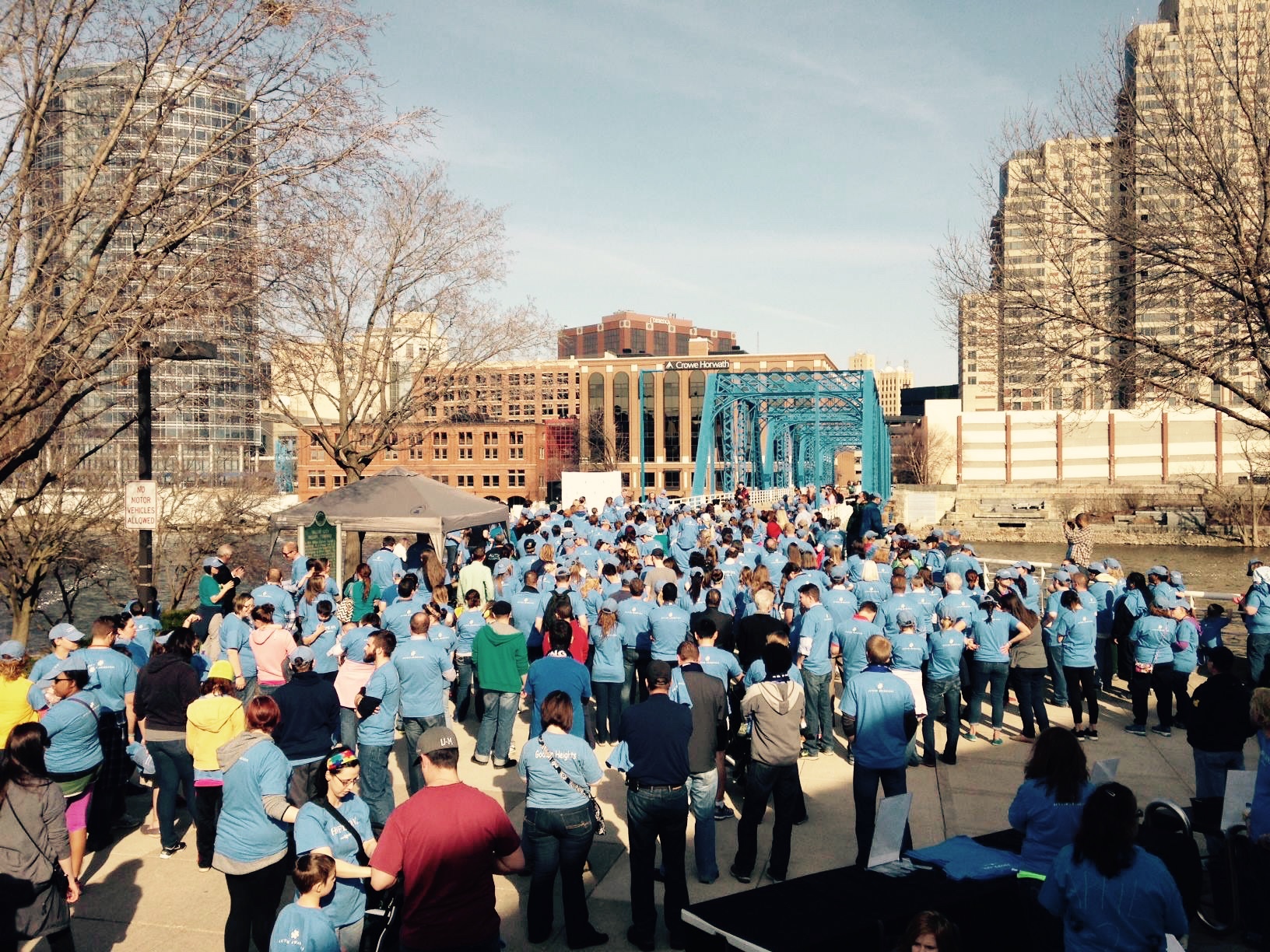
Re-Thinking Privilege and Visibility in The Trans Community: How Solidarity and Advocacy Can Make The World Safe for All of Us

I gave this speech as the keynote address for the 2014 West Michigan Transgender Day of Remembrance: A Gathering of Hope, tonight. 

FullSizeRender 2

Some of the dedicated people who volunteered their time to make this event happen

FullSizeRender 3I get to stand up alongside some amazing talent in my advocacy role

Thank you so much for allowing me to speak to you, and thank you to all our allies for being here tonight. This is a special night for our community. Even nationally, we don’t have a lot of spaces that belong just to trans people. Because of this, we very rarely have opportunities to welcome you into our space. But tonight, I’m borrowing Pastor Doug’s (and, well, Teri’s and my) church and appropriating it as “our space” (Sorry, Pastor!). So, I do want to take a moment to welcome you all into a space that belongs to trans people. If you’re one of my trans siblings, you belong here. Tonight, this is your space. Yours in which you should be proud of whom and what you are, yours in which you should hold your head up high, yours in which you should demand that you be seen and counted and recognized. And, if you’re here as an ally, for this one rare time, please let us welcome you into our space. You belong here, too. Because trans people are people, and people don’t stand alone, and you are our community.

Now, what I’m about to say may make some of you uncomfortable – but I would feel wrong if I didn’t say it. The thought behind it made me uncomfortable, for a long time. I also think you, like me, will be better for being uncomfortable. Chad Griffin is the CEO of the Human Rights Campaign, probably the biggest LGBT advocacy organization in the world. He came to Southern Comfort Conference a few months ago, to apologize to our community for HRC’s historic missteps towards us. HRC kind of owed us that apology. When Chad did that, he started by acknowledging his privilege.

I want to do the same. I want to acknowledge the stark contrast between my life and the lives of the siblings we are here today to mourn. Where many of them were impoverished and more than a few experienced homelessness, I have always had a warm bed to sleep in, and enough money to pay for everything I needed and a fair amount of what I wanted. Where many of them were estranged from their families, my parents have been so good to me, and if not perfectly understanding of what it’s like to be me, open to trying. My father said, “I don’t know why you came to ask me if I accept you – of course I accept you, you’re my child.” My mother said, “If anybody in the family has a problem with you, they’ll have to come through me,” and she’s as fierce as I aspire to be, so I wouldn’t mess with her. Where many of them were cut off from their communities, I should acknowledge that I live in a world of talking business over lunch or after-dinner drinks (or, sometimes, brunch!). Far from losing anyone in either my personal or professional community through transitioning, my social network has only grown and strengthened. Far from losing recognition for my expertise in autism, I gained recognition now also for my role in the LGBT community. And where many of our siblings were seen as what the police protected “us” from, I am able to generally assume, when I see a police officer, that they are there to protect and serve me. Their presence makes me feel more, not less safe. I want to come clean about all of this. I don’t want to stand up here and ignore how I do not face many of the risks that felled our siblings – 268 in the last year, I think that’s 12% more than last year.

I want to come clean about the disparity between me having about as good an experience transitioning here in West Michigan as anyone has, anywhere, and the siblings, not just out there, but right here, who struggle with a lack of acceptance or access to resources, and of course, the siblings who paid the ultimate sacrifice, just for being what God made them. We live in an intersectional world. Some of us live at the intersection of multiple forms of marginalization, that make it harder to live authentically, harder to be accepted, harder to survive. And some of us live at the intersection of multiple forms of privilege, that make even challenging life experiences, like transitioning, something through which we not only survive, but thrive. That’s privilege. Mostly, I didn’t earn it. It’s just a matter of luck.

FullSizeRender

Look at me, getting all fierce

Of course, that’s not the whole story. It’s just a starting point, to challenge you to think differently about how we go farther in getting the world to accept us, in getting our needs taken seriously, and in finally seeing a world where freedom is a right and not a matter of being “one of the lucky ones.” For ALL trans people. To get, there, we need to re-think our use of privilege and visibility. They need to become not just something for which we apologize, or about which we are bashful, but weapons that we will use to win this thing.

So, while I respect that each of us must make choices that are best for them – we cannot build the revolution on anyone’s back – I do want to push you to think differently about being visible. When I was coming out, I knew that I couldn’t be “stealth” in my profession. I’m in a small technical field. Even if I moved to Texas, too many people in my field know me. I could not have been stealth in my profession. But I could have been stealth, in my community, in Texas or some other far-flung place. I thought about this, after I started transitioning, and before my story became public. For a moment. I chose not to leave. Not just because I love Grand Rapids – I do – but because not being stealth gave me an opportunity to be a little more fearless as an advocate. I had a little less to lose. Plus, I don’t really know any other place to wear my heart other than my sleeve. Everybody who knows me knows that.

If you’re a trans person in the room, and you’re engaged in professional or other leadership spaces, especially, you’re kind of used to something that’s new to me, over the four months or so since I went “full time.” You get used to the times when, over and over again, you sit at a table, or speak up in a conversation, or stand up in front of a crowd, and you realize that you are boldly going where no trans person has gone before. And you get used to the sense that there are a million other times when you’re doing that, and you didn’t even realize it. When we go into those spaces and we own them – we stand tall, and proud, and fierce, and we stare down anyone who stares at us, or we throw them a dismissive smile – our visibility makes it easier for the next trans person, and the next trans person, and the next. Even when they hate us, your visibility helps us, because it outs the hate. And when you look around this room, you realize that we have lots of different kinds of visibilities. Some of us are visible with our faces. Some of us are visible with our voices. We are visible by our presence. You are visible just by gathering here tonight. All of you have one kind of visibility or another.

And what about our privilege? Right here, in Grand Rapids, the LGBT community and our allies, we raised more than $280,000 in pledges and donations for Our LGBT Fund. In less than four months. Trans people are represented at that table – as donors and as leaders in the Fund. We are being vocal about our needs and our expectations as we begin the process of prioritizing what we can do with this new source of funding, so that we make sure that trans people are represented at that table as recipients of the supports this funding will bring, as well. Money is one kind of privilege that gets us to the the table. It’s a privilege the trans community is hesitant to mobilize, although today, even small contributions to causes, when added up, can make a difference and emphasize our role in changing things.

But money is just one privilege. Connections, cultivated friendships, opportunities you’ve had to develop skills or prestige, all these privileges are currency in a very real way. That currency helps us get a seat at those tables. But, we choose to be at those tables, because it’s important to make sure we have a voice in the conversation. What I want to challenge you with, tonight, is that we have more privileges than we realize. Some of you work for large corporations. Some of you have privilege by membership in an ethnic group or social class. Many of you have privilege that education brings. Again, when you look around this room, you realize that we have lots of different kinds of privileges. Those privileges, when we lord them over each other, when we use them to build a wall between us and our community, become terrible. But when we we leverage those privileges to make the world a better place for trans people, they can be redeemed.

You can see this – leveraging privilege and visibility – writ large these days. And you don’t even have to look outside our own trans community. I came out in a time of Laverne Cox, Janet Mock, Kristin Beck, and Chaz Bono. Their use of privilege and visibility to advance trans acceptance and inclusion – especially leveraging their talents in something other than being trans – made it easier for me. Honestly, they’re kind of hard to argue with. Kristin is like a real-life G.I. Joe character. Laverne had what started as a small role in Orange Is The New Black and kind of stole the show, and not because she was trans, but because she’s an amazing actress and has a warm, lovable personality. And Janet is inspiring as an example about how to be graceful and real, at the same time, for anyone (myself certainly included). And Chaz? Well, I guess I just wish I could dance like Chaz can! Each one of them, in their coming out, made a choice to be visible. They made a choice to leverage their privileges – whether talent or name or appearance or connections – to advance our cause. Those of you who are here as allies, who maybe only know one trans person, who haven’t had the opportunity to be in a space where we’re the majority, you may not know just how many more stories there are, out there, like Kristin’s, Chaz’s, Janet’s, or Laverne’s. You may not know just how awe-inspiring the talent level is when you get a room of trans people together. But you trans people in the room, you know better. All that talent, if we focus it on changing the world for us, can be powerful in changing our perception as a community. So, this is how privilege and talent become weapons.

In the days to come, we’re going to need those weapons. We’re going to need to get uncomfortable, because this is war. So I’m calling on you to ask – how and where are you willing to be visible? And will you think again about the privileges you have and how you can use them in this fight? In a world where so many of you have done so much to advance the cause of marriage equality, we’ve got a lot to do to teach the rest of the LGBT community that “it ain’t a party if I ain’t invited” (even though we’ve always been here). In a world where we need so many candles to mourn our dead, we need to hold accountable the people who have the gall to say we’re “fully protected” already and that our state’s civil rights amendment doesn’t need to include us (this isn’t hypothetical – we need your help on this right now). And in a world where people still call us unnatural, in contradiction to scientific evidence and common sense, we need to teach people the truth – what our friends know already: that the colors are brighter, the laughter more joyous, the songs more cheerful, and the world so much better, when our community embraces us.

My Open Letter to The Mayor

An open letter to Mayor George Heartwell of Grand Rapids.

I personally have been blessed, aside from the benefit of the city’s non-discrimination ordinance, with overwhelming support, acceptance, and graciousness from my community. I transitioned at work in a Christian non-profit in Grand Rapids, and there is really no company of any size or place in the world where my transition could have gone better than here. But we’re not all this lucky. Many LGBT people do struggle with housing or employment, and are pushed to choose between being authentic and true to themselves, and being able to live, love, and work in Michigan. Many highly talented LGBT people leave Michigan for this very reason – and I know many of these stories personally as well as many more who consider leaving the state every day.

See more over on our blog at The Network!