My Talk to PFLAG Holland / Lakeshore This Week

Good evening, everyone, and thank you so much for having me out to speak to you. I want to spend some time sharing with you my story, and I want to use it as a lead-in to talk to you about how we’re re-imagining LGBT community and the role of the LGBT community center, in the Greater Grand Rapids area, and how we need you to be a part of this.

But let me start with my story. Way back when, when I was a little child, I remember very clearly that, whenever there was a choice to do, have, or be things that girls wanted versus those that boys wanted, I always wanted what the girls wanted or had to do. Even when it seemed to most people like the boys had the better option. But right away, I also remember learning that most of this would get me scolded, made fun of, or sometimes punished. The rules seemed confusing to me. I saw girls with painted nails and it seemed to me like mine should be painted, too, but that didn’t go over so well. By the time I was a preschooler, I had a system down to pass as a boy. I wasn’t too good at rough and tumble play, but I liked riding bikes, I learned to like baseball, and then I really took to Lego bricks and building spaceships – people kind of love it when little boys want to build spaceships. Now, I’ve always loved building things, although, as I’ll tell you later, the things I build now are a little different than anything I thought I’d be building back in those days.

In the meantime, over my childhood years, it seemed to me, with the force of everything everyone was telling me, despite what I felt like on the inside, I must be a boy, although obviously not a very good one. So I spent my daydreams dreaming that magic, space aliens, reincarnation, anything, would turn me into a girl, and I imagined all the adventures that girl would go on, the kind of woman she would be, what it would be like to be a bride, but I never thought I could be that girl. I figured out that I could play with the more tomboy girls, especially if there were other boys around, and I could “get away” with that. Every once in a while, I really lucked out, and I found an activity that was mostly full of girls, and I could again “get away” with participating in it. The violin was a major score (some of you can sympathize, if you know how catty and high-strung budding violinists are). Later on, I “got away” with … reading Anne of Green Gables (and later yet, Jane Austen and Charlotte Bronte). This kind of stuff helped a little.

My school unselfconsciously used a lot of logos that look suspiciously like they belong to the Black Panther Party. For serious.

My school unselfconsciously used a lot of logos that look suspiciously like they belong to the Black Panther Party. For serious.

My parents moved here, to Holland (I’m a West Ottawa grad) when I was in third grade. That was a culture shock – think back to Holland in the mid-1980s. I felt like, suddenly, I went from having diverse playmates and lots of Indians around to being one of five non-Dutch kids in my school. I joke that me and the Italian-American kid had to band together, and it’s really not so much of an exaggeration. But I learned to hold my own. I learned to have friendships with girls and boys – having female friends was really nice, because many of the ones that became my friends naturally let me into their lives, and while they didn’t necessarily treat me like a girl, they didn’t treat me like a boy, either. I had male friends, too, and I did like some boy interests – my parents let me learn how to program computers when I saw six or seven years old, and I’ve been scripting as long as I was writing, and computers, again, were a great cover, since they seemed innocuously boyish. So I got through. It got confusing, sure. I was supposed to crush on girls, and I was interested in them, but what I couldn’t put into words was that, like them, I wanted – needed – to be someone’s bride, not anyone’s groom. So I dated… maybe one girl in high school. And I didn’t know how to respond to her affection. And I panicked, and although we became friends later, I always felt badly for that. I got fighting the way girls fight out of my system via orchestra – there was this one girl who was always challenging me for my chair, and I took delight in beating her, even though I was playing a $100 violin and didn’t have private lessons.

By the time I finished high school, I kind of understood that there were “Indian Approved Fields” – my parents weren’t keen on medicine, and there was just something about IT that, as appealing as it was (and who knows, maybe I could have gotten in on the bubble?), I didn’t want. So I went to U of M for engineering. I was good at it, too. Really good grades continued to be part of the sham – not that I’m not proud of or identified with my learning capacity, but anything that I could do that seemed to be what I was supposed to be doing … it helped keep up the façade. Michigan was so much fun, too. I wrote for a student newspaper (and briefly was its editor-in-chief). I led an honors society. I met two of my best friends, even today, at orientation, and I had pizza with them at two in the morning and stayed up all night (I didn’t understand all-nighters, because I didn’t really procrastinate in those days, but they seemed exotic, and so I’d pick a class and not do my homework so I could stay up all night with Wei… it was Engineering Mathematics – Fourier equations and loop integrals and stuff – it was really easy and I wasn’t worried about getting it done, anyways). So… I was good at it, but I didn’t have any passion for it. I didn’t date, but I started having really intense platonic friendships with women.

I got exposed to lots of new things in college, that I’d heard of in magazines but never seen before – you know, like English literature majors (my Indian friends swore they weren’t real). I got exposed a little to gender and sexuality politics. There was something alluring about queer community on campus, but in those days, queer was all about being socially non-conforming, and I just didn’t see how that could be me. I’d heard of “transsexual,” but only in the context of the Rocky Horror Picture Show, and I’m just not Tim Curry. I got lots of weird data. I didn’t know other guys who loved Jane Austen like I did. Or who wanted to be pretty and not handsome. People would comment about gender differences, like how men and women sit, and I’d laugh along and yet know I sat like the women did except when I was extra cautious to imitate the guys. So… I made it work. I did Intervarsity, and later Graduate Christian Fellowship. I moved into more applied physics, and I stayed for a couple of years at U of M doing ultrafast optics. And had more really intense, platonic relationships with girls, and one kind of questionably romantic one that broke my heart, also. That was a negative experience on so many levels. I think she recognized that I wasn’t what she was meant to be with… but neither of us had the words for it, and we did have this intense connection, albeit not a physical one really.

By that time, I just wasn’t finding passion in physics. I left to work in engineering. Again, as always, I was actually really good at it. The projects were never quite right, though. I got hired at Ford to ultimately spend two years proving that a technology they’d acquired was a hoax, and working myself out of a job – it was a big win, but I struggled to get an opportunity to try and do something else that would make me relevant to the organization, since they’d hired me (with a great salary) based solely on highly technical skills that turned out to be largely irrelevant once the technology was clearly a dud. In hindsight my leadership was really protective of me (more on this in a bit). I did consulting briefly, but I was terrible at that. I did supplier warranty and then product development. I had a big win, again – I picked up a project that had a five year developmental cycle and had to be started over, more than four years in. I worked my butt off, and I got that part on those vehicles, in working condition, without missing a beat. So I was really a pretty good engineer. And what I did like about it was that it was kind of social – I mean, there was technical engineering, sure, but a lot of that was driving to the plant, spending days at a time there, bonding with the people on the floor, so that when I needed to prototype in a rush or get them to do something they didn’t want to do, they would take care of me first.  Plants are noisy and scary (I probably don’t seem now, like I much belong in one, but I can hold my own). Back at Ford, we had a couple of deaths in our plants, and someone died on one of the lines at Textron that actually ran parts that I was designing. On a machine I’d actually operated once or twice on prototypes, myself (because I sweet talked them, and I did their work for them sometimes, and they took really good care of me). That was scary, and it was hard to mourn someone I’d known, even in passing, and support the people I was working with, all with a deadline still looming. I made that work, but during that time, I knew I’d had enough. Masters-degree-or-no, I was done with engineering. I took night classes. Rebelliously enough, in Psychology, because I’d looked at things – I’d actually almost gone to business school – and I wasn’t sure anything would make me any happier.
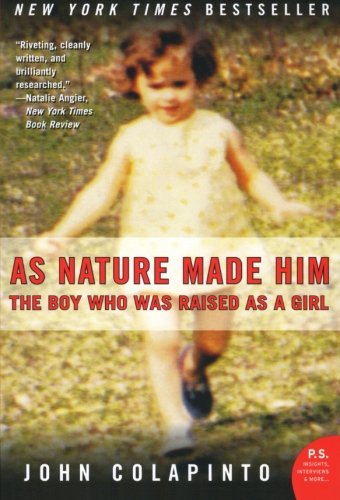
As Nature Made Him is a really remarkable look at the question of nature and nurture and their roles in human gender identity.

As Nature Made Him is a really remarkable look at the question of nature and nurture and their roles in human gender identity.

Surprise, surprise, I saw a human sexuality class, and I took it. And… I found out about all kinds of things. I found out about the range of human sexual experience. I tried dating guys, but it was a bust – I was attracted to them, but I was clearly in the wrong place. And I was attracted to girls, sort of. Anyways, I didn’t seem gay exactly, even though (straight) people thought I was gay not uncommonly. Interestingly, the gay guys all knew I wasn’t one of them. I also found out about other things. There was this kid (David Reimer) from Manitoba. Maybe you know this story. So the doctor tried to do this kind of circumcision on him that involves … well, basically, they burnt his penis off. This other person, Dr. John Money, a psychologist, was trying to prove that gender was socially constructed / behaviorally learned. So he told them to basically remove the boy’s testicles, also, and create girl parts, and treat him like a girl. Later, they followed up with hormones. Except their little girl always wanted to pee standing up, and did other things that didn’t really fit. Okay, so this was practical – I started peeing sitting down, and if small, that was vastly preferable. Later, Reimer “transitioned” back to the man he was supposed to be, although he ultimately killed himself, at just a little younger than my current age. This led me to, in turn, find out that there were transgender people. But at that time (this was about 2002), I couldn’t find any examples of happy trans people (somehow, I didn’t find some books that had already been published, like Jan Morris’s Conundrum. Kate Bornstein’s book was about to come out, but that would probably have been too much for my delicate mind to handle. Jenny Boylan’s book was what I needed, but it was still about a year away at that time. I basically drew the conclusion that there was no future in transitioning, and I put it out of mind.

I did ease up on myself. I didn’t come across, at that time, the idea of being genderqueer, but that’s what I did/was/tried. I did little things, like shaving all the hair off my arms and chest, that made me feel less like a boy. I had been overweight, and I really worked on myself, just before this, on losing weight, and as I lost weight, I felt light and airy and … girlish. It became quite out of control – a diagnosable eating disorder, and it probably almost killed me. But, I also connected with other people with eating disorders, and … again, I found a community of women, in which I was largely accepted as one of them (although also flirted on / hit on / etc). And, as I got thin, I got into fashion, and at that time, there were guys wearing girl jeans and so on, and … that was, again, in a very androgynous way, kind of amazing and liberating. But also unsatisfying, because I was still perceived as a man, and utterly unsuited to the role. Like camping outside heaven’s gate, faraway so close, and I was probably at my darkest emotionally in those years. I just didn’t see how I’d have a Pride and Prejudice kind of ending to my story. I didn’t want to kill myself, but I just had visions in my mind of my life… just not ending well. Thoughts of death, yes, but also the fear of living on, for a long time, miserably.

There were other revolutions. I was taking these psychology classes – living a double life as something than the good Indian engineer son my parents thought they had. Okay, this doesn’t sound rebellious to you, but you don’t come from a nice Brahmin family. It’s way more rebellious than it sounds – one of the things that contributed to my parents’ acceptance of me later, is that I have a cousin who’s a symphony conductor, and that “lifestyle choice” is way less acceptable to my family than being transgender. Anyways, whereas I was a good engineer, I found no questions I wanted to answer. I found in psychology, I could solve problems – I was good at that, and engineering education made me even better at it – but they were problems about people. Marie Curie said that, as scientists, we “must concern ourselves with things and not people.” Even though the advice came from a woman, I just couldn’t swallow it. So this was something. So, I applied for and got accepted to a clinical psychology program. I didn’t know what this neuropsychology thing was, that I was interviewing with (… with the president of the International Neuropsychological Society, I should mention, whom I told this), but he was nice to me anyways, and let me come to grad school in spite of that. So I moved to the University of Florida.

Psychology grad school was great for a “I knew by now that I was supposed to be a girl” like me. Engineering classes had one woman for every 7-8 men, back when I was at U of M, but my psychology classes were close to the opposite. More platonic kind of intense friendships. But also I started dating in earnest, finally. I fell in love… I really did feel in love, although I was acting out a character to be anyone’s boyfriend. This was also weird, because she knew about my anorexia, she knew that I liked to wear girl pants if I could get away with it (even if they looked and fit just the same as guy pants, I wanted them because they were girl pants). She mostly accepted all of that. It didn’t work out, anyways, but when I was at the University of Chicago, for internship, I dated with a vengeance – I did eHarmony and went on maybe 25 first dates. I dated one woman for a couple months, and then I dated someone for a year, into the time I moved to GR, to do my fellowship here. We broke up, again, I loved these women, but I wasn’t what they needed, and I guess I did kind of know that. I dated again here – amazingly, I was actually… appealing to women, which was also all very weird about all of this. I settled into a relationship that lasted three years. It was enough, again, to try and make it work. A lot of us think “love will cure me,” and I thought that, too. But it doesn’t, of course. So I tried, really hard, but it just wasn’t working. And living with a girlfriend really meant that I felt like my one space of privacy – not that I was doing anything at home – well, I basically felt like I had no place at all where I could be me, except maybe in my fantasy or dreams. But, I persevered. I took my job at Hope Network, in part to stay here and try to make the relationship work, and in part because it really was a fantastic opportunity (that also almost killed me!).

Finally, after all of this, as she and I were both realizing we needed to move on, I started waking up to the world around me. We live in kind of amazing times. I supported a local theatre company – Actors, go see their plays! – and they did a play called Looking for Normal. About a trans woman. And so I had season tickets, and I took guests to see it. I go to all the plays, so I didn’t know what it was about in advance. And then I’m getting uncomfortable in my seat. I’m looking around to see if anyone as obvious signs of the pitchfork they’ve got under their seat. I’m waiting for the boos and jeers. Except. There aren’t any. No, the play gets a standing ovation. Wow. So I did what any 21st century girl does. I googled. And… I found out the world I’d been hiding myself from. I found Jenny Boylan’s book, and I found out that there were transgender people who transitioned and maintained their social and professional standing. I found out that one of them – Lynn Conway – had an office in the EECS building at U of M, and I must have walked by it a thousand times in the six years I was there, without even knowing she was there. And I found out the modern truth. Transition was not really (for me) inaccessibly expensive. It was safe. It did work. And I could be me without losing things I valued about my current life. I took a deep breath, and as my girlfriend was moving out, I got ready to seriously consider transition. I found a therapist. I came out, for the first time in my life, this is last October – to one of the women I took to the play. She was a lesbian woman who had come out later in life, and who had left behind a significant part of her life to be true to herself. That first night, coming out at a coffee shop, I said something I’d never told anyone in my life – in Chicago, I paid for a therapist out of my own pocket for almost a year, and she helped me so much with my eating disorder, but I never breathed a word about my gender to her. It was amazing. She was gracious. And accepting. And not entirely surprised. I didn’t sleep a wink that night, that had felt like such a revolutionary act. I came out to other close friends. I started therapy. I went to Own Your Gender at the Network, our adult trans group.  So I was expecting maybe there would be one or two people there, and they’d think, “You aren’t trans, stop pretending,” or maybe they’d catch me out and put me on TV or something. But actually I walked into a room and saw more than 20 trans faces staring back at me. And gained a sense of confidence. A few months later, I went to First Event in Boston, and if 20 trans faces could give me confidence, imagine being around a few hundred of them.

So, anyways, in December, I came out to my boss. She took a deep breath, and said, in essence, “Okay, let’s do this. We support you.” She talked to her boss, my CEO, a day or two later, and he took a deep breath, and he said, in essence, “Okay, let’ do this. We support you.” And as I kept coming out to people, something magical happened. We estimated losses. Everyone told me there’d be losses. We calculated “acceptable casualties” that my still-vulnerable autism program could sustain. But there weren’t any. I came out one by one to the 50 families we had in therapy by this spring. I’m not going to administer a scale to them, “On a scale of 1 to 5, how much do you accept me?” But the ones that cried with me, hugged me, said, “You do your thing, you’ve got to be you,” or “we kind of know a thing or two about having a child that isn’t anything like what you expected to have, and then it turns out they’re pretty great… if we can do this, you can do this.”  I’ll count those as positives. And if they didn’t say anything, just said, “Okay, I understand, thank you, I don’t have any concerns,” I counted them as neutrals. So I had a rate of 70% positive, 28% neutral, and 2% (one person) who responded negatively. Incidentally, that one person got over herself within all of about four hours, and she and her child are still a part of my clinic. I didn’t lose professional contacts either – far from it, networking with OutPro at the GR Chamber of Commerce, I gained so many new business contacts that I scarcely have time to develop them. I got on a plane in February to come out to my parents, and I was ready, if it came to it, to sit on the curb in front of their house and call a cab back to the airport from my cell phone. To get on that plane, I had to be that ready. But they listened, and listened. Then, my dad said, “Okay, but I don’t know why you came to ask us if we accept you. Of course I accept you. You’re my child.” My dad isn’t given to dramatics, this is pretty impressive. And my mom said, “Okay, if anyone in the family has a problem with you, they have to come through me.” That’s pretty par for the course for my mommy – I get in trouble every once in a while, because you really don’t want to see what I’m like if you mess with my kids, and I get that from her. So I didn’t lose them, either When we finally did a staff meeting for my staff, to come out to the ones who didn’t know yet, HR came. I led the meeting. At the end, the HR people said they wished they could go to more staff meetings like this, because my people were so supportive and it was so easy and without tension. Get that – this crazy meeting where your boss’s boss tells you she’s really a girl… it’s the easy meeting.

And… that brought me to the end of July this year. About five months ago. I got a lot of advice to take some kind of sabbatical, but there was too much going on, and by then, I was way too much of a feminist to be “hushed away” like some pregnant daughter of a socialite. So… we did this staff meeting on a Monday morning, and we’d already arranged for a summer staff party at my house for the following Friday. Everyone said they were still coming. In December, I had made the goal of our holiday party to make them feel safe, to make them feel welcome, and to make them feel like part of the family and not just employees. In July, they returned the favor with interest. And they did so happily. And it was easy.

And here I am. A happy girl, changing the world for kids with autism by day, and the LGBT community by night.

And here I am. A happy girl, changing the world for kids with autism by day, and the LGBT community by night.

Fast forward five months, and my transition hasn’t cost me anything with my social life – it’s only made it way better. I haven’t lost friends, but I’ve gained a ton. The very worst responses I have have been mildly lacking in understanding. No one calls me names. I walk with confidence. My career hasn’t slowed down any. We still get invited to parties. I’m not saying that this is what happens. But I want to stop, and take a moment, and say that this is what happened. In Grand Rapids. At a Christian Service Agency. Where even the pastors like me. The next staff party I threw (last week) was even bigger yet. And it happened, amazingly, without a clear policy of LGBT workforce inclusion, with offices in the suburbs (where Grand Rapids’ pioneering non-discrimination ordinance doesn’t apply), and with all of us just doing our best to cobble a transition plan together without much experience in doing this. That’s surprising – in fact, we did have one prior transition happen at Hope Network, some years ago, but it did not go very well, and that makes my experience even more surprising.

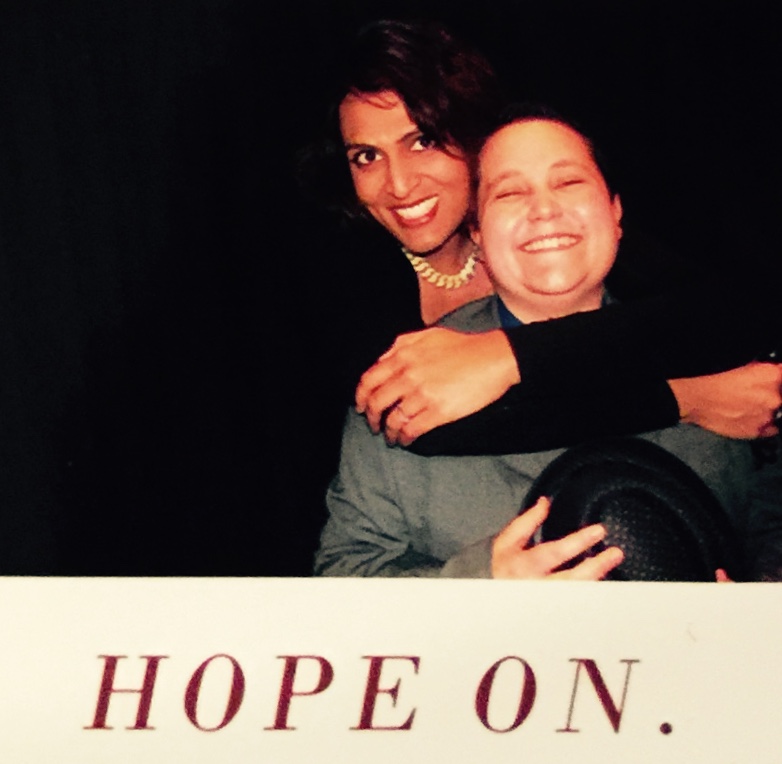
Back in January, probably the fourth or fifth time I left the house in makeup, a friend called me to go out to an inclusive bar downtown (Pub 43, it’s gone now) on a cold, cold day. My friend can be kind of a downer, so I felt like I had to say yes and reward good behavior. So I put a dress on, and out I went. I walked up the rusty back stairs, trying not to fall in heels. And this person catches my eye, standing with friends, at the top of the fire escape on a smoke break. Wearing a cute little vest, tie, and pocket watch. And opens the door for me. And our eyes meet. And… I’m taken. I wasn’t looking for a woman in my life. I realized in transition I’m mostly attracted to men, which never made sense until I could get my head around the idea of being their girlfriend. But I was also happy single. And yet, here’s this butch. So I bat my eyelashes, get Teri to come over to talk to me and my friends. Turns out she’s a writer. An in. So we talk on Facebook, and I ask to read her writing (oldest trick in the book). And she’s shy, and flirty, but doesn’t ask me out on a date. So I set it up. And she almost doesn’t come – car troubles. So I pick her up. And she seems nervous. So I touch her arm, and there’s electricity. But she runs out of the car when I drop her off, and she doesn’t kiss me, and that hurts. Well, I don’t give up easily. I invite her over. I tell her, “This time, you better kiss me.” And she does. And it’s wonderful. And I can wrap my head around being a lesbian. For her. Except… our relationship doesn’t seem to stay exactly lesbian. It gets way het. She’s my prince charming. I tell her – because we’re kind of crazy about each other, I want to be your wife someday, but it doesn’t feel right, calling you my wife. But I will if that’s what you want, or partner, or what do you want? Later… quite a bit later, I find out what I kind of already knew. Teri entered my life identified as a butch lesbian, but is increasingly identifying as a trans man in queer-safe spaces, with the hopes of doing so everywhere soon. And the thing is, the really crazy thing is, that people get us. I bring him to my work Gala in November, and it’s perfectly natural. He’s chatting up the clergy and one of our board members. We’re a perfectly natural couple. And here I am at our Gala again, for the third time altogether, and for the first time, in a black dress. Which is where I belong, but now also as I belong.
FullSizeRender

Mad fierce in the photobooth at the Hope Network Annual Gala 2014

And, there it was, my Jane Austen ending starting to come true, after all. So let me use that story as an introduction into the Network. I network by temperament. So I approached transition like everything else – I built a constituency. I gauged supporters. I stacked the deck. During my transition, I wasn’t sure what would happen. We did make a hedge plan, and we almost moved to Houston. But we didn’t, because GR is where we belong. Because my autism team needs me. Because my neighborhood needs me. The Network needed me too, and asked me to join the board.

After I knew I was staying, I accepted. As I did that, I found an organization with a deep history. In 1987, a group from West Michigan went to a historic march on Washington, DC, to press for gay and lesbian rights. They came back from the march energized about sustaining that momentum here in West Michigan. In 1988, we had our first Pride. At its peak, we had probably 13,000 people at Pride. But the organization wasn’t developed or nurtured. By the time I came to it, it was in dire straits. It served maybe 150-200 people in support groups, but it wasn’t really nourishing or growing those groups. It had maybe 7,000 people still coming to Pride, but it had lost the momentum, whereas we could have the biggest pride in Michigan. We hadn’t really grown our activities to celebrate the broader LGBTQIA+ story, either, and we weren’t an effective partner really with anyone. We had a dilapidated membership, a senior leader who did not have the right skill set, and a diminished board, with capable people, but far too few of them.

I’ve turned around engineering projects. I turned around the Center for Autism. So I set to figuring out how to turn around the Network. I did a lot of happy hour conversations and power lunches. I asked a lot of people a lot of questions. And this is what I came up with.

We live in historic times. In 2004, a popular vote amended our constitution to block marriage equality. In 2014, we clearly have a majority on our side. Sure, key leaders in organizations like the Church are against us, but most of their followers are not – the Vatican may not be very LGBT-friendly, but the overwhelming majority of Catholics are. We’ve had recent setbacks, to be sure. Elliott-Larsen was not a victory for us, although we were able to stop MiRFRA in its tracks. But, the first key thing I want you to understand about re-imagining LGBT Community, is that we are on the precipice of a world in which our lives matter, and our loves matter. And that world is about to see just how much our gifts matter. Because we’re out here changing the world, already, just nobody knows it. You know it, if you’ve come to a space like an OutPro event. When you do a 360 in that space, you have to be astonished at the kind of leadership and seniority we’ve achieved across every kind of industry. The truth is, when you look at an OutPro event, you start to wonder how or if Grand Rapids could even run if it didn’t have us. We’ve got a lot to give. We are giving a lot. And we’re not just making the world better or safer for LGBT people. We’re doing it for all of us.

That’s the first thing. The second thing is that, in this world, where our lives increasingly matter, and our loves matter, and we are free to practice our gifts, it is increasingly clear that the gains we have made in the 45 years since Stonewall, have not come for everyone. There’s an ever-larger segment of stories like mine. My board president moved into a small neighborhood of affluent and powerful people. They didn’t just accept him and his husband. Because of him and his family, they came together, and the whole neighborhood is closer than it was before. At the same time, there’s a subset of LGBT people who, if you ask them, would think stories like mine or his are crazy. Because they remain severely marginalized and oppressed. Often, it’s because they are multiply marginalized. They live at the intersection of being LGBT and… being from a marginalized ethnic community, growing up in poverty, surviving abuse/neglect, surviving mental illness, etc., etc. But whatever the cause, they’re being left behind – and that disparity is growing, not shrinking. The things we’ve been doing over almost fifty years, which culminate in unheard of things like the way in which my transition has been received, they are simply not benefitting this subset, and they will predictably continue to not benefit this subset.

It’s the confluence of these two realizations that’s at the core of my proposal to reimagine LGBT community. We have to think about what LGBT community means when many of us are no longer very oppressed. When we have our rights. And we have to think about how we can change the conversation so that the movement benefits not just people like me, but all of us.

The way that I propose to do that – the leap from yesterday’s thinking about LGBT community (which is what I found at the Network), to tomorrow’s thinking, is that we need to be thinking and building, right now, a model of the LGBT community not just as an oppressed, marginalized group, but as a stakeholder minority. In the way that some of our overrepresented ethnic minority groups have done, we want to “flip the script,” and not just keep fighting for our rights, but increasingly showcase our public commitment to building vibrant and dynamic communities that are inclusive not only of us, but of everybody. I believe it’s an approach that’s uniquely suited to West Michigan. As a community, we have conservative values. We believe in economic development as the cornerstone of prosperous communities, and our communities have made key investments to leave behind the comfort of what Holland or Grand Rapids was, 20 or 30 years ago, to embrace having a future. LGBT people have a lot to give in this. And following our over-represented minority group examples, this is how we move our community into a place of entrenchment, where we’re part of the establishment, and we’re not invited to the table for scraps, but because we belong at the table.

We started on this re-imagining with the Network about two months ago. It’s early yet. But we’re investing in three strategic pillars. First, we’re going to double down on our heritage of Nurturing The Family. This means that we’re going to really enhance our groups, work to increase membership, and work to make sure the map of our groups matches the needs of the community. Right now, we have active groups for LGBT youth, the trans community, cross dressers, men’s and women’s social groups, parent support groups, and a book club. We’re going to add this year, new activities around wellness interventions for the LGBT community (in partnership with MDCH and other community centers), and a new group for people who are LGBT and experiencing mental illness or behavioral health challenges. Brand new is Our Narratives, our new educational program series. The flagship of this is a workshop that we do (actually, at our home), with small groups. We teach a structured format in which people can tell their stories, integrate their stories with the broader struggles of their community, and leverage the impact of their stories to push for change, both large and small. Outcomes data from our first session indicate that, while the people who come to the program know their own identity, they don’t know how their own struggles relate to the broader story of the LGBT community, and they don’t know how to ask for change or feel comfortable doing so. When they leave, they show significant (in one day) increases in these areas. And they’re going to build an army of advocates. We’re just starting. In January, we’re doing So You Want To Be An Ally. It’s every bit as subversive as it sounds. We’re going to make you re-think everything you thought you knew about what it means to be an ally. And when I say you, I mean all of us – because LGBT people act as allies to people in the other letters (just like I’ll never understand what it’s like to be a gay man). But the thing is, a lot of us make pretty bad allies. A lot of the time. We co-opt the movement. We want our voices to be louder than theirs. We set the expectation that the people whose allies we are place our needs above theirs – that they stop talking, and let us advocate for them. We make them stop their conversation and explain themselves to us. Over and over. And we make too many mistakes and show them too little respect. That’s not being an ally. So we’re going to teach all of us what it means to be a real ally. It’s going to be hard, and it’s going to be challenging, but we’re going to build a real Family with deep and strong roots this way.

Second, we’re going to dramatically expand how we think of Celebrating Our Diversity. Pride is a good start. We’ve got one of the best family-friendly Prides in the world. What we do best is something different from San Francisco, but we have an unparalleled space in which we can party and have a good time, out in the open, LGBT and ally like, and right in the heart of our city, where we belong. But we want to have the biggest Pride in Michigan, someday soon (it’s a friendly competition!). Some of you came to Transgender Day of Remembrance, and so this is maybe your second dose of Mira, but this is just the start of what we’re going to do here. We’re going to build a celebratory calendar throughout the year. We’re just getting started with this, and it’ll take time. But we’re going to do more to celebrate more layers of the LGBT community. We’re going to celebrate the layers many people don’t know about yet, like the asexual/aromantic community (or “Aces”). We’re going to celebrate coming out. We’re going to partner, too. Maybe you can help us create an annual event that recognizes the parents who helped make us possible (like my fierce mom!). We’re looking for partnerships to do things like celebrate LGBT figures in different ethnic groups in town, partnerships to recognize LGBT women and the contribution they make to women’s history, or LGBT businesspeople and the contribution they make to the economy, again, in partnership with the mainstream community. We’re going to use each of these events to highlight how the world is a better place not in black and white, but in all the colors of the rainbow.

Finally, we’re going to invest in something brand new, which is a radical new Engaging with Our Community. This will take a little time, but we’re starting to build an LGBT Volunteer Corps. What we’re going to do with it is instill a culture of volunteerism for the broader good, in LGBT people (because LGBT community goes beyond being gay – we’re a group of really great, passionate, engaged people). Already, whenever anything good happens in our cities, you can bet there are LGBT people involved. But no one knows it. In the future, if there’s a river cleanup, if there’s a building project, a neighborhood renovation, I want the community to count on a contingency of people in Network t-shirts to show up, LGBT people and our allies shouldering the burden alongside their neighbors.

And that’s how we win. We build a world that is better for everybody. Rather than responding to negativity from elements in, say, minority faith communities, we show solidarity with their communities, and this calls them out as they are – small minded individuals, not voices for the people. We build a world where people stop thinking of us as the next annoying group we need to give rights to (coming close on our heels, as I understand it, is people who want to marry horses), and instead, they call us when they need buy-in to make something great happen. And we stand hand-in-hand, and our solidarity creates a chain that uses this to lift all our people out, let them all come out of whatever closets they’re in, and let them walk free and proud, where they belong, at the heart of our community.

If we do all this, we don’t just dream of a future where stories like mine aren’t exceptional. We build that future. And we own it. So. That’s what we’ve been up to. That’s how we’re re-imagining LGBT community. And we need your help. We need you to be members – to take a public stand that you are an owner in great LGBT community and in a partnership to build greater, more vibrant communities. You can also support us by coming to our Gala, February 21, tickets on sale at our website, or if you’d like to talk to us about sponsorship opportunities, we have some great ones. As PFLAG, we also want you to be our partners – by finding ways to co-educate or a celebratory event put on in partnership between us.

Thank you so much for your time. Thank you so much for being allies, and for believing.

Re-Thinking Privilege and Visibility in The Trans Community: How Solidarity and Advocacy Can Make The World Safe for All of Us

I gave this speech as the keynote address for the 2014 West Michigan Transgender Day of Remembrance: A Gathering of Hope, tonight. 

FullSizeRender 2

Some of the dedicated people who volunteered their time to make this event happen

FullSizeRender 3I get to stand up alongside some amazing talent in my advocacy role

Thank you so much for allowing me to speak to you, and thank you to all our allies for being here tonight. This is a special night for our community. Even nationally, we don’t have a lot of spaces that belong just to trans people. Because of this, we very rarely have opportunities to welcome you into our space. But tonight, I’m borrowing Pastor Doug’s (and, well, Teri’s and my) church and appropriating it as “our space” (Sorry, Pastor!). So, I do want to take a moment to welcome you all into a space that belongs to trans people. If you’re one of my trans siblings, you belong here. Tonight, this is your space. Yours in which you should be proud of whom and what you are, yours in which you should hold your head up high, yours in which you should demand that you be seen and counted and recognized. And, if you’re here as an ally, for this one rare time, please let us welcome you into our space. You belong here, too. Because trans people are people, and people don’t stand alone, and you are our community.

Now, what I’m about to say may make some of you uncomfortable – but I would feel wrong if I didn’t say it. The thought behind it made me uncomfortable, for a long time. I also think you, like me, will be better for being uncomfortable. Chad Griffin is the CEO of the Human Rights Campaign, probably the biggest LGBT advocacy organization in the world. He came to Southern Comfort Conference a few months ago, to apologize to our community for HRC’s historic missteps towards us. HRC kind of owed us that apology. When Chad did that, he started by acknowledging his privilege.

I want to do the same. I want to acknowledge the stark contrast between my life and the lives of the siblings we are here today to mourn. Where many of them were impoverished and more than a few experienced homelessness, I have always had a warm bed to sleep in, and enough money to pay for everything I needed and a fair amount of what I wanted. Where many of them were estranged from their families, my parents have been so good to me, and if not perfectly understanding of what it’s like to be me, open to trying. My father said, “I don’t know why you came to ask me if I accept you – of course I accept you, you’re my child.” My mother said, “If anybody in the family has a problem with you, they’ll have to come through me,” and she’s as fierce as I aspire to be, so I wouldn’t mess with her. Where many of them were cut off from their communities, I should acknowledge that I live in a world of talking business over lunch or after-dinner drinks (or, sometimes, brunch!). Far from losing anyone in either my personal or professional community through transitioning, my social network has only grown and strengthened. Far from losing recognition for my expertise in autism, I gained recognition now also for my role in the LGBT community. And where many of our siblings were seen as what the police protected “us” from, I am able to generally assume, when I see a police officer, that they are there to protect and serve me. Their presence makes me feel more, not less safe. I want to come clean about all of this. I don’t want to stand up here and ignore how I do not face many of the risks that felled our siblings – 268 in the last year, I think that’s 12% more than last year.

I want to come clean about the disparity between me having about as good an experience transitioning here in West Michigan as anyone has, anywhere, and the siblings, not just out there, but right here, who struggle with a lack of acceptance or access to resources, and of course, the siblings who paid the ultimate sacrifice, just for being what God made them. We live in an intersectional world. Some of us live at the intersection of multiple forms of marginalization, that make it harder to live authentically, harder to be accepted, harder to survive. And some of us live at the intersection of multiple forms of privilege, that make even challenging life experiences, like transitioning, something through which we not only survive, but thrive. That’s privilege. Mostly, I didn’t earn it. It’s just a matter of luck.

FullSizeRender

Look at me, getting all fierce

Of course, that’s not the whole story. It’s just a starting point, to challenge you to think differently about how we go farther in getting the world to accept us, in getting our needs taken seriously, and in finally seeing a world where freedom is a right and not a matter of being “one of the lucky ones.” For ALL trans people. To get, there, we need to re-think our use of privilege and visibility. They need to become not just something for which we apologize, or about which we are bashful, but weapons that we will use to win this thing.

So, while I respect that each of us must make choices that are best for them – we cannot build the revolution on anyone’s back – I do want to push you to think differently about being visible. When I was coming out, I knew that I couldn’t be “stealth” in my profession. I’m in a small technical field. Even if I moved to Texas, too many people in my field know me. I could not have been stealth in my profession. But I could have been stealth, in my community, in Texas or some other far-flung place. I thought about this, after I started transitioning, and before my story became public. For a moment. I chose not to leave. Not just because I love Grand Rapids – I do – but because not being stealth gave me an opportunity to be a little more fearless as an advocate. I had a little less to lose. Plus, I don’t really know any other place to wear my heart other than my sleeve. Everybody who knows me knows that.

If you’re a trans person in the room, and you’re engaged in professional or other leadership spaces, especially, you’re kind of used to something that’s new to me, over the four months or so since I went “full time.” You get used to the times when, over and over again, you sit at a table, or speak up in a conversation, or stand up in front of a crowd, and you realize that you are boldly going where no trans person has gone before. And you get used to the sense that there are a million other times when you’re doing that, and you didn’t even realize it. When we go into those spaces and we own them – we stand tall, and proud, and fierce, and we stare down anyone who stares at us, or we throw them a dismissive smile – our visibility makes it easier for the next trans person, and the next trans person, and the next. Even when they hate us, your visibility helps us, because it outs the hate. And when you look around this room, you realize that we have lots of different kinds of visibilities. Some of us are visible with our faces. Some of us are visible with our voices. We are visible by our presence. You are visible just by gathering here tonight. All of you have one kind of visibility or another.

And what about our privilege? Right here, in Grand Rapids, the LGBT community and our allies, we raised more than $280,000 in pledges and donations for Our LGBT Fund. In less than four months. Trans people are represented at that table – as donors and as leaders in the Fund. We are being vocal about our needs and our expectations as we begin the process of prioritizing what we can do with this new source of funding, so that we make sure that trans people are represented at that table as recipients of the supports this funding will bring, as well. Money is one kind of privilege that gets us to the the table. It’s a privilege the trans community is hesitant to mobilize, although today, even small contributions to causes, when added up, can make a difference and emphasize our role in changing things.

But money is just one privilege. Connections, cultivated friendships, opportunities you’ve had to develop skills or prestige, all these privileges are currency in a very real way. That currency helps us get a seat at those tables. But, we choose to be at those tables, because it’s important to make sure we have a voice in the conversation. What I want to challenge you with, tonight, is that we have more privileges than we realize. Some of you work for large corporations. Some of you have privilege by membership in an ethnic group or social class. Many of you have privilege that education brings. Again, when you look around this room, you realize that we have lots of different kinds of privileges. Those privileges, when we lord them over each other, when we use them to build a wall between us and our community, become terrible. But when we we leverage those privileges to make the world a better place for trans people, they can be redeemed.

You can see this – leveraging privilege and visibility – writ large these days. And you don’t even have to look outside our own trans community. I came out in a time of Laverne Cox, Janet Mock, Kristin Beck, and Chaz Bono. Their use of privilege and visibility to advance trans acceptance and inclusion – especially leveraging their talents in something other than being trans – made it easier for me. Honestly, they’re kind of hard to argue with. Kristin is like a real-life G.I. Joe character. Laverne had what started as a small role in Orange Is The New Black and kind of stole the show, and not because she was trans, but because she’s an amazing actress and has a warm, lovable personality. And Janet is inspiring as an example about how to be graceful and real, at the same time, for anyone (myself certainly included). And Chaz? Well, I guess I just wish I could dance like Chaz can! Each one of them, in their coming out, made a choice to be visible. They made a choice to leverage their privileges – whether talent or name or appearance or connections – to advance our cause. Those of you who are here as allies, who maybe only know one trans person, who haven’t had the opportunity to be in a space where we’re the majority, you may not know just how many more stories there are, out there, like Kristin’s, Chaz’s, Janet’s, or Laverne’s. You may not know just how awe-inspiring the talent level is when you get a room of trans people together. But you trans people in the room, you know better. All that talent, if we focus it on changing the world for us, can be powerful in changing our perception as a community. So, this is how privilege and talent become weapons.

In the days to come, we’re going to need those weapons. We’re going to need to get uncomfortable, because this is war. So I’m calling on you to ask – how and where are you willing to be visible? And will you think again about the privileges you have and how you can use them in this fight? In a world where so many of you have done so much to advance the cause of marriage equality, we’ve got a lot to do to teach the rest of the LGBT community that “it ain’t a party if I ain’t invited” (even though we’ve always been here). In a world where we need so many candles to mourn our dead, we need to hold accountable the people who have the gall to say we’re “fully protected” already and that our state’s civil rights amendment doesn’t need to include us (this isn’t hypothetical – we need your help on this right now). And in a world where people still call us unnatural, in contradiction to scientific evidence and common sense, we need to teach people the truth – what our friends know already: that the colors are brighter, the laughter more joyous, the songs more cheerful, and the world so much better, when our community embraces us.

The Secret Lives of Boys

Reading a novel I just finished*, it occurred to me that, as a trans woman, I (we) have a unique perspective. While I sometimes regret not having had a proper girlhood, and I didn’t really have a proper boyhood, because I was never more than pretending to be a boy, as an outsider, I had an intimate glimpse into the secret life of boys that few women are afforded. Most of the time, I just feel like a survivor, but I enjoyed my strange childhood (bullying, teasing, and my internal dysphoria notwithstanding), albeit not nearly as much as I do my queerhood. As I reflect on my transition from being a perceived-male leader to a woman leader in the workplace, and I continue to learn to understand (& frequently still wonder at) my male peers (although I’ve had more female than male bosses, and even my favorite engineering supervisor was a woman … I’m not so unsocialized as a woman), I actually think it’s quite a gift to have had this.

I’m a feminist, and I really believe I try to be a truly radical one, but the part of me that doesn’t wish I were an upper middle class British daughter in Jane Austen’s day makes me wish I were a 50s housewife**. I’ve adjusted pretty readily to my current life, where I’m the breadwinner, and am entirely likely to make far more than my girlfriend, for the foreseeable future, even if she is the man of the house***. She has taken on some of the yardwork, but I also do the vscuuming and the laundry and the cooking and the majority of the dishes, so I’m kind of the housewife also. And damn me, but I like it, and I even kind of like it when my partner feels me up while I’m cooking instead of helping. It’s fulfilling****.

I also could’ve been the other Boleyn girl, but that ended a bit badly….

But, I did spend my childhood riding bicycles around the neighborhood, pushing how far we were allowed to explore from the house. We put playing cards in the spokes to make motorcycle sounds and our moms got mad when the deck was missing the jack of clubs and the two of hearts. We explored the undeveloped land at the end of my street, which was maybe two acres, but felt like an empty national park, and we played king of the mountain. I sucked at this. Once, we went to the corner ice cream store. I didn’t wear shoes, and my friend Paul didn’t wear a shirt. The sign said, no shirt, no shoes, no service, and I think they wouldn’t have turned away two six year olds, but I lent Paul my shirt because his shoes didn’t fit me. My mommy was mad that time also – Paul’s mom wouldn’t give him money, so I shared mine, against her wishes. We also once ate cat food that came in a sample package in the mail, because the box said it was for ages six and under (now this should go in a footnote where I can minimize embarrassment). I had boy adventures. I got to come up in the treehouse where the (other) girls weren’t allowed. I got to shoot a hunting rifle when we went to see somebody’s hick cousin outside town (I’m Indian … I have lots of cousins and none of them have guns). Sure, there were girls in our little gangs, most of my childhood. There was one in my earliest group of friends (she was a jerk though, and mostly friends with Paul … maybe she viewed me as competition! Probably they’re married now…), and later I occasionally managed to score a separate clique of girl friends, who included me on girl imaginative play that delightfully involved less killing things. But I was also included, especially in those young years before puberty, in pretty much the full boy experience, and they weren’t.

In fairness, there were also eras (most of adolescence) when I also really was excluded from the world of the young men, and I can tell you that sharing the boys’ locker room during puberty was terrible, and where the bruises from the kids punching me for fun, were incurred. Boys making fun of my nipples was pretty terrible (they’ve, erm, grown on estrogen, but they looked more like girls’ nipples even then, just like I’ve always had hips, at least since adolescence).

To some extent, this inclusion in the boys club did pick up again after puberty. By eleventh grade, the teasing had largely ended. I had a clique again of intimate friends, still mostly boys with a few girls, and I started being included in some guy stuff again. I really loved and valued my friendship with my freshmen college roommate, and my two best friends still, whom I met at orientation, although I increasingly seemed like an awkward fit into the boys’ hall in the dorm (my roommate and I were both odd fits in our hall full of Long Islanders).

After college, there was a summer when we would hang out at my friends Calvin and Chris’s place, and play tennis or swim until it got dark, and then Wei would cook steaks shirtless (this looks like the same story you’re imagining where all the people are white, except with less body hair). I was already shifting to spending more and more of my time becoming platonic friends with women (other women, but I wasn’t ready for that clarification quite yet … this was a gradual progression, and as I’ve learned to navigate not getting crushes on them, because I don’t really feel attracted to feminine women, they make way more sense for me as close friends than men, outside of the handful with whom I share decades and who will own my heart until the day I die). And so, yet again, this inclusion faded over time.

Nobody has invited me to a poker party in a long time, and the only Super Bowl party invitation I can think of in years came from one of my female best friends, Lisa. We went out to a restaurant my friend manages. There were root chips in ridiculous quantity. I had a mixed drink and later got food poisoning. Anyways. The truth is I’ve been an outsider to the private lives of men for years, and even any male privilege I retain now is largely eroded by the well known facts that I love pink, watch romantic comedies way too often and cry all the time (also when telling stories about our autism kids), and like brunch way more than yard work. And trunk sales way more than power tools. Way, way more.


These are still way better for making bicycles make cool motorcycle noises, although my friend Wei is now apparently a coolly competent card sharp at the poker table

As for the boys, I retain their sense of adventure, and although it’s shaded with body image issues and shame and guilt that any other woman who survived anorexia knows well, most of the time, I share their sense of agency. Like them, I still thrill when I can use my talents and when I solve problems. Like them, I enjoy it sometimes when life is quick, when it is unpredictable, just as I enjoy (sometimes) running to the next terminal at the airport 10 minutes before boarding, to get Starbucks, and weaving through the slow moving passengers a I dash back to get “in before the lock.” (Okay, I did this right before the flight on which I wrote this post, and, uncharacteristically for me, I did not get a peppermint mocha, nor did I get a birthday cake pop.) And I also have some of their battle hardening, from the time I had to rescue an engineering project that had lost more than three years of its four year development cycle, and get it out the door, essentially flawlessly, in all of eight months. The battle scars from coming into my Center, driving out the people who were killing it like Jesus in the moneychanger section of the Temple or a World War I soldier invading an enemy foxhole. Sometimes I feel like it killed the little girl inside, a bit, but I also am proud of my survival (and overcoming anorexia is a pretty good girl template of overcoming … hardly any guy is strong like a girl who survived that!).

Thus, in ways, I’ve been working on the problem of how to be a professional woman, just like any other woman, long before I transitioned. But some of this won’t really come into fruition until I’m full time, in the next couple months*****. A lot of the leaders around me are women, in this environment, but a lot are men. It is kind of useful to have grown up with their kind, at a level of intimacy girls don’t have. Maybe I’ll make a good double agent for other career women. Like most of my female leader peers, I think our femininity adds to, not subtracts from, the workplace. I think mine already has, because I’ve always been feminine, and when the last vestiges of pretending are gone, it will, even more so.

But I don’t dream some Amazonian vision of the future where men are obsolete. I think they bring a lot to the workplace, too. I wonder at them. I admire their strength, physical and emotional, although I think we push our boys too hard, to be too strong, too hard, and too soon. Nonetheless, I like their strong arms****** and their strong hearts. I don’t think that women are better than men, and certainly I don’t think men are better than women. I think we’re just different. I don’t think that every child needs a mom and a dad (two moms or two dads is great, and one of either suffices for many in a pinch), and I dont think that because it was Adam and Eve, that Adam and Steve can’t look equally cute together. I do think women and men complement each other, and that masculinity and femininity complement each other, on a broader scale (and in my, ahem, private life… I love being in love with a butch). We are better with both, albeit letting both develop naturally, and not policing our boys into masculinity or our girls into femininity.

And thus, I’m thankful that I got to be a girl in deep cover*******, and I think it adds to my womanhood rather than subtracting from it. My therapist thinks I carry way more male privilege than I do, and warns me about how I’ll withstand loosing it. I wish she would listen better and talk less, but my undercover girlhood amongst the boys, paired with my increasing comfort in and confidence with my feminity, will help me navigate my womanhood with grace and courage. And I shall wear my scars, both scars of bicycle crashes and scars of the heart, proudly. They are badges of honor, and even when I conceal them with makeup, they make me more beautiful.

* Pat Frank’s Alas, Babylon, our at-the-time-of-writing current book club book…it’s excellent, I really enjoyed it. And I didn’t pick it, so don’t start with me!

** Just for those of you who don’t know me well, the vast majority of me is too busy being in love with this moment and and this life to spend too much time thinking how good I’d look with alabaster skin and a corseted dress or my hair in pins and a tweed skirt and cape. Although I do have a tweed skirt and hairpins….

*** Not to be insensitive to my girlfriend or to overdo the idea of the butch-femme relationship mirroring the heterosexual relationship, or to give too much ammunition to the fellas who want to know “who’s the guy,” but this is pretty much the way it is… I’ve even caught my girlfriend mansplaining things to me, like how I should manage the $2M budget of the clinic I build from ashes with my bare hands (and my team, whom I love, it really was NOT all me… After we got rid of all the people who were snakes in our midst, the people we have left are my true family, and it would break my heart to leave them).

**** The tail end of second wave feminism and the very beginnings of the “land grab” era did at least lead to things like questioning the feminism in belittling a woman for liking to keep house.

***** It’s so close. I ordered girl business cards. I have a skirt suit. And a transition plan for work. I probably can submit my paperwork to change my name in about a month. And I just can’t wait.

****** As long as they’re not ridiculous. All the ladies know exactly what I’m talking about.

******* I borrow this – Jill Davidson, a fellow trans woman psychologist, called her memoir Undercover Girl. I like Connected Queer still, but I have to admit she aced it with that title.

Getting My Ears Pierced

I finally got my earlobes pierced*. It was a good experience. The piercing specialist, who has crazy gaugings with gears spinning in them and most likely some advanced form of clean/renewable electric power generation happening inside, asked me if I would want to gauge my ears at any point in the future (considerate of him to ask, and I’m fine with other people gauging their ears, but #No).

This got me to thinking about something along the lines of the hierarchical sexism problems that Julia Serano writes about. I identify as queer** in two senses. I am gender non-conforming, in the sense that I try to / want to conform well within female normative appearance (happily) and behavior but I was assigned male at birth***. I am also sexually non-conforming in that I am bisexual-going-on-lesbian, in a really amazing relationship with a lesbian identified woman who has always known me and accepted me as a woman, even when it’s under the male mask for work, etc.

And yet, right? (In Japanese, the women especially say あの、ぬ。I find this a lot more artful, but, well, my Japanese is rusty these days, but you think I sound like a girl in English, whew, you should hear me speak Japanese.) As queer people have more and more come out into the open, doesn’t it sometimes seem that being appearance non-conforming is more queer than being LGBTQIA+? It seems like a different thing than the days, back when I was in college, that people called the local coffee chain “Oppresso Royale” for policing tattoos and piercings. Rather, it seems sometimes that queerness of the appearance kind – having lots of tattoos, body piercings, dressing in non-conforming ways, sometimes is a shibboleth for queer spaces. *Cough* really a shibboleth for BTQIA+ spaces and maybe occasionally L spaces (I haven’t had opportunities to go to that many L spaces, but I do get invited). I guess this isn’t really a new thing. Kate Bornstein, of all people, has an experience in her wonderful memoir where she gets read as cis/het in a lesbian bar, and they kind of gave her the “this is no place for a pretty little thing like you” line until it turned out she was kinkier-than-thou.

This is really absurd and is really an element of something between hierarchicalism and what Serano calls Oppression Olympics. It is, ultimately, putting people into different better/worse categorizations based on variables like race/sex/appearance rather than rejecting the notion that people are fundamentally more and less valuable in an intrinsic way****, from one to the next.

Queer spaces should not gatekeep sexual/gender minorities based on stuff that is not fundamentally related to being a sexual/gender minority. Being trans and being a woman who loves a woman make me queer. That woman I love has a number of tattoos, and sometimes I kiss them and sometimes I like looking at them, and other times I really don’t have strong feelings about her tattoos, or even her discussion of getting a sleeve, and occasionally I make fun of them. But my not having any tattoos, and no piercings except my ungauged earlobes, in which I wear girly earrings that match my outfit whenever possible, do not de-queer me, and it’s no more right that I be looked down upon because I am au naturel than for me to look down on someone because they are pierced or tattooed. 

Really fundamental to this concern is the idea of identities, experiences, and behaviors being more revolutionary because they are farther from the mainstream. In that way, my argument is that it is much the same as claiming femmes somehow invalidate the experience of other lesbian women by their femininity or preserve the patriarchy because they kiss women, but do so in lipstick and heels. Maybe it’s even easier to see in the idea that somehow non-tattooed people are oppressing tattooed people with their plain skin. The bottom line is that the truly revolutionary acts are to be authentic to oneself, and to decide that all people matter. And the revolution won’t be over, until life is equal, until love is equal, until gifts are equal. 

* Use a reputable tattoo / piercing parlor, it’s worth it.

** Sometimes I hear people in the trans community use queer to mean non-binary, instead of saying the more specific genderqueer. I’d really like to push to keep queer as an umbrella identification, because there’s no other good word that tries to capture the entirety of people who are gender and/or sexually non-conforming to societies’ expectations. Like the concept of “colored,” the umbrella use of queer is a political construct – because we all experience marginalization because we are queer, like nearly Ll “colored” people have experienced at least some marginalization in a “white” society. It is not my intent to imply that there is a homogeneity to queer people or to straight (cis/het) people. There isn’t, and that’s the whole point.

*** I find this language clumsy and overly indulgent of implausibly constructionist gender theories, but whatever.

**** Careful readers will note I am a Fountainhead-loving libertarian and wonder at this statement. I take a constructionist view of equality. I do not believe that people are born equal, nor do I believe they remain equal over the course of their lives. I think we create societal systems, however, that give them equality in the sense of opportunity. Those societal systems reduce/eliminate, and I reject, the idea of valuating people on many things that they are rather than do, such as race or sex. I also reject valuating people based on extraneous variables – I don’t give someone the kind of respect I value most because of their tattoos – tattoos have nothing to do, mostly, with my loves – passion, creativity, ingenuity. I will give mad props to a really pretty tattoo, though, because I love beauty.

Learning to Be Loved

I’ve said before that I really haven’t been fooling anyone with the sad drag show that has been my male life. At support group the topic of coming out on social media came up – I’ve always been out here, obviously, and on Facebook. That’s because I resisted joining Facebook for the longest time, and my erstwhile male identity never was on FB. Twitter is a different story – I have a fairly mature presence there, with a lot more followers than anywhere else. So, it’s actually important to me, and I have given a little thought to coming out on Twitter. I joked at group that I would say, “I’m transgender. I’m sorry for my sad impersonation of a man. I know it’s embarrassing, it won’t happen again.” That actually pretty much sums it up – if you follow me on Twitter* you’ll probably actually see that tweet in a few months. It’s probably funnier to me than anyone – it probably won’t be how I finally break into Huffington Post’s Funniest Tweets by Women weekly column. Sigh.

I’m kind of a walking stereotype, which I’ve also said before. I like heels (but not embarrassingly high, and those chunky low heel pumps from Coach are being discounted, hmmm…). I like skirts and dresses (but not too short). I like makeup (but not too much eye shadow, it looks garish on me). I’m not even full time and I have two designer purses (Saffiano is way nicer than I expected it to be, incidentally). I drink cosmos and drink every kind of martini but an actual, normal martini. I listen to girly music. And cry along at the sad songs. Kind of a lot. I still dream of being Elizabeth in Pride & Prejudice (the original, not the one with zombies, although in a pinch I’m open to negotiation). I’m flirty, often just because it’s fun, and I understand the concept of a flirty hemline.

The one place where I’m not exactly a walking stereotype is the continuing ambiguity of my sexual orientation. I do find it incredibly liberating to say I’m not really sexually/romantically attracted to very feminine women, although I like them a lot as friends, and I enjoy looking at how they dress and do their makeup, and I try to learn some tricks from them, because I’m pretty moderately feminine myself. That pretending went away immediately when I came out the first time. I want to be a beautiful woman (and the emotionally unstable one, but let’s not get into that trope) far more than I want to be with one. And I always nod along silently when women say they’re not that into guys based on their looks. Preach it, sisters. I was never really attracted to what I was “supposed” to be attracted to. I am attracted to masculinity, though. At least in relatively small to moderate doses, I find it achingly beautiful. I don’t want to be it. I never have, and this is a big part of why my attempt at masculinity is so sad (on a particularly butch day in my en homme form** I’m probably roughly Ellen DeGeneres). But the gap teeth and the goofy smiles and the bravado, I find it all amazingly cute. So I say masculinity, whatever. I’m attracted to my girlfriend’s masculinity. Or butchness. Or agency. Or whatever. It’s so much hotter to me than girly girlness.

I adore how she can wear the same couple of shirts she cycles through day after day without any self-consciousness, while I try to remember the last outfits the people I’ll see today saw me in, to avoid the mortification that they’ll see me in the same outfit again (I’ve been a little bit less like this in my en homme form, recently, because it’s just getting harder and harder to put on a male mask, even a kind of a sad one, day after day, but before transition for some time, I was pretty much like this already). I love that she doesn’t consider matters such as whether her underwear matches her clothes. That her clothes are pretty much not getting ironed unless I do it. That she went to a “bro party” because her friend considers her one of the guys (and I get to tease her and pretend to suspect that there were strippers involved). That she lets me say I’m attracted to her masculinity (I usually say butchness, but I have said it that way) and isn’t threatened by it.

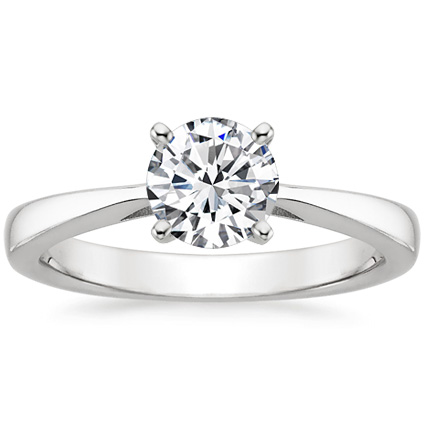
She’s got some issues that we’re working through, too, to be sure, and I’m still kind of holding on to see how those get worked out. But. I’m kind of in love with her. Okay, when I say kind of, I mean my heart’s skipped a lot of beats recently. I want to build a nest for her and not let her do any of the decorating (she’s been trying to convince me recently that her choices are not terrible, and I’m observing the evidence, but so far, #No). Okay, I’ve already begun reminding her that diamonds are the Taurus birthstone and educating her about the importance of truly conflict-free, ethical trade diamonds. Soon I’m sure I’ll start dropping hints*** about my ring size (7.5) and setting preferences (something simple and elegant, probably white gold, just one stone, nothing ostentatious). Okay, I’m a little embarrassed that I actually typed all that “out loud.” And haven’t deleted it (and in fact saved the strikeout text for a much less embarrassing admission in the next paragraph and neither this nor the really embarrassing thing I say in the footnotes).

trellis-ring

Yeah. So, erm something like this with a didn’t-leave-a-shorty-armless diamond, please? What… not subtle enough to put a picture of an engagement ring in the middle of a blog post? Can I at least work out some click-through arrangement? Or should I just be really embarrassed at blatantly inserting a picture of an engagement ring in this post?

And…moving on.

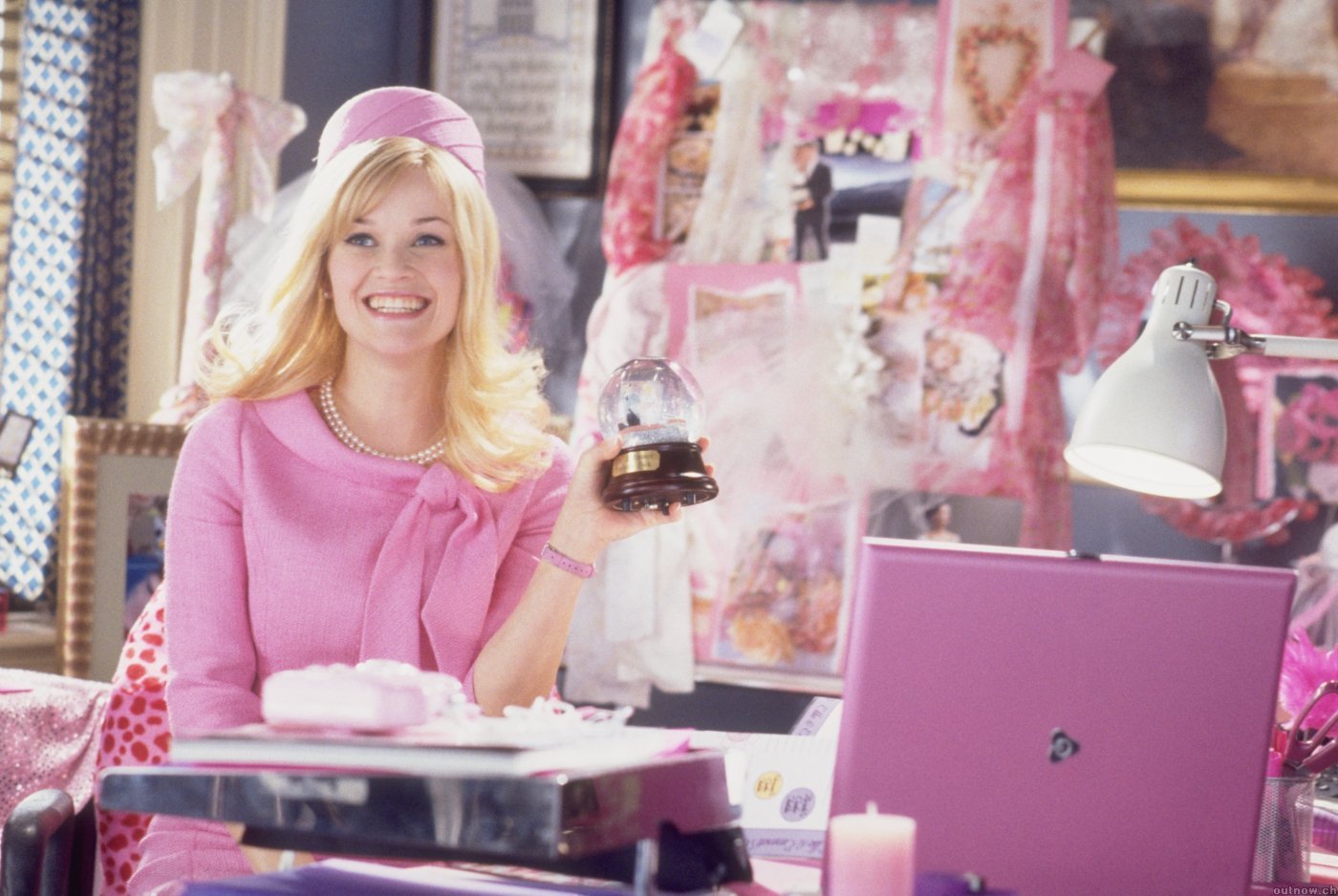
In terms of defining my sexuality, I’m really not bisexual-going-on-lesbian in the pansexual kind of sense (being bisexual means a whole lot of things, and covers a really wide range of experiences and orientations, incidentally). I really like a slice of mildly to moderately masculine/butch people. The rest, I feel, is actually *gasp* sort of like how those creepy sexologists describe feminine sexuality – I’m kind of attracted to everything pretty. I don’t foresee myself being with a hairy, dirty-white-cap wearing football superfan, and I don’t really want anyone who thinks his biceps are prettier than I am. But… a sensitive guy with strong arms and a gentle smile? A dog and a pickup truck Prius Subaru-with-a-manual-transmission-so-I-can-borrow-it-in-snowstorms-and-continue-to-drive-pretty-but-impractical-convertibles? Swoon. I know. Stereotype. Total Reece Witherspoon movie moment. And I’m sure if I were not in love, and if he came along, Reece will steal him from me anyway, probably by talking him into teaching her how to drive a manual transmission. Hands meet on the shifter. Happy ending by the two hour mark, and time left over to buy new pink Prada pumps that I would never be able to pull off. Sigh.

legallyblond

Oh my god, oh my god you guys…

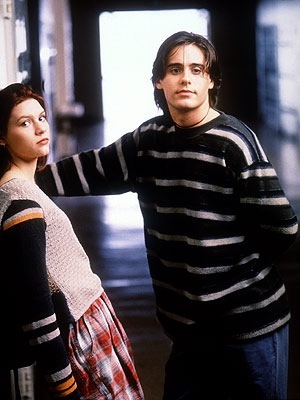
I write all of this in support of a really cool story that came up on my timeline recently about a cis/het woman who fell for a trans man. I loved that article.

selfmade

Seriously, this was such a beautiful piece, it really made me cry

My situation is quite a bit different, but my experience of sexuality is very similar – there’s some level at which masculinity is kind of a separate entity from maleness (particularly karyotype maleness, since I do consider the gentleman in the story to be male). It would be ideal to call it something other than masculinity to avoid policing anyone else’s gender expression. But whatever, you know intuitively, most of you, what I’m talking about. Whether the objects of our affection are cis men, trans men, or butch women, she and I are both attracted to masculinity or whatever else you want to call it. I haven’t met her, but I suspect like me, it might just her heart swoon. It might make her want to preen and do her hair just right. Maybe it makes her want to twirl around so her boyfriend can appreciate her dress. I kind of get that, because I’m enjoying the same with my girlfriend. It is, in essence, the “deep in the binary” feminine experience of romance and desire, and it’s really just like the straight experience of feminine desire, just queerer. It’s what I’m going through to learn how to finally feel attraction without compromise. And it’s an important milestone on the way to being loved and loving, in a romantic sense, again, without the hangups and compromises and unspoken components all this had when I was pretending to be a man.

And let’s not get into a hierarchy discussion of how it’s less queer than more gender or tradition non-conforming relationships, this is a love story, not the Olympics. Everybody should win their own prize.

* For safety reasons, I’m not linking my Twitter account here, until I come out on Twitter. I’m not trying to hide anything, but this blogging publicly with my full intended name en femme when I’m not full time yet is kind of uncharted territory, and I’m making this up as I go.

** I plan to be full time (Mira forevermore) around August. Can’t come a day too soon.

*** Here’s another thing… So in Michigan I can legally marry her, right now and probably for the next year or so, and it would probably “stick” later, even if I were caught wearing a cute dress, and I am for sure not going to be caught dead at my own wedding in a tuxedo. I really want to legally be a bride, though, and I may sound awfully impulsive, but there’s no way I’m getting married within a year … a small, intimate Indian wedding is 300 people and only one elephant. So I’d need to gay marry her, even if that were to happen. Erm. Support marriage equality.

Am I a Woman of Color?

I’ve done a lot of thinking about this question, both the variant asking whether I am a person of color, and more to the point, if I am a woman of color (I think less about “Am I a Woman?” … I’m at peace that I am)*. When I’ve asked Caucasian feminists to weigh in, they usually answer with an immediate (and cursory?) “yes.” I think this is correct, but an equally resounding “no” is important, and I think the full story is not told without both the yes and the no.

20140428-074210.jpg
Before it became fashionable to be Irish once a year for St. Patrick’s day, and whenever Guiness is poured or Celtic music is played, or just because one always fancied red hair, Irish Americans were the targets of a lot of racism by the “white” minority, who were somewhat less white than them

Let me start with the “no.” First, it’s important to consider that, much like the question of whether pink is for boys and blue is for girls, or vice versa, the answer to the question, “Who is white?” has changed. Riots among Anglo-Saxon (“white”), Irish, and Italian Americans in the early 20th century were characterized as race conflicts. The concept of being “white” has always really been rooted in Colonialism and control of people. “White” people were Europeans who exerted control, and “colored” people were the othered people they subjugated – predominantly Africans and indigenous Americans. Asians have long played an indeterminate role in this equation. Some of us, and sometimes, were othered as colored people, but other times, we were not. Even in the Colonial era, India had a more complex and different relationship with the crown than any other nation predominantly peopled with “colored folk.” This did not stop us from getting called names – you will occasionally even see the “N word” used to describe my ancestors by Britons (e.g., in passing in the wondrous Passage to India by E. M. Foster). I don’t want to get too sidetracked on this – complex is really a key word, and it has the funny consequence that, were in the UK instead of the US, there would be a lot more Indian faces around me, and certainly far more Indian food, but I would also be far more marginalized than I am here. I simply want to say that our experience was far different than our sisters and brothers in Africa and South America.

More recently and humorously, the mid-2000s pass-time that was Stuff White People Like listed things, well, that white people like, and I’m embarrassed to admit how many are true of me (this is part of the gag, incidentally – the blog was created by an Asian American). So, much like Othello, I am called often whiter than many of my unequivocally “white” girlfriends (I’ve only ever had one non-Caucasian girlfriend, although I’ve gone on dates with people of a variety of ethnicities). Many of my less-grounded-in-feminism women friends have told me they think of me as white. It’s not as simple as that.

20140428-073519.jpg
It’s fantastic that Stuff White People Like ended on My So Called Life. And I may be the stupidest woman alive in listening to all this Dallas Buyers’ Club debating and not realize that Jared Leto was Jordan Catalano

However, all of this should actually be easy to think about by analogy for my feminist and LGBTQIA+ friends – there’s a lot of complaining about traditional gender roles within the “binary.” (I was caught by surprise at a recent support group meeting – someone didn’t know the word; it’s come up in so many conversations in the last half year that I guess I forgot it was not a household concept. That binary is the gender binary that misrepresents maleness and femaleness, or masculinity or feminity, as being opposing states of a binary system, most crudely represented by “1” signifying the “presence” of masculinity and “0” representing the “absence” of femininity). If anything, the white/colored “binary” is far more, not less flawed and nonsensical than the male/female binary. The latter has existed across time and culture and is likely a basic (but malleable) part of the human competing strategy, and many animal ones as well. The former is rooted in an extremely narrow and Eurocentric conception of history. So, while I endorse the gender binary (for me – I am a femme and attracted to moderately masculine/butch people – I don’t push the gender binary on others or police their gender), the “race binary” is just dissonant with my experience, and in this way, I am leery of identifying as a trans woman of color, because it endorses the underlying binary.

A corollary to this: it is vitally important for people like me to remember that marginalization and oppression actually make up a relatively small part of our life histories and experiences. I mean, let’s be real. My Brahmin ancestors came from significant privilege even under the oppression of the British Raj. My parents are black sheep in my family, to some extent, because neither have a doctorate (both have masters degrees in Chemistry – in my family, when you tell an auntie you have a masters degree, they ask why you dropped out). My experience of being a trans woman is far more Coach purses and flash sales at the Limited than homelessness or poverty. It’s the kind of experience being trans where, in more than six months of coming out to more than a hundred people, I’ve had no negative responses and only actively felt gaped at twice. By this standard, arguably the President’s daughters are not women of color, either. I recognize that’s an audacious thing to say, and I don’t want to police their choice to identify or not identify as women of color. I just fear that we privileged (but non-Caucasian) women talking about oppression of racial minorities, as if our direct experience of it is enough to offer a fully informed perspective, run a risk of doing something almost as bad as “mansplaining.”

But that answer, by itself, is simply not complete.

There is also the obvious “yes.” I don’t quite have “skin the color of mocha” (my life is much closer to a queer Taylor Swift song than a queer Ricky Martin song). It’s more like honey, but it’s for sure not alabaster. A woman (of whose ethnicity I am unsure) came up to me at a support group recently and said she was glad another woman of color was there (this town is not so non-diverse, but some of it’s spaces can be amazingly over-representative of Caucasians compared to our city population).

20140428-073913.jpg
I clearly need to consider the subset of products marketed at “women of color,” or at least some of them, anyway, and scads of makeup trends will just never work for me, oh well … I could do worse than these women

Let me go briefly back to leveraging my certainty that I am a woman. I don’t have a uterus, and it’s unlikely I ever will. To my regret, I will never have a child grow inside me. This does mean that I should defer to the voices of women with uteruses (and those who used to have them) in many matters reproductive. But it does not mean that it is not an important part of my experience as a woman to co-advocate with these sisters (I love my sisterhood), and when I do so, I do so in a meaningfully different way than me advocating on behalf of other oppressed groups, in that I am advocating as a fellow woman (just as women stand up for me as a fellow woman – that night I met my girlfriend, her ex did this for me, and it was so amazing).

Furthermore, while I have not experienced so much oppression, I know what it’s like to be othered in subtler ways. I know what it’s like to not conform to the magazine image of beauty, my transness even aside – all the hair colors or makeup that don’t work with my skin, not having the “it” blue or green eyes, and so on. (In spite of having a purely Brahmin Indian lineage going back hundreds of years, I don’t exactly look like most other Indian Americans, either, that’s a topic for another time.) Interestingly, I serve and, in past settings, worked alongside many African American people, and every once in a while, one of the women compliments my having the “good hair,” (if you don’t understand what the phrase means specifically…). To be honest, I am immensely flattered that they sort of considered me one of them, since it’s not a comment they would make to Caucasian people, and certainly not to most people nominally perceived as male, as I was at the time! I know what it’s like to have a name that’s different (the name I chose occurs in several languages, including Sanskrit, but my birth name is common to Indians but not to most Americans, and instantly foreign and “exotic” sounding to Americans… to have fun with them, I point out that it means “mesmerizing” or “charming,” like a snake charmer!). I know what it’s like that the food and customs in my home were “foreign” to my peers.

In essence, I co-advocate with women not only on the basis of our co-humanity, but on shared experiences and interests and perspectives shaped by shared experiences (past, present, and future), which we have in common as women, but which men do not generally share. I do co-advocate, in this very same way, with other women of color, even if we have non-overlapping histories. There are even some ways in which my history as a woman of color (or those of other less marginalized women of color) may be uniquely informative – Lindsey Yoo makes a great case for this. I willingly and gladly take my place alongside other women of color (some of whom were oppressed a lot, and others, like, me, oppressed little or not at all), because I think the world will be a better place when these sisters and I experience less oppression and othering. While doing so, I remember my privilege. I remember that each of us occupies a unique intersection of different forces that privilege us and predispose us to oppression and marginalization. And I stand in the doorway and bid you in – because we are all better together.

* This blog post has an embarrassing number of parentheticals. Radical feminists love parentheticals almost as much as we love footnotes. I just love you so much that I can’t leave the good parts out on you.

You Gotta Have Principles

newmanifesto
I love girl power, and I’m fine with most of the logos, but it’s time we have a feminism that gets back to fighting for “equality, period”

So… Rather than merely attaching myself to hooks’ intersectionalism or to Serano’s trans-feminism, to me, these are my guiding fourth wave feminist principles:

  1. Woman is born in chains, but we are everywhere making her free – to turn Rousseau’s famous quote on its head (although there are arguments that he meant closer to what I mean), rather than pretending that we are created equal, and that our differences are arbitrary constructs, we must recognize that we are born with many inequalities that give and take privilege before we even speak for ourselves and continue to operate in modified forms throughout and beyond our lives.
  2. Sex and gender are deeply rooted in the very existence of human social constructs, and the feminism that helps us will be every bit as radical as this, in an honest manner that understands what we can can and cannot change, today, about human biology. Like Serano and other scientists, and since I am a neuroscientist myself, I do reject the idea that sex/gender are purely socially constructed – although there is arbitrariness in what is perceived as masculine and feminine at a given time, that many people naturally congregate and compartmentalize behaviors into masculine and feminine, and that these are moderately to strongly correlated with karyotype, is a stable feature of humans across time and cultures, and evidence against either a purely socially constructed or a purely genetic (excluding epigenetic effects) notion of sex and gender makes both of these extremes implausible. The focus of fourth wave feminism must not be arguing with people about their gender identity or experiences, or arguing with people about the very existence of gender and sex, but must rather be on how we can use intellectual/philosophical, legal/moral, and scientific / technological innovations to create (not restore) equal playing fields, as we learn more and more about what we can and cannot change, and how we can and cannot change human beings.
  3. Only inclusion builds stronger society. We have ample evidence that segregation does not work. We must stop banging our head repeatedly against doors marked “separate but equal” when we know that this has failed us time and time again. Although she denies it, history generally credits Phyllis Schlafly with using the fright of unisex/gender inclusive bathrooms to stop the ERA, and almost 40 years later, we’re still scared enough of equality that we are frequently choosing segregation (Civil unions? Please…) when we know it is not “close enough.”
  4. The fights for every kind of freedom, for freedom from poverty, freedom from racial/ethnic marginalization, freedom from sexual oppression, freedom from unjust or inhumane incarceration, freedom from dominance by the ignorant – they are all the same fight, and every freedom fighter is our kin-in-arms, and I am in league with everyone who dreams of and yearns for the life beyond the bars. Whenever we start a conversation with “equality for xxx,” are we not implying that, even when we get what we want, some people will be equal-er than others? I’m not saying that we can’t be pragmatic, that we can’t implement equality piece-by-piece, but we have to be clear that the ultimate goal is an inclusive world that provides whatever we mean by equality (not homogenization) as something everyone can enjoy.
  5. No one ever truly became freer standing on the neck of another. Oppressing trans women will not make cis women free. Oppressing the poor does not make the rich free. Demonizing members for mere membership in the dominant ethnic minority is as wrong as demonizing someone for other factors not under their control such as their sex, race, sexual orientation, or gender identity. We are none of us safe until we are all of us safe, and we must build freedom for those who lack it without trying to destroy the freedom of others.

buddha
“And Govinda saw that this mask-like smile, this smile of unity over the flowing forms, this smile of simultaneousness over the thousands of births and deaths — this smile of Siddhartha — was exactly the same as the calm, delicate, impenetrable, perhaps gracious, perhaps mocking, wise, thousand-fold smile of Gautama, the Buddha, as he perceived it with awe a hundred times.” — From Siddhartha by Hermann Hesse

To paraphrase Steinem, the advocates of the status quo, of ignoring all of these points, and of keeping one group or another bound in chains, they will do anything to make a woman like me seem ridiculous. They will argue with me about everything, from my hemline to my mascara to my genitals, from questionable translations of the Bible to non-credible histories of the founding fathers, in short with everything but what really matters, which is freedom for my people.

Happy Birthday, Dear Mira, Happy Birthday, to Me!

It’s my birthday. I’m, yeah, never-mind how old I am.* It hasn’t been a year since I started transitioning (it’s been about seven months), but it’s Mira’s first birthday. It’s pretty special – I’ve never gotten to be the birthday girl before, and girl, I have wanted to be. Birthday party Friday at my house, beer and wine and lots of people who love and accept me, hopefully (it’s shaping to be a decent turnout).

firstcake

I’m still debating (and running out of time) the relative merits of ordering my own cake vs. running the risk of a no-cake birthday party, which is rather more adult than one wants

It’s amazing to take a moment and think back. A year ago, I knew exactly how many people knew I was transgender. That would be one. Now, I’ve rather lost track – I’m pretty sure it passed 100, and I’m not even full-time yet. A year ago, I still thought I was a monster, and if they knew, so would everyone else. Have I ever been wrong on that one – even my daddy gets it and accepts me. My ex-girlfriend accepts me and she never accepted me when we were together. A year ago, I assumed I would die trapped in my sad-drag-king act. Today, I’m trying to figure out specific timing for when I might legally change my name, and even beginning to more seriously talk about surgical timing and options. A year ago I had testosterone running through my veins, and now I’m well into switching to running on clean-burning estrogens. A year ago, I thought transition would put me in some campy daytime-talk-show world, and last week, my employer brought in an outside counsel to help me with legal aspects of my journey, which will continue full steam without sacrificing the career I love. I actually even have some new business contacts that exist purely because I’m queer (and connected).

Where will I be in another year? If I When I survive (saying this out loud is still an adjustment for me), I hope being me all day, every day, will be starting to get … boring. I’ll probably be thinking about surgery pretty seriously, and I’ll probably have a date for it. I’m sure I’ll be thinking about what we want to do next for kids with autism (well, I’m thinking about that now, I’ll be thinking about the next next thing by then!). I’ll be working on finalizing our next national public policy paper, and maybe digging around for some good opportunities to take on a supporting cast member role in the Movement (that is, look for some minor leadership role in Division 44 or even talking to Women in Neuropsychology or other programs targeted to improve female inclusion about common advocacy points with trans sisters.

Franz_Kafka_1910

“Break the boards, bite a hole through them, squeeze yourself through an opening which in reality hardly allows you to see through it and which, when you first discover it, you greet with a blissful howl of ignorance! Where do you want to go? Beyond the boards the forest begins….” — from “Report to an Academy” by Franz Kafka**

I’ve had nights and weekends that were so impactful that, the next morning or on Monday, it seemed like the day or week before happened a thousand years ago and was foggy in my memory. The kids at Camp were like that when I did my first family weekend. The last year seems surreal, and I still can’t believe I wake up each day and glimpse freedom, that I see a life beyond the bars of the cage. It feels so good to be alive, and although I think life may be back to being a little more boring in a year, I can’t imagine how much better the big four-oh will be. Oops, I’ve rather given it away, haven’t I? But who am I kidding? I love being a middle-aged woman.

** No, this picture is not here because Throwback Thursday… it’s Wednesday today!

I Am A Radical Feminist (And Proud of It!)

Yes, you heard me rightly.

I think this needs saying. There are two historical meanings of the term radical in the context of radical feminism. Actually, Merriam-Webster lists three, although their first and second definitions are closely related (I’ll ignore definition four, or at least leave it to the Teenage Mutant Ninja Turtles).

TMNT

Radical, dude!

The classical meaning of the term, and the first two entries in Merriam-Webster, goes back to the etymology. A radical approach is one that goes back to the very roots or origin of something. The other, of course, increasingly in vogue in the last twenty years, is the use of radical as a synonym for extremist. Although I don’t personally know any feminists who really hate men (I know many who hate things men do), and I don’t know any people who are really feminist separatists, who want to live off in some female-assigned-at-birth fantasy land (although there is such a fantasy land near here),

There are radical feminisms of both kinds. I want to dedicate this post to pointing out that the former is the more important use of the term, and that the idea of feminism being radical is so important, that we must absolutely not cede the concept of radical feminism to the makers of exclusionary movements, and we must continue to stand up as radical feminists, to own this term, to love it, and to make (by the former definition) feminism that is far more, not less, radical.

To be sure, when second wave feminists began calling themselves radical (1967 is commonly cited for the inception of the term), they existed over a broad range. Some of them were shockingly (for the time) open about how they found men beautiful and appealing. Others argued that patriarchy prevented even the possibility of an ethical sexual relationship between women and men, and that notions like romantic and sexual orientations must be entirely revamped to provide any possibility of ethical comity. (This is most commonly attributed to MacKinnon, and sometimes to Dworkin, but as snopes.com points out, neither said anything like “all sex is rape,” and both were really, to me, insightful in analyzing the ethics of sexuality, particularly heterosexuality). To be fair, a few of them were openly suspicious of not just men, but of anyone assigned male at birth. Germaine Greer went farther than most, and in those days, was openly cruel to transgender people, and particularly trans women; she still has not really set the record straight, although recently her position has been more complex (and more confusing to some, although to me, having already said I think we should cut back on using the term transphobia, somewhat open to discussion). But again, others felt strongly and articulated clearly that feminism had a role in making the world not only better for cis women, but for everyone (Steinem and Firestone, notably — I think a careful read of Steinem’s work over the course of her life makes it hard to believe she was ever much of an exclusionist, but she has been far more explicit about this recently). Finally, still others seemed to vacillate (my reading of Naomi Wolf is this way). There was even room for some philosophies that tread a surreal line between comical and profound (if you haven’t read Vamps & Tramps or other early Paglia … it’s an experience, for sure).

But, this variation in feminist voices needs to be understood in the context of re-analyzing the world that made patriarchy from the roots in an honestly radical way, to figure out how to end the patriarchy. Moreover, while all these struggles for equality are the same struggle, I do feel we should not spend the bulk of our time making a villain of someone for fighting a different part of the equality struggle than the one that affects us at a given moment.

In careful reading of some of the authors I mention above, it is clear that, many times, their intent was to provoke theoretically, rather than demonize a group of people. Other times, I believe they were acting legitimately from fear, ignorance, or uncertainty, and from the memories of their own suffering (“hurt people hurt people“). But these women were spelunkers, lamps bound to their foreheads, crawling through the crevices and tunnels underpinning patriarchal society, having no idea what they might find or what it might mean. In the history of any new science or philosophy, as its principles are elucidated, their implications are not immediately understood, and claims that, in hindsight, seem erroneous or incompatible with the theory are made, being rejected later as the process continues. That is, the vagary of these early radical feminist views, to me, is just like the vagary of the early moments of new theories in physical science, new principles in software design, or other area of the design of science and technology.

Dworkin-IntercourseAt times, I was/am scared of Andrea Dworkin. I may be the only trans woman you’ll ever hear say this, but I was also strongly influenced by her way of thinking and her way of relating to the world, even if I disagree with some of her conclusions

Before I was aware of the latter use of the term radical, I used to call what evolved next, as the second wave slowed down, as a sort of “land grab” feminism (it has also been called cultural feminism and sometimes “difference” feminism falls into this space, too, when it is not called radical feminism in usurpment of the prior radical feminism). At the time, I didn’t know to articulate that the problem for me most centrally was that my own experience as a woman-in-becoming was being excluded. Nor did I really understand that, to the extent that I have any business talking about the concerns of or advocating for the needs of men, I was doing it as an outsider (because, in those days, I although my heart knew it, I, again, did not have the words to articulate that I was not, had never been a man). But what bothered me is that the feminism that succeeded radical feminism and ultimately stole its birthright was pragmatic in scary ways – willing to sacrifice ideology not just when no alternative was present, but at the drop of a hat, and willing to accept any intellectually odious approach or position if it benefited even one woman, even when it came at the cost of another woman (this cold be benefiting cis women at the cost of trans women, but most commonly, in the US, it was benefiting white women at the cost of black and Latino women).

This feminism was not honest. Rather, it was ready to be deceptive if it might prove beneficial. The old radical feminists were developing a science and a philosophy, and a technology derived from that science and philosophy. The new radical feminists were cobbling together bad technological solutions, because they did not care to understand or value the science or the philosophy.

smash-patriarchy

If there is a reason feminism is associated with monstrosity (outside of the primary reason, which is that it is a tool the patriarchy and the status quo use to stop us), it’s this dishonesty, this unwillingness to follow guiding principles like creating a more just society. Smashing the patriarchy, in contrast, is not monstrosity at all

My feeling is that the results have been disastrous. We did not pass the ERA, because of stupid things, like believing that sex segregated bathrooms were more important to preserve and enshrine than the equality of women and men. (For those of you who are feminists and physical scientists, what this reminds me most of is the Einstein-Podolsky-Rosen paradox…. sadly, nearly 40 years later, the horror of the bathroom is again being used to dehumanize trans people) Feminism became irrelevant to modern life, and we spent the intervening years in stupid arguments that ranged intellectually all the way from “is Ally McBeal a feminist?” to “Is Miley Cyrus a feminist?” instead of talking about how we empower women and build a world where our stories as women matter, get told, are heard.

Behind the scenes, on the other hand, a slightly more complex story was evolving than this “woe for the death of feminism.” Shulamith Firestone, that genius who wrote one text decades ago and largely disappeared from public conversation, I believe, understood many of the intersectional aspects of feminism from her place as a middle-class, white, cis woman. Over the coming decades, bell hooks went far farther, and alongside other women, extended this story to integrate the narratives of the poor and oppressed ethnic minorities, long blind spots of feminism, and later yet, inclusionary queer theorists extended this story to sexual and gender minorities, but largely extending the same story told by Firestone and Steinem that the true feminism was the one that took everyone’s right to personhood seriously. In my mind, as these dies coalesced into the so-called “fourth wave” (which really became an extension of the best of the second wave), the long dark night without a relevant feminism finally broke, and dawn shone, and didn’t it feel good to be alive and to be woman?

So, in the newest lexicon, I endorse the intersectionalism of bell hooks and others, and the trans-feminism of Julia Serano and others. In spirit, I find kinship with most of the people who call themselves part of the “fourth wave” of feminism, as well as most of those placed in the fourth wave by others’ attributions. I endorse these types of feminism as the most radical feminism available to me. I will do my small part (if our gifts were measured by capitalization, bell hooks would be in all caps and I would be in lower case subscript!) to extend it, and to make it more radical yet, and most likely, because we’re nowhere near done figuring this out, there will be other terms for the most radical, and most honest kind of feminism that comes to exist, and when I see it, I’ll join it. I bet Steinem and hooks will too, and if she were here to do so, so would Firestone.

And someday, maybe, just maybe, our descendants, genetic and spiritual, won’t even need to call it feminism anymore, because the radical notion that women are people will seem as worthy of question as the radical notion that the world is a globe.

Calling Out Transphobia … Less?

I think it might behoove us to pick our battles, and respond with a smile and a sense of humor, sometimes. I hope that this doesn’t make me Sheryl Sandberg, and I am not trying to make the “Lean In for Queers” point here.

20140413-103112.jpg

If I were doing Lean In for queers, I would tell you to man up.
I seem like the least sensible person in the universe
to be telling anyone to man up, particularly
as I continue the process of, well, manning down

I talk about misogyny, but you’ll notice that, so far, I don’t use the term transphobia much in this blog. It’s a real thing. It can make it illegal to use restrooms, deprive us of work, and in some cases, kill us. Part of being a connected queer is attacking this miasma of phobia by giving people a chance to know who we are, rather than hiding in the shadows and letting hatemongers do the public describing of us.

But, on Facebook, I found myself with … less of value to say on the whole topic of Jared Leto and Dallas Buyers’ Club (to be honest I haven’t gotten around to seeing it, but I think it’s in RedBox). I noticed I wasn’t the only trans woman with mixed feelings (Jenny Boylan, as always, brings a lovely balance of insight, perspective, and humor to this). More in my case, it’s a balance of being a person who just can’t hate anything or anyone if I see some small amount of good in them, and that I’m also a very live-and-let-live kind of woman. I don’t talk about transphobia that much on Facebook, either. Especially, I don’t talk about the million and one jokes that I find mildly distasteful, even though feminist scholars are increasingly studying some of this kind of behavior as “micro-aggression.” My point really is that we as a community are spending way too much time cataloging every micro-aggression and calling out everyone from Jesus Christ to Ellen Degeneres out for transphobia. Enough is too much. I’m not oops-shaming people who have chosen to be allies when they say something for which I don’t care. (Do ya like oops-shaming? I’ll also drop in a link to this great blog about abusing the word shaming in the women’s blogging world).

It’s not that I always find these jokes funny. When I can, I do gentle education. But, among my favorite movies, the ones where I know the lines by heart, I choose (yes, choose) to overlook humor I find mildly distasteful. Love, Actually has an unfortunate joke about hiring prostitutes for a bachelor party and how it “turned out they were men.” Music & Lyrics has a comment where the main character criticizes musicians for “wearing panties.” Because of my prism of gender experience as a trans person, I don’t care for these jokes. I still love these movies. I’ve been watching Love, Actually at least once a year for a decade now, and I don’t really ever watch movies even twice anymore. And Hugh Grant dancing is just fundamentally funny (& a little sexy).

20140413-103158.jpg

Hugh Grant characters are sexy, but if I ever actually had a real
relationship with a man, I would take pretty much any
character Colin Firth ever played. So there, I’m even giving him
more than the usual 300pix width, because yum

I’m also not really backing down on my principles. I still think exclusionary models of feminism are falsely radical, that they are not real feminism, because they spend more time hating out groups than empowering even the women they do accept as women. I embrace anyone’s right to identify their sexual orientation as they wish, and I think there are some people who are fluid by nature and can “choose” things like the political lesbianism of radical feminism and have it help them be more authentically “them,” but I think the way exclusionary radical feminism uses it runs the danger of being tantamount to the same controlling of women’s bodies and experiences of the patriarchy we’re all supposed to be fighting. As a trans woman in love with a lesbian cis woman, who has more lesbian friends than trans friends, I also find the idea that I hate lesbians absurdist (and you can ask my girlfriend if you want independent verification). These kinds of ideas, which mostly take their roots in third wave feminism organized around the “RadFem” identity (everyone more or less agrees whom and what was in the first two waves of feminism; whether there is a third and a fourth wave, and what constitutes what, are a little more contentious), especially when they are about controlling or excluding women, are dangerous to all women. When I first started coming out, I thought that people who spend all their time fighting “TERFs” and other exclusionary / hate-mongering people hiding under the premise of feminism, were being heroines. The truth to me, now, is that this is a waste of time, much like having debates with “creation scientists” take good people and wastes their time.

20140413-104044.jpg
When “feminists” spend their time arguing
about who is and isn’t a woman, and
who is and isn’t a woman worth empowering,
they need to be more radical, not less radical

We need to stand up against major acts of transphobia. Our sisters and brothers must be safe in the world. It is not okay when states try to make it a crime for us to use the restroom, or when it is open season for us to be fired because of our gender identity. And anyone who thinks I am a man (and that a trans man is, absurdly, a woman) is not an ally. But I think we need to shift the balance far, far, in the favor of publicizing strong and talented trans people, trans stories that go beyond the narrative around facial electrolysis and bottom surgery to how trans people are leading their communities, innovating, and living and loving alongside cis people. We need to do mor to help the cis world, including the cis queer world, have some idea of who and what on earth we are. Judging from all the cis people who have gotten to know me and are very loving and accepting, who enjoy my company, and don’t just include me on principle, I think this has to be a primary arm of our approach to building an inclusive world. For me, it’s simply also consistent with who I am – I am way too full of joy to spend all my time complaining.

Along the way, I may need to be held to my own standard, to not let this blog become negativistic. I did feel the need to start by clearing the air on some differences and nuances in perspective compared to other dominant views within trans and queer advocacy. But I need to spend more time being positive and lifting up, more time telling my story, and not be someone who silences her sisters. Please don’t oops-shame me, but I will accept your gentle reminders to be true to myself, and I’ll love you for it.