Keeping Appearances

If you know trans women, especially politically active ones, you know that most of us hate the way our coming out is portrayed in the media. A friend recently was approached by a local reporter, who misled her into thinking she would do a piece capturing her humanity and professionalism as a trans woman, and then it turned out she was looking for something with pictures of her putting makeup on, a wall of wigs (my friend doesn’t even wear wigs, nor does she need to), before and after shots, and other totally objectifying representations. At this end of the narrative spectrum are these people who love transition stories lurid. The bigger the change, the better, ideally so that no one would ever believe the pre-transition person was them (in contrast, I too, wear my own hair, more or less within the range of neutrois to feminine styles I have for years, and I’m pretty instantly recognizable in makeup as me, although I might look a little younger and, I hope, prettier). I respect all my sisters, and I know they are survivors and that everyone makes hard choices, but I was really disappointed, for instance, in the coverage of Karen Adel Scot that, among other things, depicted her shaving her face (I’ll let you Google for that one) — we really need to support each other in saying this isnot okay media behavior and that we will not let ourselves be subjected to these kind of gratuitous expectations.

20140407-201500.jpg

Okay, so you have no idea how accomplished
I felt when I made cat eye even this good,
but no photos of me doing my makeup until
they’re in a fashion magazine where women
are asked for their beauty tips. Which is
happening two-thousand-and-never. And also
can we talk about certain women who wear
cat eye way too often? Or would that be too,
well, catty? And can I also sneak “objectifeye”
into this obnoxious caption?

On the other end of the spectrum, I will admit, there are some trans people who choose transition, but their definition of transition is to declare themselves female (for some reason, I see this more with trans women than trans men, although I’ve had the luxury to get to know some great trans guys, too), and that’s the end of the story. They dress, talk, act in a way that’s only marginally distinguishable from the range of what men do and appear as. Except they want a female name and pronouns and bathrooms and so on. This, to be honest, is kind of a mystery to me, also. I might choose to accept them as female, but I don’t, if I’m honest, read them as female. And I guess I do sort of understand why someone might have pause wanting to share a bathroom with them. I have never really gotten a clear understanding of this, because the people I know who do this don’t really share their narrative, if they even perceive themselves as having one. They seem to see that as superfluous. Some of them even go so far as to view with disdain attempts to fit in (which some regrettably call “passing”), whether by wearing makeup, adjusting dress, etc., not just in themselves but also in others.

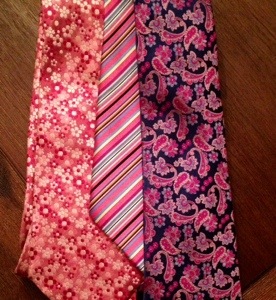
Many people have written how this kind of calculus applies particularly to women of all kinds (including trans women) — femininity, in a patriarchical world, is viewed as less authentic than masculinity and as something people “put on” instead of “are.” But I think this is where my “no transition necessary” sisters are being more than a little ridiculous. The truth is that men do put on kinds of masculinity, and women put on femininity, all the time – not just trans men and women but our cisters and brothers too. For me, being a man always felt like drag. I didn’t choose exaggerated butch masculinity as my drag. I had fun with it. I wore a lot of pink neckties. But wearing a suit and tie is “putting on masculinity” just the same as wearing eyeliner or heels is putting on femininity. It’s just not perceived that way. More particularly, it’s putting on professional workplace femininity. Granted that exists over a range, but all the cis women I’m close to (and I’ve had a lot more cis woman close friends than cis/trans anything else) make active decisions about what kind of femininity they put on, to look professional but feminine, to look cute but not slutty, to be stylish but not slavishly fashionable. It’s just judged in a more salacious way when trans women do it (and much like our cisters do this stuff… some of the worse comes from our own).
20140407-202251.jpg

So these are too cute to give away, unless someone
really appreciated them, but I’m not really sure what to
do with them, mmm-kay? I kind of 
have to channel
my inner xoJane to say things 
like mmm-kay, incidentally.

Now without getting into the whole issue of how women should not be raped, insulted, demeaned, etc, because of how feminine they choose to be, my point is that the standard that I not “put on femininity” is absurd. The reality is that I’m doing precisely what I did when I was pretending to be a “man,” except it’s far more honest. Now, I am still making choices. The girl inside says, “Hon, you’re too old for that.” Or there are lots of things that just don’t fit my body type at the moment the way I’d want to. Those problems are magnified for a trans woman who’s transitioning in adulthood and just went on hormones a month ago. So I don’t wear things I want to. Or I do wear things that aren’t my first choice, but I accept that they work on me. Is it restricted, and is it stylized to make it easier for people to consistently gender me as female and to let me feel pretty without being tacky? Well, yes, but how is that any less authentic than when, as a “man,” I said, “Okay, if I wear that, I will go way over the edge of acceptable male behavior and there will probably be a scene.” I know some trans women were way better at being men than me (like that should receive an award…) but seriously, I suck at it and that’s what it was/is like for me.

So to all my sisters who are far more gender revolutionary than me, who declare, Modo Femina*, and suddenly are women, congratulations, you’re way more of a gender revolutionary than I am. And to my sisters whose transition is like some David Copperfield act to which I’m not even good enough to be your scantily-clad-assistant-in-obnoxiously-high-heels, brava. Now just let me get on with being a middle aged woman. It’s rather delightful to me, and I’ve never wanted anything more.

* Okay, Latin was not the language I studied, and so I don’t know whether Ecce Femina, which seems much more Thus Spoke Sarah Schuster, is grammatically correct, but apparently Ovid used this, so it’s got major street cred.

Why I Choose Queer

If you know me on Facebook or in person, you know I usually say queer, not gay – I’m proud to be queer. I think “gayborhood” is something straight people came up with who are trying to be supportive but trying too hard, but I’d really like to see more “queerborhoods.”

20140407-152058.jpg

Okay, so this was on the wall at an art museum
in St. Louis…hard to resist the urge to ask
if I could buy it and put in my house (it’s HUGE!)

Lots of people have strong reactions to the word queer. Truth be told, whereas “gay” started as a code word so that we could communicate discreetly and not raise the attention of straight people, as far as I know, queer started as an insult. We reclaimed it, much like we are reclaiming our streets, our environment, our government, our civic life. So, reason number one that I like the word queer is that my small part in our work to reclaim our world is reflected in how we reclaimed our word.

The next qualm is that we have a long tradition of what we “really mean” when we talk about things like gay rights. We really mean rights for gay men, and maybe lesbians. And social acceptance of gay men, and maybe lesbians. Oh, and we hope they’re white, and affluent, and gender normative, and we hope that the men are flamboyant queens who can give us fashion recommendations and the women can help us with home improvement projects. Trans people led the revolt, before my time, at Stonewall, and yet we are just beginning to see a glimmer of a world with room for us. It’s not okay for us to be pushed to the back burner, with talk of empowering us in 10 or 30 or 50 years when we’ve got all our gay and lesbian rights down. And we need to be talking about poor queer people. And intersex and asexual people. So choosing queer is a visible and open declaration of my intersectionalism and my desire that we build something that has room for all of us (and all of me).

Beyond that, now, I don’t want to play the queerer than thou card (today!). But some of us are…well…more than one kind of queer. I’m not only transgender, but I’m also a somewhat heterocurious practicing lesbian, so if pushed on it, I identify as bisexual, although I’ll just accept the L word one of these days. Some of my trans friends are asexual, and this is a whole learning experience to me, because I don’t understand, intuitively, what it’s like to be asexual any more than I really understand what it’s like to be a man (it’s really a good analogy…the years I spent when I was single and celibate were no more asexuality than the years I’ve tolerated he/him pronouns and bathrooms that have urinals in them (eww, incidentally) make for much of manhood). So third, queer is inclusive not just of more people, but more of the whole person, including all the people who are gender/sex non-conforming in one way or another, from their orientation, to their identity, to their physiology.

To sum this all up, the rainbow we use to advocate for our cause is really emblematic. We need to not just create little chinks in the wall, that say it’s okay to be a flamboyant gay man or a butch lesbian woman, or even okay to be a feminine trans woman or a masculine trans man, when it means that we are, implicitly, saying someone else’s identity or orientation is not okay, and we’re building ourselves up on their backs. So, I choose queer. Whether you are queer or an ally, I hope you do, too.

Trans-Inclusive Spirituality

I’ve got a blog related to this topic I’m going to post in a few days, but by way of teaser, I love H. Adam Ackley’s response to the situation with George Fox University (who?) refusing services to Jayce, a trans masculine student. Dr. Ackley gets mad props for the particular Proverbs quote he leads off with.

20140408-190310.jpg

I’m deeply impressed when anyone starts a
blog with a quote like that.

In case the name sounds vaguely familiar, Dr. Ackley is the same gentleman who was kicked off faculty at Azusa Pacific University for his own transness. All us academics and quasi-academics (I have a PhD but work primarily outside the Tower) need to stand up against the monstrosity. Christian or not, it is unacceptable for any university to behave in this fashion. It defiles higher education and makes us all look bad.

20140408-190318.jpg

To be frank, I held Azusa Pacific University in low
esteem prior to this news, but it didn’t help any

Much love to Jayce, hope you get all support you deserve, and not just a degree, but an education (won’t we all live in a better world if less people get degrees and more people get educated?). Please stay tuned, I’ve lots more to say about people who build exclusionary movements under the guise of religion.

A Coming Out Story

I feel like I would be remiss if I didn’t start this blog with a coming out story. I spent most of my childhood feeling different from other boys, wanting things that girls wanted, to do the things that girls did, but always knowing I’d get in trouble if I didn’t “act like a boy.” It only got worse as I progressed into young adulthood. I think I let myself stay overweight in part because I felt a bit like an amorphous blob, and I could be a little agendered. At least, I could stay a boy, and like Kate Bornstein, boyhood was far less scary than manhood, with which I wanted nothing to do. The odd experiences continued. My English literature friends would comment on how men and women occupy space, how they sit, how they talk, and nothing would seem to match me. I could try to act like a man, but trying felt awkward and made me loathe myself. I remember I took an online quiz, around the dawn of the web, which purported to be able to classify people’s sex based on responses to seemingly random questions. It classified all my friends correctly… I was stuck amidst the pink dots, where I felt, but not where I was perceived. I laughed and joked about it. Inside I cried a little.
 ImageOkay, so she got intersectionalism, as a cis white woman in 1970.
If only more people had been listening…
When I started thinking seriously about leaving my life in engineering and science, I took psychology classes on a whim. I had always found psychology intriguing, and I’d read a number of psychology and psychiatry classics, incluing Piaget and Freud, for fun, alongside Nietszche and feminism. But I fell asleep in psychology classes in high school, and I made my freshman roommate angry by knowing all the answers to his intro psych questions, althogh I never took college psychology. Perhaps surprising no one in hindsight, I signed up for the human sexuality class. It was good. I was hooked. But moreover, I understood now that there were transgender people. This was about 2002, and at the time, sadly, there still weren’t role models of professional trans women. I knew what I was, but from everything I could see, what I was, was a monster. Although I let myself be more androgynous, I had to suppress the idea that the underlying reason was because I was struggling to grow into the woman I needed to be, not the man. Some of this was good… I embraced fashion, and I found a niche where I could be pretty but not really argue the point of being male, which was at least an improvement. I also started dieting with a vengeance, and it went well into the land of anorexia, and although I made some great friendships with other eating disordered people, I have to admit in hindsight that the biggest drug for me was how much more feminine I felt as I lost weight, and it was the biggest barrier to getting healthy again.
I kept this inside for the next 12-13 years. Then, last year, a theatre company I support and love locally did a production of Looking for Normal. The play itself has its ups and downs. I understand a trans woman friend of mine went to see it, a different day than me, and she was heartbroken when people laughed at the main character. But, the night I went, they stood up and cheered. In my conservative city. My eyes opened to the possibility that I might not be a monster. I took to the books again, but by now, there were so many role models, chief among them Jenny Boylan. I could do this. People did this. They weren’t the serial killer on Silence of the Lambs. So I started therapy. I found a support group. In October, I came out to my therapist and then to the first friend, ever. And she accepted me. In November, I attended my first Transgender Day of Remembrance. In December, I got comfortable enough to go back to support group and start going to other safe spaces “en femme.” And then as I came out to more and more close people, another accepted me, and another, and another. In February, I came out to my parents and finished coming out to my best friends from college.
Image
I don’t do before and after pictures!
I have a lot of crossroads to journey past yet. My life is a very strange thing (and a very queer thing). In my personal life, I’m amazed that my ex-girlfriend is one of my most ardent supporters. And I’m in a new relationship, in which I’m accepted as a woman by the woman I love, and again, this adventure has already been more than I could dream of. Being in a “lesbian” relationship comes surprisingly naturally, and makes more sense already than my kind of embarrassing impersonation of a man. My professional journey is particularly complex, because I do have some small amount of local name recognition, and lots of professional contacts. So far, everyone I’ve come out to professionally has been amazing. Our Chamber of Commerce started OutPro, to help LGBTQIA+ professionals feel welcome here. I’ve even started building a whole other set of professional contacts and business relationships that exist in the queer community.
I think that this story, and the thousands or millions of coming out stories in the modern age, emphasize a new world where we can be connected queers. As we come out of the closet, we have the new opportunity to live richly connected and integrated lives. And it’s going to be amazing. Welcome to the journey, and thank you for sharing it with me.

A Medical Home?

This is an historical post from an earlier blog, Adopted Son of the Autism Family, which I had before this current blog. It is re-posted without modification (other than this introductory sentence).
This may end up being a short post. My blog is pretty young, and I don’t get tons of comments, but I’d love to hear from you here or on Twitter or LinkedIn.
When I first came to Hope Network, there was a residual push for an extended idea like a medical home — that parents would want their child to receive primary care here at the Center, be seen by a dentist, maybe even get haircuts, all in addition to the main guard of autism diagnostic evaluation and therapeutic services.
How much should Autism care be “one stop shopping”?

I was (and still largely) am a little reluctant. My experience has been that the pediatricians who see our kids want to keep seeing our kids. They like our kids. They just know that they need more services than their office can offer. Likewise, I don’t really want to start an “autism school,” because I want to support our kids in thriving in our community schools (and, again, their teachers love them, and want to serve them, and they reluctantly give up time with them to let us give them a boost that will help them benefit more from school).

A big part of this is cultural – as a neuropsychologist, I am a specialist that lives off of referrals from other doctors. Typically, that would be neurologists, hematologists/oncologists, developmental pediatricians, transplant teams, and so on, but in the case of autism, that’s typically community pediatrics. Those physicians invariably see my service as part of their ongoing care of their patient. And I agree – I am glad to be of service (and the old fashioned, bowtie wearing specialist even writes that at the end of the report!). A well respected team I trained on at the University of Chicago used to compare anyone who deviated from this to Mordor in the Lord of the Rings – a pit of darkness from which escape is impossible.
However, the big other part, mission-wise, is that I want to empower families and transform communities so children with autism thrive. In their communities. Even if it would be easier, I do not want to set up a clinic with a one-way door into some alternate universe from which a child with autism can never escape, but never needs to, because all the services are offered under my roof.

There is probably room for some balance, though. If I ever got the time, I’d love to collaborate with the Aveda Institute in town to help kids who have trouble getting their haircut look fabulous, and also help train a new generation of stylists who won’t have any problem when a child with autism walks in their door. Part of me would like to have a physician presence in our clinic, and even in psychology and behaviorism, there are services we don’t provide today that I want to bring in house to make it easier on families.

What are your thoughts? How vertically integrated should autism care be? Would you like a one-stop-shopping experience, or would you like us to be more tightly integrated into the broader community, and function as a pit-stop or way-station along an integrative path?

The Cost of Inaction

This is an historical post from an earlier blog, Adopted Son of the Autism Family, which I had before this current blog. It is re-posted without modification (other than this introductory sentence).

Throughout the troubled relationship between the AutismFamily and AutismSpeaks, a common theme coming from many people I love in the Family is concern that children (and, more broadly, people of all ages) with autism are demonized by talk of autism as an “epidemic” (in fairness, AS does seem aware of the correct technical usage of this term) and what seems like scaremongering, particularly to young parents whose lives might be “ruined” by autism. If you think from the perspective of an autistic adult or an actual autism parent, it can seem reasonable — they love their children (and hopefully themselves, but let me not digress on the difficulty of learning to love oneself, or myself as the case may be, right now). They face challenges, barriers, and stigma, but they may well not see their lives as ruined. Actually, as a psychologist, feminist, and human being, I hope no one sees their life as ruined, ever — think of all the fantastic and wonderful things that came from lives that were supposedly ruined.

I understand languaging is hard. I work in a healthcare environment, so I refer to the people I serve, clinically, as patients. And most of them call me doctor (I’m happy to be on a first name basis with my handful of teen and young adult therapy patients, who need parity in this relationship and with whom I now have a long history). Accordingly, I do diagnose autism, and the team I built does provide therapies. Personally, at this point, I think arguing about these choices of language is far less important than offering the things we and others have built and are building to kids and their families, even though I do respect the languaging and think this debate needs to continue. To me, right now, I believe my nuance in calling this “therapy” and not a “support” is appropriate, and I am more focused on making it work better, be more fun, and reach more kids, than changing its name. Also, in fairness, none of the people who complain to me about these nuances have ever come to Grand Rapids to see us, and rarely do the people who come to see us really ever complain about these nuances.

In addition to how we talk about what we do for the AutismFamily itself, the second languaging challenge is what we say about why we do what we do. There’s a gap here, because many people outside the AutismFamily think what I do is dreary and sad and they tend to respond with something that comes across as, “God bless you; I’m glad someone else is doing it, so I don’t have to worry about it!” They have no idea how fun and rewarding my job is, how I’ve never had any opportunity to do anything as fulfilling as this. But beyond that part, there’s also the more societal “why’s.” Particularly in political and social circles, with funders and donors, and allies and advocates more broadly outside the AutismFamily, I do also talk about the cost of inaction. I use the same statistics doubtless most of you have memorized — the cost of providing early, intensive therapies, and the amount of cost offset down the road by reduced need for special education, adult housing supports, as well as that child going on to obtain a profession, pay taxes, and contribute in all kinds of new ways that might credibly be limited without the therapy. Alongside this, at every step of this process, that child gets more choice – choice to state her or his needs, choice to learn how to dream, dream their own dreams, and then pursue them. Choice to define their own destiny. I talk about both of these things because, to me, these are both legitimate stakes the broader community has for investing in the AutismFamily — the fiscal stake, and the moral stake. And urgency is important, because this infrastructure of services, supports, therapies, whatever you want to call thenm

Before I started going to my current church, my pastor gave a sermon in which she argued that, central to the Christmas message, is the idea that the birth of each child, everywhere, is a sacred event. That goes for every child born with autism, whether they learn to talk or not, whether we celebrate the day they write a patent or the day they write their name. At the same time, their parents wanting them to learn and grow is not monstrous, either, although we may well continue to learn and change in this area, and there may be things we do today, which turn out, in hindsight, to be wrong. They are not monsters, nor are the vast majority of people trying to build the support system they need (I said, vast majority…there are exceptions).

What I’m curious about is how we advocate together — people with autism young and old, their families and friends, and the professionals and providers and autrepreneurs, who are in this because they see the opportunity of the AutismFamily and want to develop it and serve you — in a way that respects everyone and their ability to contribute, that does not use language to demean or silence voices or experiences (“verbal” or not), and yet maintains the pace of action, which over the last 10-15 years, has clearly and dramatically improved. Now that the era of fighting for AutismAction in 2013 is nearly over, and the fight of 2014 is about to begin, what is that balance that will keep us all focused on our common foes — ignorance, inaction, apathy, stigma? And, ultimately, focused on the best and foremost foe: our own personal best, as we strive to prove that we can do even better.

Hope On!

This is an historical post from an earlier blog, Adopted Son of the Autism Family, which I had before this current blog. It is re-posted without modification (other than this introductory sentence).

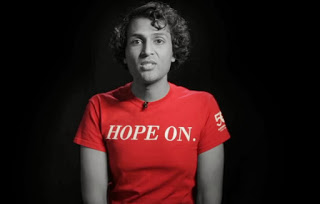
Just a quick post! A bunch of people from the Hope Network family and Huntington Bank got together to tell our story – the story of who we are, our patients, doctors, therapists, and allies side by side. Our behavior analyst, Elyse Bradford, and I, got to be in it (we’re always willing to ham it up for the cause)! Click the pic to see it over at Vimeo.

http://vimeo.com/81635427

Happy holidays, AutismFamily, and Hope On!

Inclusiveness in the AutismFamily

This is an historical post from an earlier blog, Adopted Son of the Autism Family, which I had before this current blog. It is re-posted without modification (other than this introductory sentence).

I am very sorry that my blog has been dead for months. There has been a ton going on for me, both professionally and personally. I have shared some of this with many of you on Twitter, and via other venues. Please rest assured that advocating alongside the AutismFamily remains incredibly important to me, and that I am nowhere near done fighting the fight with all my siblings in arms.

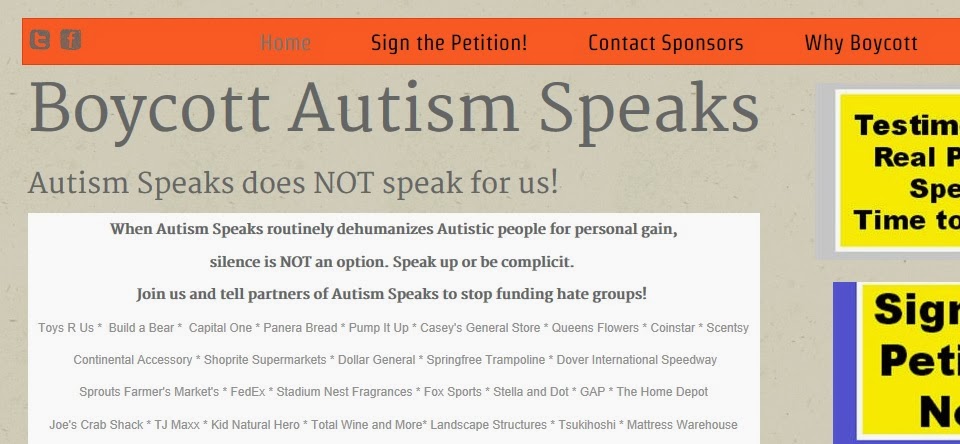
I do want to blog, at least very quickly, about the movement to boycott AutismSpeaks. In the spirit of fairness and openness, I have had a number of informal collaborations with them. They were important allies in the fight leading up to Michigan becoming the 32nd state to adopt an autism therapy benefit, and then subsequently adopt a Medicaid mandate for care as well. They continue to help work with families and their employers who have ERISA self-funded insurance, to encourage self-adoption of autism benefits, and together, we have had success with this here in West Michigan. Finally, earlier this year, I was delighted to be part of a local podcast with their presence here in Michigan, called Michigan is Listening, where I was interviewed by Anthony Ianni, a true Michigan Autism Hero.

If you follow me on Twitter, you absolutely know that I value and celebrate the broad range of opinions from the AutismFamily — from our autistic children and adults who self-advocate, to dedicate warrior parents and siblings, to the vast network of “adopted” kinfolk like me, who advocate alongside and for people with autism.

I hope that I do  have to apologize for any of this. I will not stop advocating alongside the AutismFamily. We cannot stop until we live in a world where all people with autism thrive. To do this, I believe strongly that we must be wary of exclusion from the movement to empower people with autism. So let me say what I believe simply. I believe that some people on the autism spectrum do very well with little or no “special” help in the form of therapies, educational programming, or community supports. This is not a problem. This is something to be celebrated, and I celebrate the accomplishments of each of them. They need acceptance and nurturing, and they need to be embraced by their communities and for their contributions to be valued, just like all of us.

I also believe that there are a number of people on the autism spectrum who can benefit substantially from skill building therapies, such as the Early Intensive Behavioral Intervention we provide in our clinic, and to this end, I remain firmly committed to building the network of diagnosticians, treatment providers, and support resources that these children (and adults) need.

That there are people on the autism spectrum who primarily need celebrating and acceptance, and others who need more or less intensive therapies and treatments does not place us at odds with each other. Every person on the autism spectrum is a valued and beloved member of our Family. That I love the two and three year olds in our clinic who are learning their first words does not take away from the love I have for the 20, 30, and 40-somethings I know, who are claiming their identity and place in the world, and themselves working to change the world.

In summary, I respect all the voices in the AutismFamily, including all of the voices that are currently angry. When they talk about empowerment, acceptance, and inclusion, when they lift up the challenges and needs as well as the accomplishments and gifts, of people with autism, I celebrate them. As in many other aspects of our political and social lives, I also reject voices that choose an agenda of exclusion of some people on the autism spectrum, or who value some of these lives but not others. I reject fear-mongering and hatred. I reject demonizing of people with autism no matter from whom it comes.

Thus, I am taking a firm side in this fight. I am on the side that we are Better Together. On the side that we are none of us safe until we are all of us safe. And I am on the side that all people with autism, all of their family members, and anyone who seeks to empower or help people with autism, should be embraced as part of the AutismFamily.

Sexuality and the AutismFamily

This is an historical post from an earlier blog, Adopted Son of the Autism Family, which I had before this current blog. It is re-posted without modification (other than this introductory sentence).
This is going to be a touchy one. Please consider this your trigger warning. But if you follow what I have to say below, I think you will understand why I’m not going to be quiet.
 
 
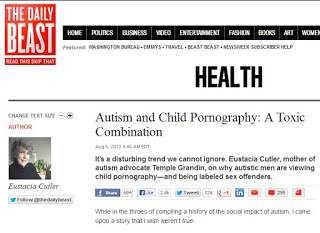
A couple of weeks ago, I saw an article in the Daily Beast with an extremely provocative title – suggesting there may be a hidden epidemic of young men with autism getting caught up in child pornography. I was taken aback by this. When I talk about criminality and people with autism, I often point out that there has historically been no real evidence supporting the idea that people with autism frequently engage in criminal or antisocial behaviors, and even a little evidence that they are less likely to do so than others. Thus, like most of the AutismFamily, when people blamed Adam Lanza’s behavior on ASD, I questioned this strongly (and still do). I was reading along in the article, and then I saw, “My daughter, Temple Grandin…” and I realized who the author of the article was! It’s one thing to ignore a post like this from some “ignorant” reporter who doesn’t know autism from asparagus. But Temple Grandin’s mom is kind of a different story, non?
I tweeted about it, but it was such a controversial topic that a dear friend and valued mentor suggested it was too inflammatory, and I deleted my tweet. Since then, Emily Willingham at Forbes responded strongly to Ms. Cutler’s views, and John Elder Robison had a more neutral appraisal. (As an aside, can we stop for a moment and note how impressive it is for Mr. Robison to model such a nuanced position on this topic, taking into account so many contravailing opinions and strong feelings on this topic… some argue Theory of Mind is a core deficit on the autism spectrum, but many of us NNNT’s could learn a thing or two from him!)
In the intervening weeks, I’ve been drawn in a lot of directions, but this topic has weighed heavily on my mind. I agree with Mr. Robison — problems that arise in the NT population often occur for radically different reasons in autism. For instance, I know an autistic adult who drank heavily for years without any real chemical dependency, and essentially went sober the day he was removed from the environment in which he did this to fit in, without looking back for a day since. Behaviorists (don’t get me started) actually have a technical terminology for this, and it’s a first fundamental principle of modern behaviorism. They say that behavior should be understood for its function (why it happens) and not its topography (what it looks like). If you want to know more about that, this GrandRounds, featuring a world expert, is a great introduction.
And the AutismFamily has been brutally honest with me about problems no one deals with. I’ve met families of toddlers who sleep less than two hours a night. I met a child who had somehow learned to poop only on windowsills. When I relate these stories to the AutismFamily, they’ve seen so many things that they don’t bat an eyelash.
And then…
And then, while this was stewing in my mind (and being astonished that Ms. Cutler’s post has not gone viral), in the last couple of weeks I heard multiple stories about sexuality and young adults in the AutismFamily, with our young people making bad decisions, with much more vulnerability to the consequences and difficulty navigating this environment than people without autism. The stories came on in a wave — I had hardly dealt with this issue at all, surprisingly, in the last two years, and not for want of asking about them, because I do. And, they forced me to radically reconsider my silence. These weren’t anecdotes. These were members of the AutismFamily who are brothers and sisters in arms — families I have been getting to know well and value dearly.
I don’t have answers. Sexuality is a tough one … we’ve all struggled, and most of us, if honest, have to admit we’ve made bad decisions at one point or another in our life. I’m hardly here to judge. It’s also deeply personal. As a clinician, I always feel like I’m prying when I ask about it, even though I try to do so in a respectful and minimally invasive way, and I ask questions only that are relevant to my ability to serve the person. When I taught undergraduates, and I asked them about clinical populations to which they are drawn and from which they recoil, they almost invariably say they’d never work with sex crimes (even though someone presenting to a medical or neurodevelopmental clinic and disclosing pedophilia, I can tell you, is really not a common occurrence).
However, I tend to agree with Mr. Robison. Although we need to hunt carefully for data and not create a witchhunt based on anecdotes, we need to understand the function of this behavior. What do we know? Following the Adam Lanza story, I think, even if there is not empirical rigor behind it, we have adequate data to know that the vast majority of individuals on the autism spectrum, outside of those with severe impairments, seek closeness, want intimacy and friendships, and as teens and adults, want romance and sexuality. Although there are a few people I’ve met whose set point, in the context of autism, is so against human interaction that they routinely recoil from it, this is not common. We also know that our sexual and relationship behaviors, of all the things we do, are among the most nuanced. Even when we are being crass (and we get crass!), navigating this space requires an immense amount of reading “between the lines” hidden cues and integrating verbal and non-verbal content with historical information and context to infer social intention. In other words, if there’s a place our teens and adults are going to struggle, we should expect this to be the place.
When we say basic functional and social communication are core issues in autism, we advocate for and provide early intensive behavioral interventions that develop these skills. When we say friendship development and community integration are crucial after that, we use tools like PEERS and CFT to empower the AutismFamily (and you know I believe that pays dividends!). And when we say that we are missing value as a society because we under-employ autistic adults, we talk about employment solutions. Isolating and silencing the sexuality of the AutismFamily makes no sense. There’s no reason to believe that approaching this topic with the exact opposite of the logic and approach that works in all other aspects of powering up the AutismFamily will somehow magically make these concerns go away.
So, in the words of Salt N’ Peppa (yes, I’m aging myself), Let’s Talk about Sex, Baby! Because, if we don’t, we’re going to regret it. 
That’s just what I’m going to do. I’m going to be brave and say, while I don’t have an answer, I won’t avoid the question. Next week, I’m bringing a pastor from Central Michigan who has been taking an honest look at talking about sexuality with special needs youth to our FamilyRounds (EDIT: this serious was discontinued some time after this post). I’m scared. Scared to talk about this, just like all of you are. But, I’m going to learn to be brave. Humbly. Alongside the AutismFamily. Because that’s what the Adopted Son does. And in learning, whether an epidemic or an isolated but serious problem, perhaps we can all build solutions for this important part of Autism Action.
P.S. A special request… to date, my blog doesn’t host a lot of comments, although I always welcome them. This post is no different. Please tell me what you think. But, particularly here, think carefully about what you disclose. My blog, like many other places online, is public, and the internet has a long lifespan. Please exercise caution in sharing personal details. If you’re a teen or young adult, and you want to get active in this conversation, perhaps work with a parent or other trusted adult mentor to make sure that you are telling your important story without placing yourself at risk. 

The Problem of Scale

This is an historical post from an earlier blog, Adopted Son of the Autism Family, which I had before this current blog. It is re-posted without modification (other than this introductory sentence).
The last several decades have seen several crucial components that make the dream of worldwide access to effective, standardized, outcomes driven evaluation and treatment for autism finally something that could come true. First, since Ivar Lovaas began to prove that early, intensive therapies could dramatically improve the ability of children with autism to learn and develop a broad range of skills, standardized protocols have emerged that allow for larger numbers of children to be more systematically treated and outcomes monitored (we use the VB-MAPP and the ABLLS-R). This is important, because it allows for a dream like being able to actually compare outcomes of your local autism provider to global averages and the historical data provided by large research studies. This is what happens if you are diagnosed with cancer, for instance — but look carefully at the autism industry. Ask how many autism providers can actually tell you the percentage of their children who obtain clinically significant gains in tested IQ, or how many achieve mainstream school placement. In spite of these being the main outcomes used to demonstrate the efficacy of ABA/EIBI therapy, they are not used by a surprisingly large number of practitioners in the field.
Second, since Dr. Lovaas, over decades, an entirely new field of providers (by training, most of the early behavior analysts were psychologists, and many senior leaders in the field are still products of psychology doctoral training) emerged. The streamlined process by which board certified behavior analysts enter the field at either the master’s or doctoral level, as well as the formal creation of junior level leaders such as board certified assistant behavior analysts (BCaBA’s — we actually just had our first ABA Tutor complete this credential), really help accelerate the broadbanding of intensive autism services. The standard for master’s behavior analysts — two years of schooling and 1500 hours of post-degree experience — for instance allows for much more rapid entry into the field, say, than the training in my specialty (4-5 years of graduate school, with 3-4 including intensive clinical work, one year of full-time clinical internship training, and two years of full-time clinical fellowship training). Within the scope of practice of ABA, these providers can still be highly effective, and this can help us address the need for thousands of behavior analysts.
Third, innovations including the Autism Diagnostic Observation Schedule (ADOS) allow for more systematic diagnosis, including pushing age of diagnosis back from the 4-5 years of age median at this point, and the 8 years of age peak, towards the 18 months of age mark, where some diagnoses can be valid, and perhaps even to 12 months when paired with electrodiagnostics. Thus, we now have the scientific basis for a technologist (like me) to take these three elements and scale them into a national and ultimately global treatment provider system. I’m not the only one — and others are far ahead of me (most particularly Dr. Granpeesheh and her team at CARD).
However, this raises a whole new problem. The transition from seeing children with autism throughout my clinical training to serving them full-time and managing a treatment team was a substantial one for me, and I had to re-write and improve almost everything about how I do what I do over the last two years. With my core clinical team, we can create a master process and a pipeline for ongoing improvement of that process (we have), and demonstrate that it produces outcomes in line with research literature (we are doing so). But unless I can infuse the DNA of that system into many clinicians on my team, I cannot be in many places at once. This is important to me — I want to create a revolution that can serve thousands and tens of thousands of children — not just the 200 I can see clinically in a year for evaluations or the 20-25 my lead behavior analyst can treat with her team. So, the biggest act of daring on my mind right now is learning to step back, and drive this process indirectly. To bring on board additional psychologists and other diagnostic practitioners, and trust them to extend the working diagnostic and treatment management system I created. To bring on more and more behavior analysts, and trust them to extend the process my lead behavior analyst and I have created. To build and continually use tools that allow me to trust that the infrastructure we create scales from 20 children to 2,000 without loss of quality. Quite the contrary, by the time we have 2,000 children in intensive services, I want our system to produce far better outcomes than we believe are possible today.
I recently tweeted one of my favorite lyrics, from Eminem’s Lose Yourself. “If you had one shot, or one opportunity, to seize everything you ever wanted – one moment – would you capture it, or just let it slip?” In order to build the thing I want, and the thing I believe the AutismFamily needs, the radical transformation in myself I made in the last two years is just the beginning. In the months to come, I will be faced with many more hard choices, and I will transform my professional skill set so radically as to be unrecognizable from today, let alone when I left my fellowship two years ago. And I will do it again, and again. Because I will not let it slip. Fifty years after Dr. Lovaas began delivering radical benefits to children with autism, only a tiny fraction of the world’s children who need EIBI get it. I have perhaps a little less than 30 years left in my career, depending on where the retirement age settles by the time I get there. I can tell you that, in 30 years, which will be almost 80 years after Lovaas began his work, I will not leave the world in the state that I found it, where lucky or wealthy children receive ABA while others get readied for a life of dependence. I will seize this like I have just one opportunity.