Live Together, Die Alone

This is an historical post from an earlier blog, Adopted Son of the Autism Family, which I had before this current blog. It is re-posted without modification (other than this introductory sentence).

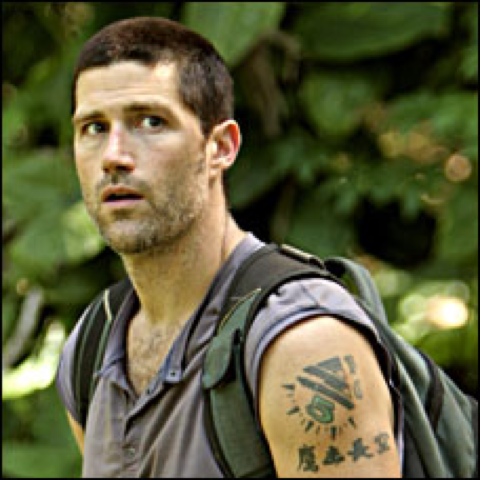
If you’re not a Lost fan, allow me to reference this excellent scene from early in the series, in which Jack implores the castaways against divisiveness. At the time, they face unknown but tangible threats – the smoke monster, the Others, and just trying to survive on a strange island away from stable food, clothing, shelter, or medical care.

I think this is also relevant to the autism family and autism advocacy. It’s a problem when we spend all our energy fighting therapies we don’t trust (or the vaccine hypothesis!) and don’t focus our energy on how most familes don’t even have a choice between established and controversial therapies, because they have insufficient access to care. It’s a problem clinically when people come to autism because they are “kid people” and don’t value the fact that those children long for growing up and living adult lives, or pediatrics people don’t prep and support their adult practitioner colleagues to serve adolescents and young adults. If we cannot love the adults our children will become, we should not serve them. It’s a problem when adults who didn’t need intensive therapies feel like they need to stand in opposition to children receiving life-changing therapies (it’s a blog for another time, and it’s not going to happen for WAAD 2013, but let me reiterate my standing invitation to Mr. Ne’emen and others to come to our clinic, and see what good EIBI is like for kids, and why we’re proud of what we do). It’s a problem when our autistic adult brothers and sisters who are deciding amongst graduate schools don’t want to stand up for their fellow people with autism who need help with sheltered employment or supported living, instead of working together to lift all autistic adults up, empower them, and celebrate their accomplishments.

All of these reasons are why it’s very important to me (even though my title is “Director of Children’s Services”) to create end-to-end solutions that serve people with autism and their families from birth well into adulthood. This is why I’ve always worked hard to make young and not-so-young autistic adults feel welcome in my clinic and strived to give them a service of which I can be proud. We can’t do it all, though, and that’s also why it’s important for me to recognize and celebrate everyone who’s in this to help people with autism, big and small, young and old, woman and man, to thrive, and everyone who sees the inclusion of people with autism and the rest of us as a good and natural evolution of who we are as a people.

Here among the autism family, our blood runs blue. 365 days a year, and 366 on leap years. It’s true for almost all of the people I know, who are associated with this community, by fate or choice. We don’t have anything to prove to each other, and we should not waste time fighting amongst the  family. Our enemies may be less tangible – systems that trap kids in a life of disability because they don’t have access to therapies, smart adults who cannot earn a living or flex their considerable talents in the workplace, moms and dads getting sneers or lectures at the grocery store, people bullied instead of cherished for who the are – but Jack’s point remains. We live together, or we die alone.

As for me, I love life. What about you? And if you love life empowering people with autism like I do, can you spend a few minutes this April finding out about how the brothers and sisters who thinks differently from you are empowering the community? Are there some at which you’d like me to take a closer look? Happy Autism Awareness Month!

Neuro-not-so-typical

This is an historical post from an earlier blog, Adopted Son of the Autism Family, which I had before this current blog. It is re-posted without modification (other than this introductory sentence).

I’m not sure who gets the original credit (please comment if you know — I linked one of the older references I found) for the running gag in the autistic adult community about the Neurotypical Syndrome. It does highlight the us v. them feeling that a diagnosis can create for autistic adults, and frequently, especially for those who struggle, but are living their lives, this dichotomy is really not what they need.

As a neuropsychologist and a director, I have many different job responsibilities. At the core of my profession, however, I’m a diagnostician. Thus, I believe strongly in the idea that diagnosing people is valuable, for the reason that I believe specific therapies or treatments (I hate the term “counseling,” but that’s another blog post!) fit specific diagnoses and the meshing of these two into a coherent treatment plan is crucial to really helping people thrive. Thus, I do think there is value in diagnosing autism, and if the signs and symptoms of autism are impairing (which is necessary for diagnosis), I think it’s reasonable to call that a disorder and to treat it.

I’m not about to depart from this belief system. I’ve seen what my team can do based on this approach and know how it changes lives.

But it’s also quite clear that someone can clearly have autism or be autistic and yet be doing just fine — in fact, although I would be happy to have a conversation about a “cure” for autism if and when this should prove feasible, I’m pretty happy helping people to “do just fine” and I am not at all sure that a “cure” would be a better choice than thriving with autism. As a referential point (I’m not autistic myself), I have Ménière’s disease, in a mild form, and after several evaluations (it took nearly five years of mentioning, but not really complaining about, the symptoms to my doctor before an ENT gave me the obvious diagnosis), it continues to be part of who I am and how I function, but I do just fine without any treatment. To me, I don’t view it as any less a disease or disorder because I don’t need it treated right now, but I would respect if someone said they didn’t see their being autistic as a disorder if they, like me with my ear problem, were doing just fine. Of course, Meniere’s disease is not autism in many senses — it’s harder for me to say that I thrive because of it, and if I were offered a cure, I would probably seriously consider it.

In addition to this, a great comment to a prior post does bring up the excellent point that neurotypicality itself is more of an abstraction than a well-defined group of people. There is so much diversity in cognitive / emotional skill-sets, from one person to the next. By comparing the group of people with autism to this abstraction, do we just serve to magnify many differences that are really not all that remarkable, particularly in those “doing just fine?” Is this as absurd as calling everyone who is not Jewish a “gentile” and assuming that we can be treated as a homogenous group purely by virtue of our non-Jewishness? These kind of out-group designations serve a valid role, and there’s a reason why there are so many examples of them (most far less palatable to discuss than the concept of being a “gentile”). The positive reasons mostly have to do with establishing the in-group identity. So, the concept of neurotypicality is really mostly of interest to autistic people and the clinicians, researchers, educators, and others who serve them. But it also has its limitations, particularly for high functioning people, because being part of a minority is already isolating in itself, and the social challenges people with autism face are isolating, do we really need to do more to create a system of isolation?

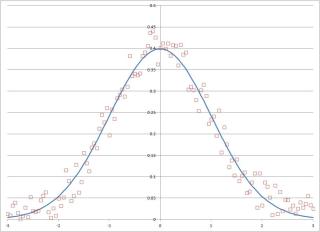
And then, there is really no “bright line” separating autism from neurotypicality, and in particular, the idea of a neurotypical itself is a problematic one. Who is actually neurotypical? Am I, trained at the graduate level in both engineering and psychology, who learned to program computers in first grade, neurotypical? We know, in neuropsychology, for instance, that many people have cognitive skills in some area or another that are significantly stronger or weaker than average, without this necessarily representing a disorder or a deviation from typicality. We talk all the time about autism occurring on a spectrum, but it is important to realize that many (but not all) human characteristics widely vary from person to person, frequently with something that approximates the normal, or Gaussian distribution, like in this picture (this could be height, weight, IQ, or a whole host of other things).
We have a mechanism, diagnostically, to separate people with autism from people with other diagnoses (or no diagnosis), but where are the lines, for those of us who are high functioning with or without autism, when it comes to specific ostensible “symptoms.” Where is the line between having a sensory abnormality and just a preference? I don’t like it when clothes are constrictive around my wrists. Lots of kids don’t like tags on clothes, tight pants (and some people who like tight pants, I think we all agree, would do better to not like them so much!), and so on. “Normal” people have aversions to food textures all the time — I couldn’t tolerate either gravy or whipped cream coming anywhere near my food until I was in my late thirties! An example I give parents and high functioning autistic people, quite frequently, when talking about transitioning sensory issues from dealbreakers to manageable issues, is thinking about minor back strain. I could come up with a fancy term for why my back hurts when I sit at my desk too long. I could probably even call it a sensory integration issue. But, if getting up periodically and talking a stretch solves the problem, wouldn’t it be easier to just do that? Since an autistic person doesn’t know, innately, what being “neurotypical” is any more than a person without autism knows what being autistic is, how do we know for sure when each molecular issue should be considered in the context of autism? Many of these molecular issues may conceptually tie to autism, but that may not mean they have a unique course of treatment — for instance, cognitive behavioral therapy seems to treat anxiety in people with high-functioning autism just like it would in people who do not have autism).

So, taking all this into consideration… I continue to believe diagnosis and treatment of autism is helpful, and I think both can be done in a valid and reliable way. But, I am cautious about treatment having the unintended consequence of preventing people from thriving rather than enabling it. I am also sensitive to creating boundaries or barriers between NT & ASD, since I see us much better working hand-in-hand. And, I am sensitive to the fact that it is not always either necessary or beneficial to understand or pathologize a symptom in the context of autism, when often simple solutions can help manage it just fine. Nonetheless, I think there is some value in the concept of the neurotypical. Mostly this has to do with helping people with autism understand what functions, in essence, as a dominant cultural structure, even if the term belies the actual heterogeneity of people who do not have autism.

With this being said, let us always remember that typical is an abstraction. We can all celebrate our deviations from typicality, because they make us unique and they contribute to the ways in which each of us uniquely make a difference in the world. When we are understanding and embracing of our differences, supporting where needed and celebrating where warranted, we will all thrive together. Where do you see it as being beneficial to make oneself aware of the differences between yourself as an autistic person and the so-called NTs? Is there a place where it’s been a hindrance to you? Or, if you’re a person without autism, what do you think of the idea that your brain is “typical?”

As for me, I declare myself neuro-not-so-typical. Welcome to the revolution.
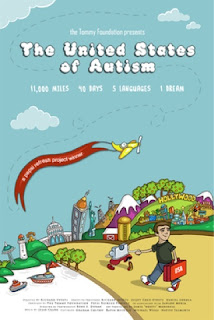
United States of Autism Coming to Grand Rapids, MI!

This is an historical post from an earlier blog, Adopted Son of the Autism Family, which I had before this current blog. It is re-posted without modification (other than this introductory sentence).

Note: See updates below – we got a bigger screen room!

It’s finally here! We’ve been talking on Twitter for weeks and weeks about the exciting United States of Autism movie. My Center is bringing it to Grand Rapids, less than a month after its world premier in New York City, on 04/30/2013. It’ll play at 6pm at Celebration Cinema North.

United States of Autism follows an autism dad trekking across America to record the stories, the joys and struggles, of autism families. The journey lasted forty days, connecting twenty families across geographical and language barriers. I first heard about this movie from a friend and ally, Tim Welsh, an autism father and prolific blogger and activist for the cause, who is featured alongside his son in the movie (many people know Tim simply as Tanner’s Dad!). Click the poster below for the trailer, and I think you’ll see why I’m excited.

One of the things I am trying to do here in Grand Rapids is to grow a stronger sense of autism community. Many of the families we serve feel like they’re going it alone, without resources or support or allies. Many don’t have connections to families with older children or young adults who’ve gone through what they are going through, nor are they connected with parents of even younger children who are trying to surmount the challenges they have already faced. Our PuzzlePartners and FamilyRounds programs, although aimed currently at the families of older teens and young adults with autism, are part of our effort to build this community.

Bringing this movie here is an important part of that effort, too. The 30th caps off Autism Awareness Month (and it happens to be my birthday!), and this is about not just being aware of autism, but using that awareness to drive action and empowerment. Last April, MI signed its autism therapy legislation into law. It went into effect in October, and this April, it is joined by the state plan and also the rollout of Medicaid autism services (in which we will be participating as a provider).

The best news in Michigan is that this April, it doesn’t just stop at autism awareness. For the first time, even if they are not super wealthy or lucky enough to access scarce scholarship resources, we can tell most families that we not only can have a plan for serving their child with autism, but now we can execute that plan.

So this one’s for all the kids beginning to thrive through our clinical therapies. It’s for the kids who upgraded to mainstream kindergarten or preschool from developmental delay or ASD classrooms. It’s for the kids who told their first jokes as a result of ABA. Is for the kids who read bedtime stories to their sisters. And most of all, it’s for all the kids in Michigan who will join their ranks in the year to come.

I hope you can come out and celebrate with me! Let’s make the United States of America the United States of Awesome!

P.S. if you’re not here in West Michigan, bring United States of Autism to your community. Tugg is great, and they’ll help you make it happen. If you need promoting help, I’m happy to tweet and retweet you, too!

UPDATES:
04/04/2013 – We are CONFIRMED! Yes! One week on sale and we have, at the moment, just 14 tickets left. Buy your tickets now! If it sells out, we’re going to try and get an even bigger space at the theater and open up more tickets. It’s time for the Autism Family to make a show of force. Make it clear that Grand Rapids will be ground zero of the Autism Revolution.

04/05/2013 – Only 10 tickets left as of this morning! Wow! Fear not, we are already in the process of asking for a switch to a bigger room to open up more seats for you. We love you, Autism Family!

04/08/2013 – We are now sold out!!! Please stay tuned for news on if we can get a larger room and open up more tickets.

04/10/2013 – We got a bigger room! Tickets are back on sale!

NT & ASD, hand in hand

This is an historical post from an earlier blog, Adopted Son of the Autism Family, which I had before this current blog. It is re-posted without modification (other than this introductory sentence).

Whenever I think about vocational resources, I think that, while there is great work being done, there are crucial pieces missing, and it does not address the tremendous range of challenges in making sure that people with autism thrive in careers. At the severe end, we have to face that there are people who may not be able to work at all, or will struggle in sheltered vocation. We need to do more about the fact that people with autism are less likely to work than people with many other disabilities (although it should be remembered many people with autism also have another potentially disabling condition). We have a pretty solid infrastructure, at least here in Michigan, for them. We have some services, too, for people who can graduate high school or get basic vocational training for entry level jobs.

We dedicated our first FamilyRounds to this topic, and we had great lectures from people in different parts of Hope Network talk solutions for sheltered to entry-level competitive employment. You can watch that here:

These programs, along with others, are making a difference for part of the Spectrum. On a smaller scale, we’ve been reading about some cool ideas, like this idea to use auditory prompting to help people with autism stay on-task at work and the great work from Dr. Tony Gentry’s lab at Virginia Commonwealth.

But autism is well known for its Temple Grandins, and there are others who do very well with autism. Unfortunately, however, even among the tremendously bright and talented people with autism, we do not systematically create an environment where they can leverage their talents or get the opportunities they deserve (and contribute to society at the level of their talents – see the struggles of this young man… his SAT scores and mine were not so far apart!). A vocational strategy for autism doesn’t work if it’s group home to high school graduate. It has to extend all the way to our people with graduate educations and high-level skills. There need to be more projects like Chicagoland’s Aspiritech.

If you ask me, when we get what we want, we won’t just talk about begging or cajoling neurotypicals to hire people with autism. They’ll do it because they’re worth the investment. And we won’t just talk about neurotypicals hiring. Alone or in partnership with NTs who get them, we’ll talk about high functioning people with autism being the engines of economic growth. Their ideas will provide jobs for the NTs, not just the other way around.

And then, if I get really crazy, my dream is to be able to set up angel capital and a mechanism to deliver it to these people, NT and ASD alike, who would work together to generate these next generation, inclusive businesses, which thrive not in spite of the fact that they hire autistic people, but because of that very fact. Is that crazy? Some people claim it’s already happening. I don’t know that I believe that all or most of the superstar entrepreneurs in Silicon Valley really have autism (as Temple Grandin perhaps semi-facetiously claims). I do know, that in much of the rest of the country and the world, this does not happen yet, and I dream of changing that someday.

What are your ideas for creating a world where society can leverage the talents of people with autism and provide them a chance to shine and be celebrated for their work contributions?

In case of a sudden loss of cabin pressure…

This is an historical post from an earlier blog, Adopted Son of the Autism Family, which I had before this current blog. It is re-posted without modification (other than this introductory sentence).

One of the best analogies I learned in my clinical training had to do with the need for parents to take care of themselves. You’ve all heard this one, boarding a plane: “In case of a sudden loss of cabin pressure, inflatable air masks will drop …” They tell you, if you are traveling with a child, secure your own mask before you help your child get their mask on. It counters every impulse most parents have. Autism parents, especially, drive, fly, run, leap, fight for their children. Every day. How could you even think about taking care of yourself before your child? But think about it: in that situation, if you try to put your child’s mask on first, you may pass out in the process due to lack of breathable air. What good would you be, to your child, in an unstable plane at 30,000 feet, unconscious? You would be no good to your child at all. The moral of the story is that, even if you don’t believe maintaining your own strength is important for you, it’s important for your son. It’s important for your daughter.

And with autism, as you all know, this is a cross-continental flight, not a puddle jump. We’re in it for the long haul.

At Camp Boggy Creek, I’ve often facilitated parent groups for parents of kids with various serious illnesses. I usually start my parent groups with an exercise where I have the parents break up in twos and find out three things about the person next to them: where they’re from, who’s in their family, and what they do for fun or to relax. A lot of our parents are resistant to the idea that they even can relax. But the amazing thing I’ve found is, once someone says, “Well, I love cruisers” or “I lift weights,” two or three other dads will chime in. Once I had two dads sitting next to each other, who’d never met before, and it turned out they were both restoring a classic muscle car. This builds community, and community provides some accountability for us all to encourage each other to take care of ourselves.

The Spartan Stores YMCA recently was generous enough to host a free night for our Teens and Young Adults in Puzzle Partners, our informal social supports program for high functioning people with autism. Although a mishap prevented the pool from being available, we got the run of the rest of the place. I got to play a dancing and zumba game on XBox 360 with Kinect, with three of our guys (and found out they can all dance better than I can!). I went for a run and got to know two young adults whose families have been friends forever. I got to play a bunch of other games. As I always try to, every time I tried to coax one more of our teens or young adults to play, but I also tried to drag parents in. And it was awesome when a parent wanted to go for a run, or another parent wanted to come downstairs and learn a light-board video game with us. Parents have to play, too.

What do you do to take care of yourselves? How do you make time for it? If you are married or have a partner, do you have a system to hold each other accountable and make time for each other, so you both keep your energy up?

Update: I got some great comments on Twitter. More than a few of you said you really don’t feel you have options to take care of yourselves. A lucky few live near extended family whom they trust with their child, and one is moving so she can rely more on relatives! (We have families of professionals interviewing in town come to our clinic so they can base their move decision based on quality of autism care. Our parents will drive, fly, walk barefoot if they have to!) Some noted friends help, but some noted they don’t feel safe yet that their friends or relatives can “handle” their kids. Where people do have support, a few manage a date night, but many wait for the kids to fall asleep to snag some couple time or even just a hot shower. Hopefully the melatonin’s working for those kids!

Welcome!

This is an historical post from an earlier blog, Adopted Son of the Autism Family, which I had before this current blog. It is re-posted without modification (other than this introductory sentence).

I have really been enjoying interacting with the autism family via Twitter, where I can be found @soulmirror. I have learned so much from other advocates, and I love sharing stories from our clinic and also connecting people with autism with each other, and with resources.

With this blog, I would like to start engaging the community in more detailed discussion on autism-related topics, and I hope to provide a space to provoke thought, build community, and work together towards our common goal of communities where people with autism and us “neurotypicals” thrive together.

By way of background, I was the child who was always building with Legos, and for most of my life, my career aspiration was to build spaceships someday. As I went through engineering college at the University of Michigan, though, I became less sure of this goal. I had been exposed to an interesting concept in high school debate, the question of how society would change if we engaged in a paradigm shift away from exploring outer space and towards exploring inner space — understanding ourselves and each other. I ultimately did get a bachelor’s and master’s in engineering, and I worked for a number of years, at the Big Three, in consulting, and at an automotive supplier. Truth be told, I was a great engineer. But, I knew it wasn’t for me.

Around that time, I took some classes in psychology on a lark, just to stay sharp mentally while I prepared for a career switch. I got accepted to a prestigious business school, but I couldn’t sign on the dotted line, because I wasn’t sure I would be any happier. I loved those psychology classes, though, and I began reading voraciously. One thing lead to another, and I wound up at the University of Florida to study clinical neuropsychology, a clinical science that uses cognitive testing to understand brain development and functioning, and to help with diagnosis and treatment planning.

At that time, I hated kids. I didn’t want to be around them, I didn’t want them as patients. I was afraid of them. I knew I would have to work with kids, however, and so I decided to volunteer at one of Paul Newman’s Hole in the Wall Camps, Camp Boggy Creek. This changed things for me. When I learned specific skills and tools, I found that I loved kids. And more importantly, they loved me. In a few short months, people from my program who passed me in the hall thought I was a “kid person,” and they were surprised when I told them I wasn’t. However, I made it through my first child clinic (a big part of which involved assessing for autism), and I actually found them remarkably rewarding, both for working with the children and for their families. From there on, I made it a point to continue working both with children and adults. It makes sense. All adults were children once, and doesn’t every child dream of who they will be when they grow up? So, I continued my training in a lifespan perspective, not only there, but also at the University of Chicago, where I interned. My fellowship, at Mary Free Bed Rehabilitation Hospital, was not lifespan, although I was glad to informally collaborate with the pediatrics team there.

That brings us to my current position. When I left Mary Free Bed, I joined Hope Network, to lead the clinical team in their fledgling autism program. In the beginning, this was a challenging job — a clinic without children to be seen and no funding to treat them sounded terrible. However, I was fortunate to be a part of the effort to pass our state’s autism therapy law (some of my press appearances are available on my work bio page), which was signed in April 2012 and went into effect that October. In the meantime, I became Director of Children’s Services, and that gave me the exciting opportunity to design and grow our whole autism program.

Today, I have a job I love like no other. The autism family has been remarkably accepting of me, and I love laughing and playing with people with autism and their families just as much as I love leading our clinical program, our informal social supports, and all the things we do professionally.

I hope you come back and get to know me more. I’ll leave you with one more glimpse into who this adopted son is, however. Early after coming on board here at Hope., I launched a professional education program, GrandRounds, and I gave the inaugural speech. That series is about to begin its second year, with lots of exciting stuff coming. Here I am, talking more recently at the Kent Regional 4C conference about screening for autism in early childhood services.

What a great year. How much has happened since then! Enjoy!